Japan Corporate History & Strategy

A database of corporate histories and key management decisions for approximately 94 Japanese listed companies.

  • Nippon PaintFounded in 1881. Established as Japan's first paint manufacturer, the company grew through automotive coatings and Asian expansion via the NIPSEA Group. Accelerating global M&A centered on its capital alliance with Wuthelam, Nippon Paint transformed into one of the world's leading comprehensive coatings manufacturers.
  • NGK Spark Plug (Niterra)Founded in 1936. Building on insulator technology, the company established the leading domestic market share in spark plugs and expanded into semiconductor package substrates. As a global manufacturer of automotive spark plugs, it has continued to grow alongside advances in engine technology.
  • Nippon SteelEstablished in 1970. Born from the merger of Yawata Steel and Fuji Steel as one of the world's largest steelmakers. Through repeated rationalization programs, the company reorganized its domestic production system, and has led global steel industry consolidation through the integration with Sumitomo Metals and the planned acquisition of U.S. Steel.
  • Mitsui Mining & SmeltingEstablished in 1892. Originating from the smelting division of Mitsui Mining, the company grew on zinc and lead from the Kamioka Mine. After itai-itai disease compensation, it shifted to electronic materials and copper foil, and expanded into automotive parts. It has transformed from a resource company into an advanced materials manufacturer.
  • Mitsubishi MaterialsEstablished in 1918. Starting as Mitsubishi Mining, the company diversified into non-ferrous metals, cement, and cemented carbide tools. The merger with Mitsubishi Mining & Cement created a comprehensive materials manufacturer. Having given birth to SUMCO (silicon wafers), the company continues to reshape its business portfolio.
  • Sumitomo Metal MiningEstablished in 1927. Originating from the Sumitomo Besshi Mine, the company expanded from the Besshi Copper Mine into domestic and overseas mine development and smelting. Securing resources through the Hishikari Gold Mine and the Morenci Copper Mine, it also entered electronic metals and functional materials as a comprehensive non-ferrous metals manufacturer.
  • DOWA HoldingsFounded in 1884. Fujita-gumi acquired the Kosaka Mine and entered the smelting business. Postwar, the company shifted to electronic materials and environmental recycling. Under President Yoshikawa's leadership, concentrated investment was directed toward the recycling business, transforming the company from a mining company into an environmental and recycling enterprise.
  • Recruit HoldingsFounded in 1960. Starting as a university newspaper advertising agency, the company successively launched information media across lifestyle domains including employment, housing, and travel. Through the acquisition of Indeed, it transformed into an HR technology company, now leading the global talent matching market.
  • Hitachi Construction MachineryEstablished in 1970. Built on Hitachi, Ltd.'s construction machinery division, the company grew with hydraulic excavators as its mainstay product. It developed the North American market through an OEM relationship with John Deere, and expanded its overseas ratio through manufacturing investments in Canada and China. A comprehensive construction equipment manufacturer.
  • KubotaFounded in 1890. Starting from cast iron pipe manufacturing, the company transformed into an agricultural machinery maker through cultivators and tractors. It grew into a global agricultural machinery major through mass export to Europe and the Americas and acquisitions of Kverneland and Escorts, while also pursuing worldwide expansion in its water and environmental infrastructure business.
  • DaikinEstablished in 1924. After successfully developing fluorocarbon refrigerants, the company grew through its air conditioning business in the postwar era. Acquisitions of OYL and Goodman established its position as a global HVAC manufacturer, and by leading adoption of the new R32 refrigerant, it has driven environmental initiatives. Daikin has grown into one of the world's largest dedicated HVAC manufacturers.
  • SharpFounded in 1912. Personally founded by Tokuji Hayakawa, the company led technological innovation in calculators and LCD displays. Its LCD panels from the Kameyama Plant took the market by storm, but large-scale investment failures plunged it into a management crisis, leading to a recapitalization by Hon Hai Precision to pursue restructuring.
  • Sanyo ElectricFounded in 1947. Toshio Iue left Matsushita Electric to establish the company, which grew through radios and washing machines. While the company accumulated technical expertise through concentrated investment in rechargeable batteries, the drawbacks of family management combined with financial deterioration, and in 2011 Sanyo became a wholly owned subsidiary of Panasonic.
  • ToyoboFounded in 1882. Established as Japan's first private spinning company, it transitioned to synthetic fibers including rayon, acrylic, and polyester. Expanding into non-textile fields such as films, biotechnology, and medical products, it transformed into a functional materials manufacturer through repeated plant closures and business restructuring.
  • KaneboFounded in 1887. Grew into Japan's largest spinning company by leading a grand consolidation of spinning firms in the Meiji era, and diversified into cosmetics. However, the failure of its diversification strategy and textile industry downturn led to insolvency, culminating in the tragic dissolution of the company in 2007.
  • Kirin HoldingsEstablished in 1907. Achieved over 60% domestic beer market share in the postwar era, maintaining the top position for an extended period. Strengthened its pharmaceutical business through the acquisition of Kyowa Hakko, and after transitioning to a holding company structure, operates on three pillars of beer, beverages, and pharmaceuticals. The company promotes overseas M&A and business portfolio transformation.
  • ABC-MARTEstablished in 1985. Achieved rapid growth with an SPA model combining shoe production in South Korea with domestic retail. Expanded nationally through aggressive store openings centered on shopping centers under the ABC-MART brand, while also advancing into Asia. The largest specialty shoe chain to surpass 1,000 domestic stores.
  • McDonald's JapanEstablished in 1971. Den Fujita opened the first store in Ginza Mitsukoshi, transforming Japan's food service industry. The company grew into one of the largest domestic food chains through repeated cycles of low-price strategies and store operations reforms.
  • SeriaFounded in 1985. Starting from mobile vending, the company expanded into permanent 100-yen shops nationwide. Leveraging a proprietary POS system and order support tools to achieve high profitability, Seria grew into a leading 100-yen shop chain through expansion into the Tokyo metropolitan area and brand renewal.
  • KikkomanFounded in 1917. Eight soy sauce brewing families in Noda merged to establish domestic market leadership in soy sauce. In 1972, the company began local production in North America, successfully building soy sauce into an international brand. While diversifying into food and beverages, the company continues to grow as a global seasoning manufacturer.
  • ZOZOFounded in 1998. Operates the e-commerce site ZOZOTOWN, which grew into one of Japan's largest fashion e-commerce platforms. In 2019, it came under the umbrella of Z Holdings, strengthening its EC infrastructure through logistics investment and expansion of store listings.
  • AdvantestFounded in 1954. Established as Takeda Riken Kogyo and pivoted from measurement instruments to IC testers. Rebuilt with Fujitsu's support, the company secured approximately 40% global market share in semiconductor test equipment, overcoming semiconductor market cycles to become a world leader in test systems.
  • KEYENCEFounded in 1972. Takemitsu Takizaki established the company as Lead Electric and concentrated investment in sensors. Achieving over 50% operating profit margin through direct sales and high-value-added strategy, the company grew into one of Japan's most profitable enterprises with a unique management approach that distributes operating profits as employee bonuses.
  • Yahoo JapanFounded in 1996. Operated Japan's largest portal site as Yahoo! JAPAN, diversifying into EC, payments, and media. After renaming to Z Holdings, expanded its platform economy through LINE integration and PayPay rollout.
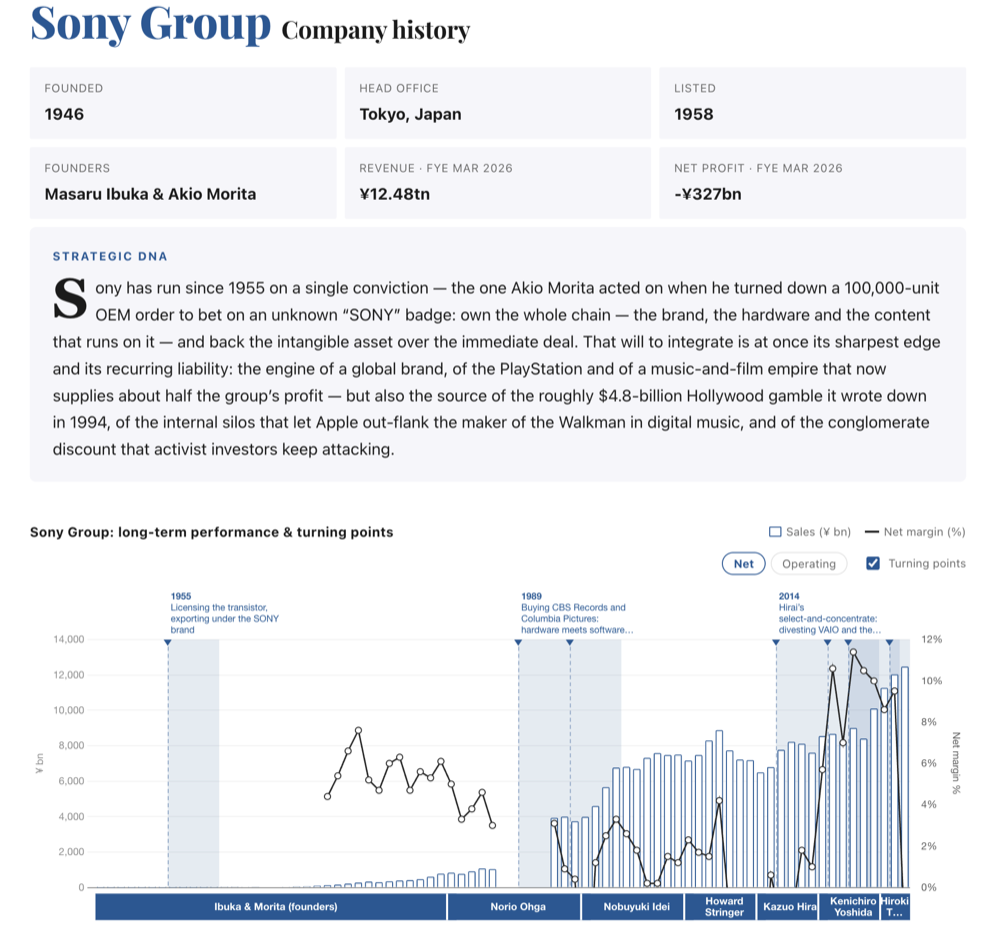
  • SonyFounded in 1946. Ibuka Masaru and Morita Akio challenged the world with transistor radios, then created culture with the Walkman and PlayStation. Through acquisitions of CBS and Columbia, the company transformed into an entertainment enterprise and continues to grow through diversified management spanning image sensors and financial services.
  • SUBARU Corporation (SUBARU)Established in 1953. Originating from Nakajima Aircraft, Fuji Heavy Industries applied aerospace engineering to automobiles and entered the mass-market with the 'Subaru 360.' The company established a distinctive driving performance identity through its boxer engine and AWD system, and after achieving success in the North American market, renamed itself SUBARU Corporation in 2017.
  • Mitsubishi Heavy Industries (MHI)Established in 1917. Originating from the Nagasaki Shipyard acquired by the Mitsubishi zaibatsu, MHI grew into one of Japan's largest heavy industry conglomerates spanning shipbuilding, power systems, aerospace, and defense. After postwar dissolution into three companies and reunification in 1964, it expanded into nuclear power, gas turbines, and fighter aircraft. Despite setbacks including the SpaceJet project cancellation and cruise ship losses, MHI achieved record profits in 2024 driven by GTCC, nuclear, and defense orders.
  • IHI Corporation (IHI)Established in 1889. Starting as the Ishikawajima Shipyard, IHI diversified into aero engines, turbochargers, and plant engineering. After withdrawing from shipbuilding and concentrating resources on aerospace, defense, and social infrastructure, the company renamed itself IHI and evolved into a comprehensive heavy industry manufacturer.
  • NissuiFounded in 1911. Entered deep-sea fishing as the Tamura Steamship Fishing Division, and grew through Antarctic whaling and North Pacific fisheries in the postwar era. Withdrew from deep-sea fishing in the 1970s and shifted to seafood processing and frozen foods, also diversifying into pharmaceuticals. Transformed into a comprehensive food company through global expansion and concentrated investment in food processing.
  • Sapporo BreweriesFounded in 1906. Born from the breakup of Dai Nippon Breweries, the company focused on reviving the Yebisu Beer brand and restoring the Sapporo brand. Entered the real estate business with the opening of Yebisu Garden Place, and pursued transformation into a global brewer through overseas acquisitions.
  • Asahi Group HoldingsEstablished in 1949. With support from Sumitomo Bank, the company undertook management restructuring and dominated the domestic beer market with the launch of 'Super Dry' in 1987. Through major M&A deals including the acquisition of Calpis and SABMiller's European operations, it transformed into a global beverage maker.
  • AjinomotoFounded in 1909. Starting from the invention of the umami seasoning 'AJI-NO-MOTO,' the company diversified into food, fine chemicals, and pharmaceuticals based on amino acid technology. Launching full-scale overseas operations early in the postwar period, the company also expanded into frozen foods and healthcare, developing into one of the world's leading amino acid companies.
  • NichireiEstablished in 1942. Founded as a wartime state-controlled company, the company transformed its business in the postwar era from cold storage and seafood processing to frozen foods. Creating household frozen food hits such as 'Honkaku Itame Chahan' and 'Toku Kara,' the company grew into a comprehensive cold chain enterprise powered by both its food and logistics businesses.
  • JTFounded in 1985. Launched through the privatization of the Japan Tobacco and Salt Public Corporation, JT accelerated global expansion through the acquisition of RJR Nabisco's international tobacco business and Gallaher in response to the shrinking domestic tobacco market. Diversifying into food and pharmaceuticals, it grew into one of the world's leading tobacco manufacturers.
  • TorayFounded in 1926. Starting as a rayon manufacturer, the company grew into a major synthetic fiber producer through technology licensing of nylon and polyester. It became the first in the world to successfully mass-produce carbon fiber, securing an overwhelming share in aircraft materials. It evolved into an advanced materials manufacturer.
  • Nissan ChemicalFounded in 1887. Starting as Japan's first chemical fertilizer manufacturer, the company passed through the Nissan zaibatsu before becoming independent. It successfully transformed its business through withdrawal from petrochemicals and concentrated investment in high-performance materials, establishing a high-profitability structure in agrochemicals, functional materials, and semiconductor materials.
  • Kyowa KirinFounded in 1936. Diversified into amino acids, pharmaceuticals, and alcoholic beverages based on fermentation technology. Became a subsidiary of Kirin HD and divested alcohol and chemical businesses to concentrate on pharmaceuticals. Pursuing transformation into a Global Specialty Pharma centered on antibody drugs.
  • Kao Corporation (Kao)Founded in 1887. Starting as a soap retailer, Kao expanded into synthetic detergents, disposable diapers, and cosmetics. The acquisition of Kanebo Cosmetics made it a major cosmetics player. Through distinctive management approaches including EVA-based management and sales company reform, Kao has maintained a high-profitability structure as a consumer goods and chemical manufacturer.
  • Chugai PharmaceuticalFounded in 1925. Grew through the detoxifying agent 'Guronsan,' then entered biopharmaceuticals in earnest by acquiring EPO manufacturing and sales rights. Strengthened R&D capabilities through a strategic alliance with Roche, and produced Japan's first domestically developed antibody drug 'Actemra.' A leading Japanese biopharmaceutical company.
  • FUJIFILMFounded in 1934. Once commanding a 70% domestic share in photographic film, the company faced market extinction due to digitalization. It executed a bold business transformation into pharmaceuticals, cosmetics, and advanced materials, evolving into a diversified conglomerate through the full acquisition of Fuji Xerox and entry into biopharmaceuticals.
  • SMCEstablished in 1959. Founded as Sintered Metal Industries, the company established a world-leading market share in pneumatic equipment. By building an immediate delivery system and a nationwide sales network, it locked in customers and expanded overseas local production. A global leader in pneumatic equipment boasting an overwhelming profit margin.
  • Hitachi, Ltd.Founded in 1910. Starting from a repair workshop at Hitachi Mine, the company grew into a comprehensive electrical manufacturer. After struggling with unprofitable semiconductor and consumer electronics businesses, Hitachi executed structural reforms to concentrate management resources on social infrastructure and IT, and transformed into a digital enterprise through the acquisitions of GlobalLogic and ABB's power grid business.
  • Kawasaki Heavy IndustriesFounded in 1878. Starting as the Kawasaki Tsukiji Shipyard, the company diversified into naval vessels, aircraft, and railway rolling stock. Split into three companies during postwar zaibatsu dissolution, the firms re-merged in 1969. Expanding the Kawasaki motorcycle brand globally, the company has developed into a comprehensive heavy industry manufacturer with pillars in defense, aircraft components, railway rolling stock, and industrial robots.
  • Nissan Motor (Nissan)Established in 1933. Starting as Automobile Manufacturing Co., Ltd., Nissan mass-produced the 'Datsun' through postwar technology licensing. After rapid growth in the North American market, the company underwent the Ghosn-led restructuring and continues to seek management rebuilding through alliance strategies as one of Japan's leading automakers.
  • Isuzu MotorsFounded in 1937. Originating from the automotive division of Ishikawajima Shipyard, the company grew through diesel trucks. Specializing in commercial vehicles, Isuzu has expanded globally with a focus on Southeast Asia, pioneering emerging markets with pickup trucks and buses as a commercial vehicle specialist.
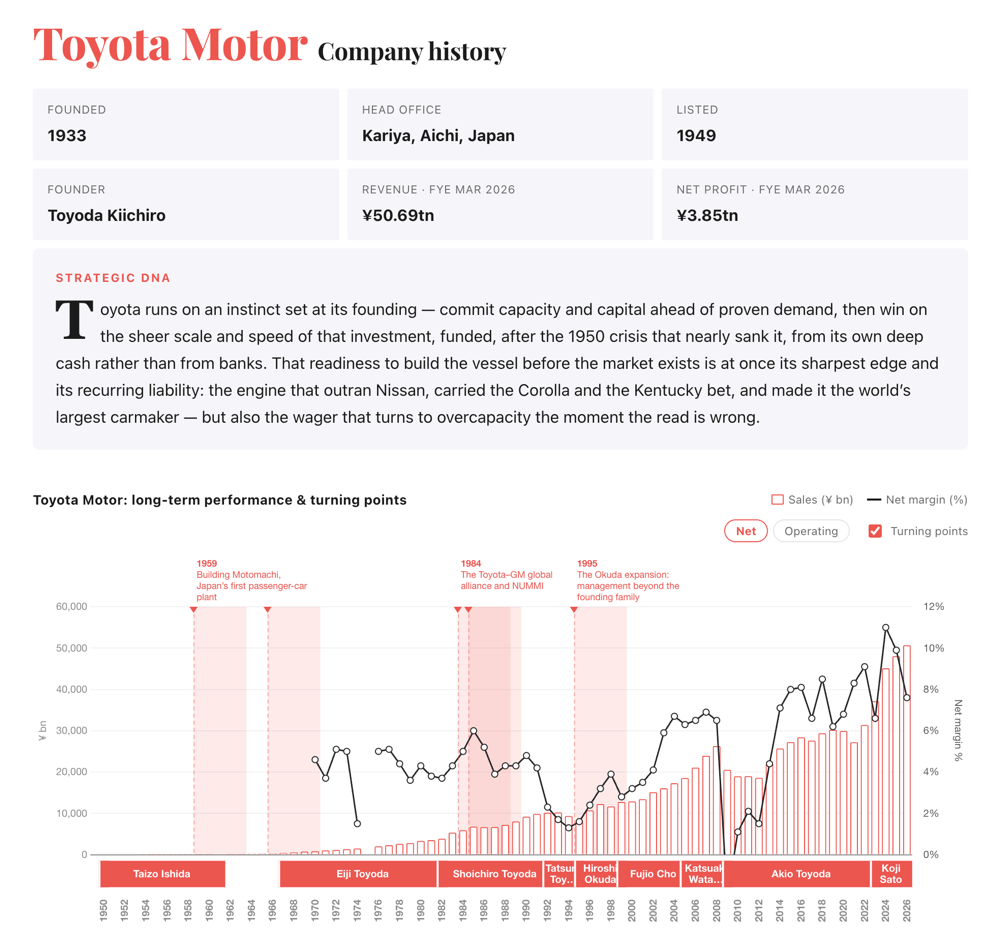
  • Toyota Motor (Toyota)Founded in 1937. Originating from the automobile division of Toyoda Automatic Loom Works, Toyota overcame a postwar financial crisis to establish the kanban system. It dominated the mass-market with the Corolla, accelerated global expansion through North American local production and the Lexus brand, and pioneered environmental technology with the Prius hybrid, growing into one of the world's largest automakers.
  • Hino MotorsFounded in 1942. Starting as Hino Heavy Industries, the company began with diesel engine and truck manufacturing and formed a capital alliance with Toyota Motor. Specializing in heavy-duty trucks and buses, Hino is a commercial vehicle manufacturer expanding local production in Southeast Asia.
  • Mitsubishi MotorsFounded in 1970. Established by spinning off the automotive division of Mitsubishi Heavy Industries, the company developed overseas markets with the Pajero and Lancer. After falling into a management crisis following a recall cover-up scandal, the company joined the Nissan-Renault Alliance to pursue reconstruction.
  • MazdaFounded in 1920. Starting from cork manufacturing, Mazda gained worldwide fame for commercializing the rotary engine. Based in Hiroshima, the company pursues proprietary technology and 'the joy of driving,' leading the efficiency of internal combustion engines with SKYACTIV Technology.
  • HondaFounded in 1946. Soichiro Honda started with auxiliary bicycle engines and established the world's leading position in motorcycles with the Super Cub. Expanded into automobiles and general-purpose products, driving technological innovation through F1 racing and CVCC engine development. The world's largest motorcycle manufacturer and a comprehensive mobility company.
  • SuzukiFounded in 1909. Starting from loom manufacturing, the company entered the four-wheeled vehicle market with the kei car 'Suzuki Suzulight.' Succeeding in its emerging market strategy through the Maruti Suzuki joint venture in India, Suzuki is a global automaker that has established a unique position in kei cars and compact cars.
  • Yamaha MotorFounded in 1955. Yamaha Motor became independent as a motorcycle manufacturer, later diversifying into marine products and robotics. The company holds the world's second-largest share in motorcycles and is a global leader in outboard motors. A mobility manufacturer that upholds the vision of being a 'Kando Creating Company.'
  • OlympusFounded in 1919. Started as a microscope manufacturer, then entered medical devices through the invention of the gastrocamera. Gained widespread recognition with the hit camera 'Pen EE,' but underwent structural reform following an accounting fraud scandal. Concentrated on medical endoscopes and transformed into a global medical device company.
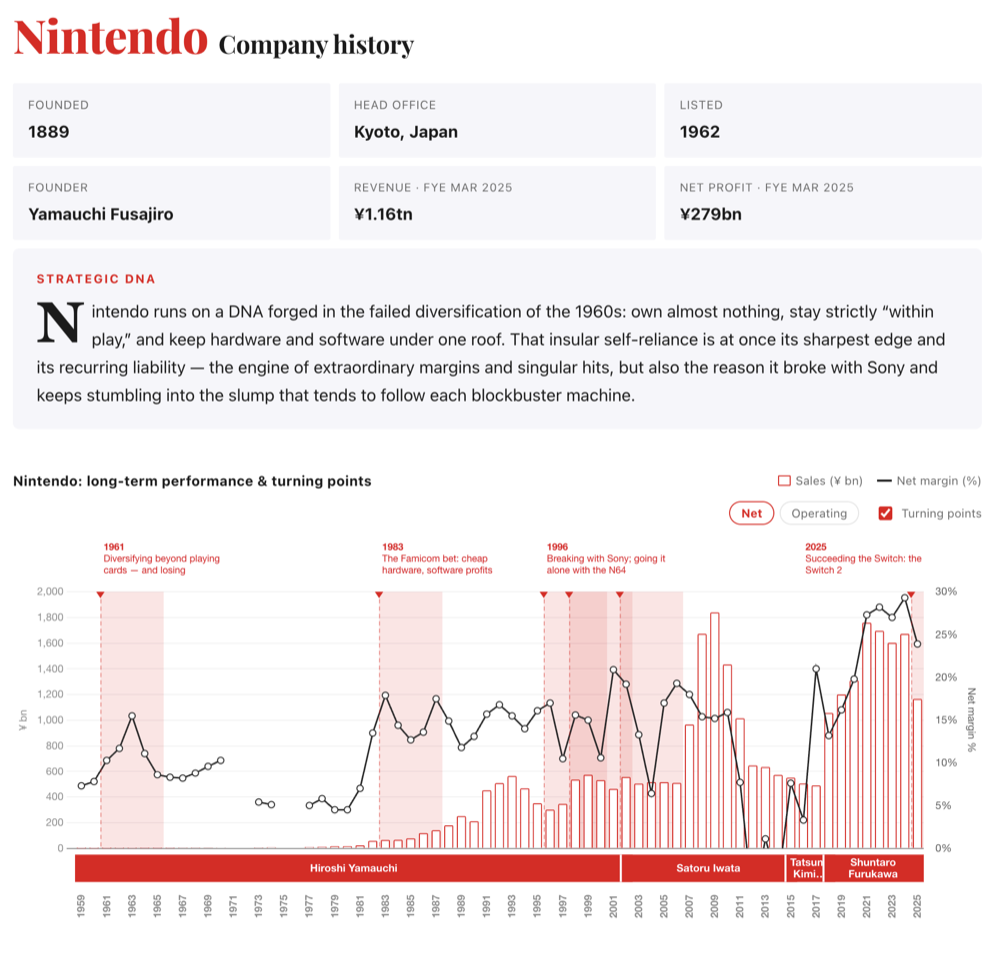
  • NintendoFounded in 1889. Starting as a playing card manufacturer in Kyoto, Nintendo created the home video game market with the Family Computer (NES) in 1983. Through a succession of innovative hardware — the DS, Wii, and Nintendo Switch — it became one of the world's most iconic entertainment companies.
  • SuntoryFounded in 1899. Shinjiro Torii built the foundation with Akadama Port Wine and took on the challenge of domestic whisky production. While remaining unlisted, the company diversified into beer, soft drinks, and health foods, and leaped to become a global spirits maker through the acquisition of Beam.
  • Nihon M&A CenterFounded in 1991. Built an M&A information network by organizing accounting firms and regional banks. Contributed to solving business succession issues for small and medium-sized enterprises through a strong sales structure, but accounting fraud was discovered in 2021.
  • DeNAMobile gaming and IT company founded in 2013. Achieved rapid growth with Mobage and pursued diversified business expansion into sports, healthcare, automotive, and other fields.
  • Rohto PharmaceuticalFounded in 1899. Known for 'Rohto Eye Drops,' the company acquired the global Mentholatum brand through the purchase of The Mentholatum Company. Expanding into skincare and health foods, and aggressively expanding into Southeast Asia, it evolved from an OTC drug maker into a comprehensive healthcare company.
  • KomatsuEstablished in 1921. Successfully manufactured Japan's first domestically produced bulldozer, and grew rapidly in construction machinery postwar. The company differentiated itself through company-wide quality control and the development of Komtrax, and strengthened its mining business through the acquisition of U.S.-based Joy Global. The world's second-largest construction equipment manufacturer.
  • FANUCFounded in 1972. Originating from Fujitsu's NC device division, Inaba Seiuemon established three pillars: NC, servo motors, and robots. With a 70% global share in NC and an operating profit margin of 36%, FANUC boasts Japan's top profitability, serving as the brain of machine tools that underpins manufacturing worldwide.
  • HOYAFounded in 1941. Starting as an optical glass manufacturer, the company diversified into eyeglass lenses, contact lenses, and semiconductor mask substrates. It established a high-profitability structure through ROE-focused management and withdrawal from unprofitable businesses, and supports cutting-edge semiconductors with EUV mask blanks.
  • CanonFounded in 1933. Starting as a camera manufacturer, Canon grew through a 'camera in the right hand, office equipment in the left' strategy covering copiers and printers. The company expanded its business domains through cell production systems and M&A, evolving into a global precision equipment manufacturer.
  • YamahaFounded in 1897. Starting from organ repair, Yamaha established the top domestic share in pianos. It created a market through Yamaha Music Schools and diversified into Electone, semiconductors, and audio. After the Kawakami family's departure and subsequent business restructuring, the company returned to instruments and acoustics, surpassing a market capitalization of 1 trillion yen.
  • ITOCHU CorporationFounded in 1858. Starting as an Omi merchant under the first Chubei Ito, the company evolved from a textile trading house into a general trading company. ITOCHU took on risk through the rescue merger of Ataka & Co., expanded non-resource businesses through its CITIC investment and FamilyMart strengthening, and rose to the top among trading companies in profitability.
  • Sumitomo Corporation
  • Mitsubishi CorporationFounded in 1918. Evolved from the commercial division of Mitsubishi Goshi into a general trading company. Built a profit base through resource and energy investments, and expanded into consumer industries through acquisitions of Lawson and Cermaq. Pursued balanced management through portfolio reshuffling.
  • Ataka & Co.Founded in 1909. Starting from bullion import and sales, the company grew through steel trading. Pursuing ambitions of becoming a general trading company, it invested heavily in large-scale projects, but the failure of its oil refining venture left it with approximately 200 billion yen in bad debts, leading to its collapse in 1977.
  • SanrioFounded in 1960. Starting from gift product sales, the company established a global brand through its character licensing business led by Hello Kitty. Sanrio became a pioneer of the character business through theme park operations (Puroland) and global expansion.
  • SogoFounded in 1830. Transforming from an Osaka kimono shop into a department store, the company pursued mass store openings nationwide under President Hiroo Mizushima. Overinvestment backfired after the bubble burst, and in 2000 the company filed for civil rehabilitation, sending shockwaves through the department store industry.
  • MaruiFounded in 1937. Starting from installment sales, Marui established a unique business model by combining youth-oriented fashion with credit cards. Through its concentration on the EPOS Card business and venture investments, the company evolved from a retailer into a fintech enterprise.
  • Mitsubishi EstateFounded in 1890. The Mitsubishi zaibatsu purchased Marunouchi in a single transaction and developed it from a red-brick district into a modern office district. As one of Japan's largest real estate developers, the company has led redevelopments in Marunouchi, Roppongi, and Otemachi, and developed large-scale mixed-use facilities including Yokohama Landmark Tower.
  • Yokogawa ElectricFounded in 1920. Started as an instrument manufacturer and entered industrial automation with the CENTUM integrated control system. Through a merger with Hokushin Electric and a joint venture with HP, the company leverages core technologies in control and measurement to drive digital transformation of industrial plants.
  • IbidenEstablished in 1912. Starting from hydroelectric power generation and carbide manufacturing, the company transformed into a semiconductor component manufacturer through printed wiring boards. It achieved rapid growth with package substrates for Intel and also entered the automotive market with DPFs. The company metamorphosed from a power company into an advanced semiconductor materials manufacturer.
  • Nidec CorporationEstablished in 1973. Founded by Shigenobu Nagamori, the company captured global market share in HDD spindle motors. Through aggressive M&A, it expanded its business domains and shifted toward automotive and industrial motors, growing from a precision small motor maker into a comprehensive motor manufacturer.
  • Kyocera CorporationEstablished in 1959. Built on ceramic technology, Kyocera supplied IC substrates to IBM and captured global market share in semiconductor packages. The company pursued diversification including participation in establishing DDI (now KDDI), and is known as a comprehensive electronic components manufacturer shaped by the management philosophy of founder Kazuo Inamori.
  • NikonFounded in 1917. Started as a military optics manufacturer, and grew in the postwar era on the twin pillars of cameras and steppers (semiconductor lithography equipment). Faced difficulties from failed customer transitions in steppers and a shrinking camera market, and is now exploring new business areas including the acquisition of a 3D printer company.
  • SCREEN HDFounded in 1868. Transformed from a heritage printing plate-making company to a semiconductor manufacturing equipment maker (wafer cleaning), establishing the world's leading market share. Spun off printing-related equipment to concentrate resources on semiconductor equipment, achieving record-high profits alongside semiconductor demand expansion.
  • Tokyo ElectronEstablished in 1963. Starting from car radio exports, the company entered the semiconductor manufacturing equipment business through a distributorship with Fairchild. Through in-house development and acquisitions, Tokyo Electron expanded its equipment lineup and grew into one of the world's top semiconductor manufacturing equipment makers.
  • YaohanFounded in 1930. Starting from the Yaohan Food Department Store in Atami, the company aggressively expanded overseas. Despite its unconventional management—including relocating the group headquarters to Hong Kong—overinvestment and accounting fraud came to light, and the company filed for corporate reorganization in 1997, going bankrupt.
  • MercariFounded in 2013. Pioneered Japan's C2C market with the flea market app 'Mercari,' achieving rapid growth and listing in 2018. Expanded into the payment domain with Merpay, and pursues global growth including U.S. expansion.
  • PanasonicFounded in 1918. Konosuke Matsushita started the company as an electrical appliance workshop and built a home electronics empire through the divisional system and the 'tap water philosophy.' The company integrated Sanyo Electric and Panasonic Electric Works, and focused on Tesla batteries and automotive businesses. It transitioned to a holding company structure and pursued structural reform.
  • Hikari TsushinFounded in 1988. Starting from mobile phone sales agency operations, the company expanded corporate telecom and OA equipment sales through mass hiring. After overcoming the HIT SHOP scandal, it transitioned to a recurring revenue business model. Diversification into insurance and water delivery businesses led to record-high profits.
  • Nippon ShokubaiFounded in 1941. Built global market share in acrylic acid and superabsorbent polymer (SAP) based on catalyst technology. Starting from maleic anhydride, the company transitioned its core products to ethylene oxide and SAP. A functional chemical manufacturer expanding globally.
  • CyberAgentFounded in 1998. Starting from an internet advertising agency business, the company expanded into proprietary media including Ameba Blog and AbemaTV. It made an early decision to shift to smartphones and continues to grow on three pillars: advertising, gaming, and media.
  • Toyota IndustriesEstablished in 1926. Originating from Sakichi Toyoda's automatic loom manufacturing, the company became the source of Toyota Motor. Diversifying into forklifts, car air-conditioning compressors, and textile machinery, it built a multi-business foundation as a core member of the Toyota Group.
  • Kutsu no MarutomiFounded in 1950. Starting from a shoe store in Nagoya, expanded 'Kutsu Ryutsu Center' (Shoe Distribution Center) nationwide to capture the leading domestic market share. Performance deteriorated due to rapid diversification and saturation of suburban store openings, and the company filed for civil rehabilitation in 2000.
  • Takeda PharmaceuticalFounded in 1781. Starting as a medicine wholesaler, Takeda produced blockbuster drugs including Alinamin, Leuprorelin, and Prograf. Through the Shire acquisition, Takeda entered the global top 10 and transformed into a global pharmaceutical company with rare diseases and plasma-derived therapies at its core.
  • TeijinFounded in 1918. Starting as Teikoku Rayon, the company diversified into synthetic fibers including polyester and nylon. It also expanded into pharmaceuticals, IT, and carbon fiber, breaking away from its founding rayon business. Through the acquisition of aramid fiber operations and strengthening of healthcare, it transformed into a materials-pharmaceutical conglomerate.
  • DENSOFounded in 1949. Spun off from the electrical components division of Toyota Motor, the company established a leading domestic position in automotive electrical parts. Expanding into engine control, air conditioning, and safety systems, DENSO has become a global supplier driving the transformation of mobility society through ADAS and electrification technologies.
  • BridgestoneFounded in 1931. Originating as a division of Nippon Tabi, the company grew as a specialized tire manufacturer. Through the acquisition of Firestone in the U.S., Bridgestone rose to become one of the world's largest tire makers, overcoming quality issues to establish a global management structure.
  • ShiseidoFounded in 1872. Starting as a Ginza pharmacy, the company entered cosmetics, establishing domestic leadership through its chain store system and the Hanatsubaki brand. It has aggressively pursued overseas acquisitions, aspiring to become a global beauty company, while driving structural reform to concentrate on skincare and prestige segments.
  • NitoriFounded in 1967. Starting from a furniture store in Sapporo, expanded nationwide through roadside locations using a Specialty store retailer of Private label Apparel (SPA) model. Achieved both low prices and quality through local production in Indonesia and Vietnam and proprietary logistics, recording 36 consecutive periods of revenue and profit growth as a furniture and household goods chain.
  • KDDIEstablished in 1984. Entered the long-distance telephone market as Daini Denden (DDI), then launched KDDI and au through the three-way merger of DDI, KDD, and IDO. Secured the second-largest domestic market share in mobile telephony, and is pursuing transformation into a platform company through the expansion of the au economic zone and full-scale development of financial services.
  • Saizeriya

Why History Explains Japanese Strategy

Japanese corporations don’t follow textbook rationality — they follow contextual rationality, a logic forged through decades of layered decisions, institutional relationships, and cultural imperatives. A strategy that looks inefficient today often reveals itself as the inevitable product of choices that were entirely rational within their historical moment.

This is what makes Japan’s corporate world simultaneously fascinating and opaque. Among advanced economies, few remain as difficult to read from the outside. The logic is there — but it’s embedded in context that rarely gets translated.

That’s the purpose of this site. As a Japanese software engineer, I map the strategic histories of Japan’s major listed companies: the decisions that built them, the turning points that reshaped them, and the accumulated logic that drives them today. My goal is to make the invisible visible — to translate the contextual rationality of Japanese business so the world can engage with it on its own terms.

What Japanese listed companies need is a balance of constructive engagement and external pressure — and that begins with understanding them.

Japan Corporate History & Strategy

94 Companies / 631 Key Decisions

Est. 1881
Nippon Paint
Revenue
¥1.4T
2023/12
Profit
¥118B
2023/12
Founded in 1881. Established as Japan's first paint manufacturer, the company grew through automotive coatings and Asian expansion via the NIPSEA Group. Accelerating global M&A centered on its capital alliance with Wuthelam, Nippon Paint transformed into one of the world's leading comprehensive coatings manufacturers.
Est. 1936
NGK Spark Plug (Niterra)
Revenue
¥614B
2024/03
Profit
¥83B
2024/03
Founded in 1936. Building on insulator technology, the company established the leading domestic market share in spark plugs and expanded into semiconductor package substrates. As a global manufacturer of automotive spark plugs, it has continued to grow alongside advances in engine technology.
Est. 1970
Nippon Steel
Revenue
¥8.9T
2024/03
Profit
¥549B
2024/03
Established in 1970. Born from the merger of Yawata Steel and Fuji Steel as one of the world's largest steelmakers. Through repeated rationalization programs, the company reorganized its domestic production system, and has led global steel industry consolidation through the integration with Sumitomo Metals and the planned acquisition of U.S. Steel.
Est. 1892
Mitsui Mining & Smelting
Revenue
¥647B
2024/03
Profit
¥26B
2024/03
Established in 1892. Originating from the smelting division of Mitsui Mining, the company grew on zinc and lead from the Kamioka Mine. After itai-itai disease compensation, it shifted to electronic materials and copper foil, and expanded into automotive parts. It has transformed from a resource company into an advanced materials manufacturer.
Est. 1918
Mitsubishi Materials
Revenue
¥1.5T
2024/03
Profit
¥30B
2024/03
Established in 1918. Starting as Mitsubishi Mining, the company diversified into non-ferrous metals, cement, and cemented carbide tools. The merger with Mitsubishi Mining & Cement created a comprehensive materials manufacturer. Having given birth to SUMCO (silicon wafers), the company continues to reshape its business portfolio.
Est. 1927
Sumitomo Metal Mining
Revenue
¥1.4T
2024/03
Profit
¥59B
2024/03
Established in 1927. Originating from the Sumitomo Besshi Mine, the company expanded from the Besshi Copper Mine into domestic and overseas mine development and smelting. Securing resources through the Hishikari Gold Mine and the Morenci Copper Mine, it also entered electronic metals and functional materials as a comprehensive non-ferrous metals manufacturer.
Est. 1884
DOWA Holdings
Revenue
¥717B
2024/03
Profit
¥28B
2024/03
Founded in 1884. Fujita-gumi acquired the Kosaka Mine and entered the smelting business. Postwar, the company shifted to electronic materials and environmental recycling. Under President Yoshikawa's leadership, concentrated investment was directed toward the recycling business, transforming the company from a mining company into an environmental and recycling enterprise.
Est. 1960
Recruit Holdings
Revenue
¥3.4T
2023/03
Profit
¥368B
2023/03
Founded in 1960. Starting as a university newspaper advertising agency, the company successively launched information media across lifestyle domains including employment, housing, and travel. Through the acquisition of Indeed, it transformed into an HR technology company, now leading the global talent matching market.
Est. 1949
Hitachi Construction Machinery
Revenue
¥1.4T
2024/03
Profit
¥93B
2024/03
Established in 1970. Built on Hitachi, Ltd.'s construction machinery division, the company grew with hydraulic excavators as its mainstay product. It developed the North American market through an OEM relationship with John Deere, and expanded its overseas ratio through manufacturing investments in Canada and China. A comprehensive construction equipment manufacturer.
Est. 1890
Kubota
Revenue
¥3.0T
2023/12
Profit
¥238B
2023/12
Founded in 1890. Starting from cast iron pipe manufacturing, the company transformed into an agricultural machinery maker through cultivators and tractors. It grew into a global agricultural machinery major through mass export to Europe and the Americas and acquisitions of Kverneland and Escorts, while also pursuing worldwide expansion in its water and environmental infrastructure business.
Est. 1924
Daikin
Revenue
¥4.4T
2024/03
Profit
¥260B
2024/03
Established in 1924. After successfully developing fluorocarbon refrigerants, the company grew through its air conditioning business in the postwar era. Acquisitions of OYL and Goodman established its position as a global HVAC manufacturer, and by leading adoption of the new R32 refrigerant, it has driven environmental initiatives. Daikin has grown into one of the world's largest dedicated HVAC manufacturers.
Est. 1912
Sharp
Revenue
¥2.3T
2024/03
Profit
-¥150B
2024/03
Founded in 1912. Personally founded by Tokuji Hayakawa, the company led technological innovation in calculators and LCD displays. Its LCD panels from the Kameyama Plant took the market by storm, but large-scale investment failures plunged it into a management crisis, leading to a recapitalization by Hon Hai Precision to pursue restructuring.
Est. 1947
Sanyo Electric
Revenue
¥1.5T
2011/03
Profit
-¥35B
2011/03
Founded in 1947. Toshio Iue left Matsushita Electric to establish the company, which grew through radios and washing machines. While the company accumulated technical expertise through concentrated investment in rechargeable batteries, the drawbacks of family management combined with financial deterioration, and in 2011 Sanyo became a wholly owned subsidiary of Panasonic.
Est. 1882
Toyobo
Revenue
¥414B
2024/03
Profit
¥2B
2024/03
Founded in 1882. Established as Japan's first private spinning company, it transitioned to synthetic fibers including rayon, acrylic, and polyester. Expanding into non-textile fields such as films, biotechnology, and medical products, it transformed into a functional materials manufacturer through repeated plant closures and business restructuring.
Est. 1887
Kanebo
Revenue
¥438B
2004/03
Profit
2004/03
Founded in 1887. Grew into Japan's largest spinning company by leading a grand consolidation of spinning firms in the Meiji era, and diversified into cosmetics. However, the failure of its diversification strategy and textile industry downturn led to insolvency, culminating in the tragic dissolution of the company in 2007.
Est. 1907
Kirin Holdings
Revenue
¥2.1T
2023/12
Profit
¥113B
2023/12
Established in 1907. Achieved over 60% domestic beer market share in the postwar era, maintaining the top position for an extended period. Strengthened its pharmaceutical business through the acquisition of Kyowa Hakko, and after transitioning to a holding company structure, operates on three pillars of beer, beverages, and pharmaceuticals. The company promotes overseas M&A and business portfolio transformation.
Est. 1985
ABC-MART
Revenue
¥344B
2024/02
Profit
¥40B
2024/02
Established in 1985. Achieved rapid growth with an SPA model combining shoe production in South Korea with domestic retail. Expanded nationally through aggressive store openings centered on shopping centers under the ABC-MART brand, while also advancing into Asia. The largest specialty shoe chain to surpass 1,000 domestic stores.
Est. 1971
McDonald's Japan
Revenue
¥352B
2022/12
Profit
¥20B
2022/12
Established in 1971. Den Fujita opened the first store in Ginza Mitsukoshi, transforming Japan's food service industry. The company grew into one of the largest domestic food chains through repeated cycles of low-price strategies and store operations reforms.
Est. 1985
Seria
Revenue
¥236B
2025/03
Profit
¥11B
2025/03
Founded in 1985. Starting from mobile vending, the company expanded into permanent 100-yen shops nationwide. Leveraging a proprietary POS system and order support tools to achieve high profitability, Seria grew into a leading 100-yen shop chain through expansion into the Tokyo metropolitan area and brand renewal.
Est. 1917
Kikkoman
Revenue
¥619B
2023/03
Profit
¥44B
2023/03
Founded in 1917. Eight soy sauce brewing families in Noda merged to establish domestic market leadership in soy sauce. In 1972, the company began local production in North America, successfully building soy sauce into an international brand. While diversifying into food and beverages, the company continues to grow as a global seasoning manufacturer.
Est. 1998
ZOZO
Revenue
¥213B
2025/03
Profit
¥65B
2025/03
Founded in 1998. Operates the e-commerce site ZOZOTOWN, which grew into one of Japan's largest fashion e-commerce platforms. In 2019, it came under the umbrella of Z Holdings, strengthening its EC infrastructure through logistics investment and expansion of store listings.
Est. 1954
Advantest
Revenue
¥487B
2024/03
Profit
¥78B
2024/03
Founded in 1954. Established as Takeda Riken Kogyo and pivoted from measurement instruments to IC testers. Rebuilt with Fujitsu's support, the company secured approximately 40% global market share in semiconductor test equipment, overcoming semiconductor market cycles to become a world leader in test systems.
Est. 1972
KEYENCE
Revenue
¥922B
2023/03
Profit
¥363B
2023/03
Founded in 1972. Takemitsu Takizaki established the company as Lead Electric and concentrated investment in sensors. Achieving over 50% operating profit margin through direct sales and high-value-added strategy, the company grew into one of Japan's most profitable enterprises with a unique management approach that distributes operating profits as employee bonuses.
Est. 1996
Yahoo Japan
Revenue
¥1.7T
2023/03
Profit
¥189B
2023/03
Founded in 1996. Operated Japan's largest portal site as Yahoo! JAPAN, diversifying into EC, payments, and media. After renaming to Z Holdings, expanded its platform economy through LINE integration and PayPay rollout.
Est. 1946
Sony
Revenue
¥13T
2024/03
Profit
¥971B
2024/03
Founded in 1946. Ibuka Masaru and Morita Akio challenged the world with transistor radios, then created culture with the Walkman and PlayStation. Through acquisitions of CBS and Columbia, the company transformed into an entertainment enterprise and continues to grow through diversified management spanning image sensors and financial services.
Est. 1917
SUBARU Corporation (SUBARU)
Revenue
¥4.7T
2024/03
Profit
¥385B
2024/03
Established in 1953. Originating from Nakajima Aircraft, Fuji Heavy Industries applied aerospace engineering to automobiles and entered the mass-market with the 'Subaru 360.' The company established a distinctive driving performance identity through its boxer engine and AWD system, and after achieving success in the North American market, renamed itself SUBARU Corporation in 2017.
Est. 1917
Mitsubishi Heavy Industries (MHI)
Revenue
¥4.7T
2024/03
Profit
¥222B
2024/03
Established in 1917. Originating from the Nagasaki Shipyard acquired by the Mitsubishi zaibatsu, MHI grew into one of Japan's largest heavy industry conglomerates spanning shipbuilding, power systems, aerospace, and defense. After postwar dissolution into three companies and reunification in 1964, it expanded into nuclear power, gas turbines, and fighter aircraft. Despite setbacks including the SpaceJet project cancellation and cruise ship losses, MHI achieved record profits in 2024 driven by GTCC, nuclear, and defense orders.
Est. 1889
IHI Corporation (IHI)
Revenue
¥1.3T
2024/03
Profit
-¥68B
2024/03
Established in 1889. Starting as the Ishikawajima Shipyard, IHI diversified into aero engines, turbochargers, and plant engineering. After withdrawing from shipbuilding and concentrating resources on aerospace, defense, and social infrastructure, the company renamed itself IHI and evolved into a comprehensive heavy industry manufacturer.
Est. 1911
Nissui
Revenue
¥886B
2025/03
Profit
¥25B
2025/03
Founded in 1911. Entered deep-sea fishing as the Tamura Steamship Fishing Division, and grew through Antarctic whaling and North Pacific fisheries in the postwar era. Withdrew from deep-sea fishing in the 1970s and shifted to seafood processing and frozen foods, also diversifying into pharmaceuticals. Transformed into a comprehensive food company through global expansion and concentrated investment in food processing.
Est. 1906
Sapporo Breweries
Revenue
¥478B
2022/12
Profit
¥5B
2022/12
Founded in 1906. Born from the breakup of Dai Nippon Breweries, the company focused on reviving the Yebisu Beer brand and restoring the Sapporo brand. Entered the real estate business with the opening of Yebisu Garden Place, and pursued transformation into a global brewer through overseas acquisitions.
Est. 1949
Asahi Group Holdings
Revenue
¥2.9T
2024/12
Profit
¥193B
2024/12
Established in 1949. With support from Sumitomo Bank, the company undertook management restructuring and dominated the domestic beer market with the launch of 'Super Dry' in 1987. Through major M&A deals including the acquisition of Calpis and SABMiller's European operations, it transformed into a global beverage maker.
Est. 1888
Ajinomoto
Revenue
¥1.5T
2025/03
Profit
¥70B
2025/03
Founded in 1909. Starting from the invention of the umami seasoning 'AJI-NO-MOTO,' the company diversified into food, fine chemicals, and pharmaceuticals based on amino acid technology. Launching full-scale overseas operations early in the postwar period, the company also expanded into frozen foods and healthcare, developing into one of the world's leading amino acid companies.
Est. 1942
Nichirei
Revenue
¥662B
2023/03
Profit
¥22B
2023/03
Established in 1942. Founded as a wartime state-controlled company, the company transformed its business in the postwar era from cold storage and seafood processing to frozen foods. Creating household frozen food hits such as 'Honkaku Itame Chahan' and 'Toku Kara,' the company grew into a comprehensive cold chain enterprise powered by both its food and logistics businesses.
Est. 1949
JT
Revenue
¥3.1T
2024/12
Profit
¥183B
2024/12
Founded in 1985. Launched through the privatization of the Japan Tobacco and Salt Public Corporation, JT accelerated global expansion through the acquisition of RJR Nabisco's international tobacco business and Gallaher in response to the shrinking domestic tobacco market. Diversifying into food and pharmaceuticals, it grew into one of the world's leading tobacco manufacturers.
Est. 1926
Toray
Revenue
¥2.5T
2024/03
Profit
¥22B
2024/03
Founded in 1926. Starting as a rayon manufacturer, the company grew into a major synthetic fiber producer through technology licensing of nylon and polyester. It became the first in the world to successfully mass-produce carbon fiber, securing an overwhelming share in aircraft materials. It evolved into an advanced materials manufacturer.
Est. 1887
Nissan Chemical
Revenue
¥227B
2024/03
Profit
¥38B
2024/03
Founded in 1887. Starting as Japan's first chemical fertilizer manufacturer, the company passed through the Nissan zaibatsu before becoming independent. It successfully transformed its business through withdrawal from petrochemicals and concentrated investment in high-performance materials, establishing a high-profitability structure in agrochemicals, functional materials, and semiconductor materials.
Est. 1936
Kyowa Kirin
Revenue
¥442B
2023/12
Profit
¥81B
2023/12
Founded in 1936. Diversified into amino acids, pharmaceuticals, and alcoholic beverages based on fermentation technology. Became a subsidiary of Kirin HD and divested alcohol and chemical businesses to concentrate on pharmaceuticals. Pursuing transformation into a Global Specialty Pharma centered on antibody drugs.
Est. 1887
Kao Corporation (Kao)
Revenue
¥1.6T
2024/12
Profit
¥198B
2024/12
Founded in 1887. Starting as a soap retailer, Kao expanded into synthetic detergents, disposable diapers, and cosmetics. The acquisition of Kanebo Cosmetics made it a major cosmetics player. Through distinctive management approaches including EVA-based management and sales company reform, Kao has maintained a high-profitability structure as a consumer goods and chemical manufacturer.
Est. 1925
Chugai Pharmaceutical
Revenue
¥1.1T
2023/12
Profit
¥325B
2023/12
Founded in 1925. Grew through the detoxifying agent 'Guronsan,' then entered biopharmaceuticals in earnest by acquiring EPO manufacturing and sales rights. Strengthened R&D capabilities through a strategic alliance with Roche, and produced Japan's first domestically developed antibody drug 'Actemra.' A leading Japanese biopharmaceutical company.
Est. 1934
FUJIFILM
Revenue
¥3.2T
2025/03
Profit
¥261B
2025/03
Founded in 1934. Once commanding a 70% domestic share in photographic film, the company faced market extinction due to digitalization. It executed a bold business transformation into pharmaceuticals, cosmetics, and advanced materials, evolving into a diversified conglomerate through the full acquisition of Fuji Xerox and entry into biopharmaceuticals.
Est. 1959
SMC
Established in 1959. Founded as Sintered Metal Industries, the company established a world-leading market share in pneumatic equipment. By building an immediate delivery system and a nationwide sales network, it locked in customers and expanded overseas local production. A global leader in pneumatic equipment boasting an overwhelming profit margin.
Est. 1910
Hitachi, Ltd.
Revenue
¥9.7T
2024/03
Profit
¥590B
2024/03
Founded in 1910. Starting from a repair workshop at Hitachi Mine, the company grew into a comprehensive electrical manufacturer. After struggling with unprofitable semiconductor and consumer electronics businesses, Hitachi executed structural reforms to concentrate management resources on social infrastructure and IT, and transformed into a digital enterprise through the acquisitions of GlobalLogic and ABB's power grid business.
Est. 1878
Kawasaki Heavy Industries
Revenue
¥1.8T
2024/03
Profit
¥25B
2024/03
Founded in 1878. Starting as the Kawasaki Tsukiji Shipyard, the company diversified into naval vessels, aircraft, and railway rolling stock. Split into three companies during postwar zaibatsu dissolution, the firms re-merged in 1969. Expanding the Kawasaki motorcycle brand globally, the company has developed into a comprehensive heavy industry manufacturer with pillars in defense, aircraft components, railway rolling stock, and industrial robots.
Est. 1933
Nissan Motor (Nissan)
Revenue
¥13T
2024/03
Profit
¥427B
2024/03
Established in 1933. Starting as Automobile Manufacturing Co., Ltd., Nissan mass-produced the 'Datsun' through postwar technology licensing. After rapid growth in the North American market, the company underwent the Ghosn-led restructuring and continues to seek management rebuilding through alliance strategies as one of Japan's leading automakers.
Est. 1937
Isuzu Motors
Revenue
¥3.4T
2024/03
Profit
¥176B
2024/03
Founded in 1937. Originating from the automotive division of Ishikawajima Shipyard, the company grew through diesel trucks. Specializing in commercial vehicles, Isuzu has expanded globally with a focus on Southeast Asia, pioneering emerging markets with pickup trucks and buses as a commercial vehicle specialist.
Est. 1933
Toyota Motor (Toyota)
Revenue
¥45T
2024/03
Profit
¥4.9T
2024/03
Founded in 1937. Originating from the automobile division of Toyoda Automatic Loom Works, Toyota overcame a postwar financial crisis to establish the kanban system. It dominated the mass-market with the Corolla, accelerated global expansion through North American local production and the Lexus brand, and pioneered environmental technology with the Prius hybrid, growing into one of the world's largest automakers.
Est. 1942
Hino Motors
Revenue
¥1.5T
2024/03
Profit
¥17B
2024/03
Founded in 1942. Starting as Hino Heavy Industries, the company began with diesel engine and truck manufacturing and formed a capital alliance with Toyota Motor. Specializing in heavy-duty trucks and buses, Hino is a commercial vehicle manufacturer expanding local production in Southeast Asia.
Est. 1970
Mitsubishi Motors
Revenue
¥2.8T
2024/03
Profit
¥155B
2024/03
Founded in 1970. Established by spinning off the automotive division of Mitsubishi Heavy Industries, the company developed overseas markets with the Pajero and Lancer. After falling into a management crisis following a recall cover-up scandal, the company joined the Nissan-Renault Alliance to pursue reconstruction.
Est. 1920
Mazda
Revenue
¥4.8T
2024/03
Profit
¥208B
2024/03
Founded in 1920. Starting from cork manufacturing, Mazda gained worldwide fame for commercializing the rotary engine. Based in Hiroshima, the company pursues proprietary technology and 'the joy of driving,' leading the efficiency of internal combustion engines with SKYACTIV Technology.
Est. 1946
Honda
Revenue
¥20T
2024/03
Profit
¥1.1T
2024/03
Founded in 1946. Soichiro Honda started with auxiliary bicycle engines and established the world's leading position in motorcycles with the Super Cub. Expanded into automobiles and general-purpose products, driving technological innovation through F1 racing and CVCC engine development. The world's largest motorcycle manufacturer and a comprehensive mobility company.
Est. 1909
Suzuki
Revenue
¥5.4T
2024/03
Profit
¥268B
2024/03
Founded in 1909. Starting from loom manufacturing, the company entered the four-wheeled vehicle market with the kei car 'Suzuki Suzulight.' Succeeding in its emerging market strategy through the Maruti Suzuki joint venture in India, Suzuki is a global automaker that has established a unique position in kei cars and compact cars.
Est. 1955
Yamaha Motor
Revenue
¥2.6T
2024/12
Profit
¥119B
2024/12
Founded in 1955. Yamaha Motor became independent as a motorcycle manufacturer, later diversifying into marine products and robotics. The company holds the world's second-largest share in motorcycles and is a global leader in outboard motors. A mobility manufacturer that upholds the vision of being a 'Kando Creating Company.'
Est. 1919
Olympus
Revenue
¥936B
2024/03
Profit
¥243B
2024/03
Founded in 1919. Started as a microscope manufacturer, then entered medical devices through the invention of the gastrocamera. Gained widespread recognition with the hit camera 'Pen EE,' but underwent structural reform following an accounting fraud scandal. Concentrated on medical endoscopes and transformed into a global medical device company.
Est. 1889
Nintendo
Revenue
¥1.7T
2024/03
Profit
¥491B
2024/03
Founded in 1889. Starting as a playing card manufacturer in Kyoto, Nintendo created the home video game market with the Family Computer (NES) in 1983. Through a succession of innovative hardware — the DS, Wii, and Nintendo Switch — it became one of the world's most iconic entertainment companies.
Est. 1899
Suntory
Revenue
¥3.0T
2022/12
Profit
¥136B
2022/12
Founded in 1899. Shinjiro Torii built the foundation with Akadama Port Wine and took on the challenge of domestic whisky production. While remaining unlisted, the company diversified into beer, soft drinks, and health foods, and leaped to become a global spirits maker through the acquisition of Beam.
Est. 1966
Nihon M&A Center
Revenue
¥44B
2025/03
Profit
¥11B
2025/03
Founded in 1991. Built an M&A information network by organizing accounting firms and regional banks. Contributed to solving business succession issues for small and medium-sized enterprises through a strong sales structure, but accounting fraud was discovered in 2021.
Est. 1999
DeNA
Revenue
¥135B
2023/03
Profit
¥9B
2023/03
Mobile gaming and IT company founded in 2013. Achieved rapid growth with Mobage and pursued diversified business expansion into sports, healthcare, automotive, and other fields.
Est. 1899
Rohto Pharmaceutical
Revenue
¥239B
2023/03
Profit
¥26B
2023/03
Founded in 1899. Known for 'Rohto Eye Drops,' the company acquired the global Mentholatum brand through the purchase of The Mentholatum Company. Expanding into skincare and health foods, and aggressively expanding into Southeast Asia, it evolved from an OTC drug maker into a comprehensive healthcare company.
Est. 1921
Komatsu
Established in 1921. Successfully manufactured Japan's first domestically produced bulldozer, and grew rapidly in construction machinery postwar. The company differentiated itself through company-wide quality control and the development of Komtrax, and strengthened its mining business through the acquisition of U.S.-based Joy Global. The world's second-largest construction equipment manufacturer.
Est. 1956
FANUC
Revenue
¥733B
2022/03
Profit
¥213B
2022/03
Founded in 1972. Originating from Fujitsu's NC device division, Inaba Seiuemon established three pillars: NC, servo motors, and robots. With a 70% global share in NC and an operating profit margin of 36%, FANUC boasts Japan's top profitability, serving as the brain of machine tools that underpins manufacturing worldwide.
Est. 1941
HOYA
Revenue
¥763B
2024/03
Profit
¥183B
2024/03
Founded in 1941. Starting as an optical glass manufacturer, the company diversified into eyeglass lenses, contact lenses, and semiconductor mask substrates. It established a high-profitability structure through ROE-focused management and withdrawal from unprofitable businesses, and supports cutting-edge semiconductors with EUV mask blanks.
Est. 1933
Canon
Revenue
¥4.0T
2022/12
Profit
¥244B
2022/12
Founded in 1933. Starting as a camera manufacturer, Canon grew through a 'camera in the right hand, office equipment in the left' strategy covering copiers and printers. The company expanded its business domains through cell production systems and M&A, evolving into a global precision equipment manufacturer.
Est. 1897
Yamaha
Revenue
¥462B
2025/03
Profit
¥13B
2025/03
Founded in 1897. Starting from organ repair, Yamaha established the top domestic share in pianos. It created a market through Yamaha Music Schools and diversified into Electone, semiconductors, and audio. After the Kawakami family's departure and subsequent business restructuring, the company returned to instruments and acoustics, surpassing a market capitalization of 1 trillion yen.
Est. 1858
ITOCHU Corporation
Revenue
¥14T
2023/03
Profit
¥845B
2023/03
Founded in 1858. Starting as an Omi merchant under the first Chubei Ito, the company evolved from a textile trading house into a general trading company. ITOCHU took on risk through the rescue merger of Ataka & Co., expanded non-resource businesses through its CITIC investment and FamilyMart strengthening, and rose to the top among trading companies in profitability.
Est. 1945
Sumitomo Corporation
Revenue
¥6.8T
2023/03
Profit
¥565B
2023/03
Est. 1918
Mitsubishi Corporation
Revenue
¥22T
2023/03
Profit
¥1.2T
2023/03
Founded in 1918. Evolved from the commercial division of Mitsubishi Goshi into a general trading company. Built a profit base through resource and energy investments, and expanded into consumer industries through acquisitions of Lawson and Cermaq. Pursued balanced management through portfolio reshuffling.
Est. 1909
Ataka & Co.
Revenue
¥1.5T
1977/03
Profit
-¥31B
1977/03
Founded in 1909. Starting from bullion import and sales, the company grew through steel trading. Pursuing ambitions of becoming a general trading company, it invested heavily in large-scale projects, but the failure of its oil refining venture left it with approximately 200 billion yen in bad debts, leading to its collapse in 1977.
Est. 1960
Sanrio
Revenue
¥73B
2023/03
Profit
¥8B
2023/03
Founded in 1960. Starting from gift product sales, the company established a global brand through its character licensing business led by Hello Kitty. Sanrio became a pioneer of the character business through theme park operations (Puroland) and global expansion.
Est. 1830
Sogo
Revenue
¥157B
2000/02
Profit
-¥138B
2000/02
Founded in 1830. Transforming from an Osaka kimono shop into a department store, the company pursued mass store openings nationwide under President Hiroo Mizushima. Overinvestment backfired after the bubble burst, and in 2000 the company filed for civil rehabilitation, sending shockwaves through the department store industry.
Est. 1937
Marui
Revenue
¥218B
2023/03
Profit
¥22B
2023/03
Founded in 1937. Starting from installment sales, Marui established a unique business model by combining youth-oriented fashion with credit cards. Through its concentration on the EPOS Card business and venture investments, the company evolved from a retailer into a fintech enterprise.
Est. 1890
Mitsubishi Estate
Revenue
¥1.5T
2024/03
Profit
¥168B
2024/03
Founded in 1890. The Mitsubishi zaibatsu purchased Marunouchi in a single transaction and developed it from a red-brick district into a modern office district. As one of Japan's largest real estate developers, the company has led redevelopments in Marunouchi, Roppongi, and Otemachi, and developed large-scale mixed-use facilities including Yokohama Landmark Tower.
Est. 1920
Yokogawa Electric
Revenue
¥540B
2024/03
Profit
¥62B
2024/03
Founded in 1920. Started as an instrument manufacturer and entered industrial automation with the CENTUM integrated control system. Through a merger with Hokushin Electric and a joint venture with HP, the company leverages core technologies in control and measurement to drive digital transformation of industrial plants.
Est. 1912
Ibiden
Revenue
¥418B
2023/03
Profit
¥76B
2023/03
Established in 1912. Starting from hydroelectric power generation and carbide manufacturing, the company transformed into a semiconductor component manufacturer through printed wiring boards. It achieved rapid growth with package substrates for Intel and also entered the automotive market with DPFs. The company metamorphosed from a power company into an advanced semiconductor materials manufacturer.
Est. 1973
Nidec Corporation
Revenue
¥2.3T
2024/03
Profit
¥125B
2024/03
Established in 1973. Founded by Shigenobu Nagamori, the company captured global market share in HDD spindle motors. Through aggressive M&A, it expanded its business domains and shifted toward automotive and industrial motors, growing from a precision small motor maker into a comprehensive motor manufacturer.
Est. 1959
Kyocera Corporation
Revenue
¥2.0T
2024/03
Profit
¥101B
2024/03
Established in 1959. Built on ceramic technology, Kyocera supplied IC substrates to IBM and captured global market share in semiconductor packages. The company pursued diversification including participation in establishing DDI (now KDDI), and is known as a comprehensive electronic components manufacturer shaped by the management philosophy of founder Kazuo Inamori.
Est. 1917
Nikon
Revenue
¥717B
2024/03
Profit
¥32B
2024/03
Founded in 1917. Started as a military optics manufacturer, and grew in the postwar era on the twin pillars of cameras and steppers (semiconductor lithography equipment). Faced difficulties from failed customer transitions in steppers and a shrinking camera market, and is now exploring new business areas including the acquisition of a 3D printer company.
Est. 1868
SCREEN HD
Revenue
¥505B
2024/03
Profit
¥71B
2024/03
Founded in 1868. Transformed from a heritage printing plate-making company to a semiconductor manufacturing equipment maker (wafer cleaning), establishing the world's leading market share. Spun off printing-related equipment to concentrate resources on semiconductor equipment, achieving record-high profits alongside semiconductor demand expansion.
Est. 1963
Tokyo Electron
Revenue
¥1.8T
2024/03
Profit
¥364B
2024/03
Established in 1963. Starting from car radio exports, the company entered the semiconductor manufacturing equipment business through a distributorship with Fairchild. Through in-house development and acquisitions, Tokyo Electron expanded its equipment lineup and grew into one of the world's top semiconductor manufacturing equipment makers.
Est. 1930
Yaohan
Revenue
¥157B
1997/03
Profit
-¥36B
1997/03
Founded in 1930. Starting from the Yaohan Food Department Store in Atami, the company aggressively expanded overseas. Despite its unconventional management—including relocating the group headquarters to Hong Kong—overinvestment and accounting fraud came to light, and the company filed for corporate reorganization in 1997, going bankrupt.
Est. 2013
Mercari
Revenue
¥187B
2024/06
Profit
¥16B
2024/06
Founded in 2013. Pioneered Japan's C2C market with the flea market app 'Mercari,' achieving rapid growth and listing in 2018. Expanded into the payment domain with Merpay, and pursues global growth including U.S. expansion.
Est. 1918
Panasonic
Revenue
¥8.5T
2024/03
Profit
¥444B
2024/03
Founded in 1918. Konosuke Matsushita started the company as an electrical appliance workshop and built a home electronics empire through the divisional system and the 'tap water philosophy.' The company integrated Sanyo Electric and Panasonic Electric Works, and focused on Tesla batteries and automotive businesses. It transitioned to a holding company structure and pursued structural reform.
Est. 1988
Hikari Tsushin
Revenue
¥602B
2024/03
Profit
¥122B
2024/03
Founded in 1988. Starting from mobile phone sales agency operations, the company expanded corporate telecom and OA equipment sales through mass hiring. After overcoming the HIT SHOP scandal, it transitioned to a recurring revenue business model. Diversification into insurance and water delivery businesses led to record-high profits.
Est. 1941
Nippon Shokubai
Revenue
¥409B
2025/03
Profit
¥17B
2025/03
Founded in 1941. Built global market share in acrylic acid and superabsorbent polymer (SAP) based on catalyst technology. Starting from maleic anhydride, the company transitioned its core products to ethylene oxide and SAP. A functional chemical manufacturer expanding globally.
Est. 1998
CyberAgent
Revenue
¥803B
2024/09
Profit
¥16B
2024/09
Founded in 1998. Starting from an internet advertising agency business, the company expanded into proprietary media including Ameba Blog and AbemaTV. It made an early decision to shift to smartphones and continues to grow on three pillars: advertising, gaming, and media.
Est. 1926
Toyota Industries
Revenue
¥4.1T
2025/03
Profit
¥271B
2025/03
Established in 1926. Originating from Sakichi Toyoda's automatic loom manufacturing, the company became the source of Toyota Motor. Diversifying into forklifts, car air-conditioning compressors, and textile machinery, it built a multi-business foundation as a core member of the Toyota Group.
Est. 1950
Kutsu no Marutomi
Revenue
¥121B
2000/02
Profit
-¥9B
2000/02
Founded in 1950. Starting from a shoe store in Nagoya, expanded 'Kutsu Ryutsu Center' (Shoe Distribution Center) nationwide to capture the leading domestic market share. Performance deteriorated due to rapid diversification and saturation of suburban store openings, and the company filed for civil rehabilitation in 2000.
Est. 1781
Takeda Pharmaceutical
Revenue
¥4.6T
2025/03
Profit
¥108B
2025/03
Founded in 1781. Starting as a medicine wholesaler, Takeda produced blockbuster drugs including Alinamin, Leuprorelin, and Prograf. Through the Shire acquisition, Takeda entered the global top 10 and transformed into a global pharmaceutical company with rare diseases and plasma-derived therapies at its core.
Est. 1918
Teijin
Revenue
¥1.0T
2025/03
Profit
¥8B
2025/03
Founded in 1918. Starting as Teikoku Rayon, the company diversified into synthetic fibers including polyester and nylon. It also expanded into pharmaceuticals, IT, and carbon fiber, breaking away from its founding rayon business. Through the acquisition of aramid fiber operations and strengthening of healthcare, it transformed into a materials-pharmaceutical conglomerate.
Est. 1949
DENSO
Revenue
¥6.4T
2023/03
Profit
¥348B
2023/03
Founded in 1949. Spun off from the electrical components division of Toyota Motor, the company established a leading domestic position in automotive electrical parts. Expanding into engine control, air conditioning, and safety systems, DENSO has become a global supplier driving the transformation of mobility society through ADAS and electrification technologies.
Est. 1931
Bridgestone
Revenue
¥4.3T
2023/12
Profit
¥331B
2023/12
Founded in 1931. Originating as a division of Nippon Tabi, the company grew as a specialized tire manufacturer. Through the acquisition of Firestone in the U.S., Bridgestone rose to become one of the world's largest tire makers, overcoming quality issues to establish a global management structure.
Est. 1872
Shiseido
Revenue
¥973B
2024/12
Profit
¥22B
2024/12
Founded in 1872. Starting as a Ginza pharmacy, the company entered cosmetics, establishing domestic leadership through its chain store system and the Hanatsubaki brand. It has aggressively pursued overseas acquisitions, aspiring to become a global beauty company, while driving structural reform to concentrate on skincare and prestige segments.
Est. 1967
Nitori
Revenue
¥896B
2024/03
Profit
¥87B
2024/03
Founded in 1967. Starting from a furniture store in Sapporo, expanded nationwide through roadside locations using a Specialty store retailer of Private label Apparel (SPA) model. Achieved both low prices and quality through local production in Indonesia and Vietnam and proprietary logistics, recording 36 consecutive periods of revenue and profit growth as a furniture and household goods chain.
Est. 1984
KDDI
Revenue
¥5.8T
2024/03
Profit
¥740B
2024/03
Established in 1984. Entered the long-distance telephone market as Daini Denden (DDI), then launched KDDI and au through the three-way merger of DDI, KDD, and IDO. Secured the second-largest domestic market share in mobile telephony, and is pursuing transformation into a platform company through the expansion of the au economic zone and full-scale development of financial services.
Est. 1967
Saizeriya
Revenue
¥183B
2023/08
Profit
¥5B
2023/08