Founded in 1936. Diversified into amino acids, pharmaceuticals, and alcoholic beverages based on fermentation technology. Became a subsidiary of Kirin HD and divested alcohol and chemical businesses to concentrate on pharmaceuticals. Pursuing transformation into a Global Specialty Pharma centered on antibody drugs.
1936
Strategic Decision
Kyowa Chemical Research Institute Established
The Prototype of a Fermentation Chemical Manufacturer Born from the Loss of Military Technology
1949
Kyowa Hakko Kogyo Kabushiki Kaisha Established (Old company dissolved under the Corporate Reconstruction Act; launched as successor company)
1949Kyowa Hakko Kogyo Kabushiki Kaisha Established (Old company dissolved under the Corporate Reconstruction Act; launched as successor company)
1949
Stock Listed on Tokyo Stock Exchange
1949Stock Listed on Tokyo Stock Exchange
1951
Partnered with Merck; Began Manufacturing Tuberculosis Drug 'Streptomycin'
1951Partnered with Merck; Began Manufacturing Tuberculosis Drug 'Streptomycin'
1953
Accelerated Acquisitions of Distilled Spirits Companies
1953Accelerated Acquisitions of Distilled Spirits Companies
1956
Invented Fermentation Method for Monosodium Glutamate Production (Entering Competition with Ajinomoto)
1956Invented Fermentation Method for Monosodium Glutamate Production (Entering Competition with Ajinomoto)
1958
Merged with Sanyo Chemical Industries; Opened Ube Factory
1958Merged with Sanyo Chemical Industries; Opened Ube Factory
1959
Launched Prescription Drug 'Mitomycin' (Actinomyces isolated from soil in Shibuya Ward)
1959Launched Prescription Drug 'Mitomycin' (Actinomyces isolated from soil in Shibuya Ward)
1967
Four-Division Structure (Pharmaceuticals, Alcoholic Beverages, Chemicals, Food)
1967Four-Division Structure (Pharmaceuticals, Alcoholic Beverages, Chemicals, Food)
1981
Kyowa Medex Established
1981Kyowa Medex Established
1983
Chairman Benzaburo Kato Passed Away
1983Chairman Benzaburo Kato Passed Away
1991
Launched Hypertension and Angina Treatment 'Coniel'
1991Launched Hypertension and Angina Treatment 'Coniel'
2001
Sold Janssen Kyowa to J&J
2001Sold Janssen Kyowa to J&J
2002
Sold Alcoholic Beverages Business to Asahi Breweries
2002Sold Alcoholic Beverages Business to Asahi Breweries
2004
Chemical Business Spun Off; Kyowa Hakko Chemical Established
2004Chemical Business Spun Off; Kyowa Hakko Chemical Established
2005
Food Business Spun Off; Kyowa Hakko Foods Established
2005Food Business Spun Off; Kyowa Hakko Foods Established
2007
Acquired 'Daiichi Fine Chemical' from Daiichi Sankyo
2007Acquired 'Daiichi Fine Chemical' from Daiichi Sankyo
2008
Strategic Decision
Kirin HD Acquired Kyowa Hakko via TOB
The Integration Logic Between a Beer Company and a Pharmaceutical Company Connected by Fermentation Technology
2011
Transferred Kyowa Hakko Chemical to KJ Holdings
2011Transferred Kyowa Hakko Chemical to KJ Holdings
2011
Acquired ProStrakan Group plc of the UK
2011Acquired ProStrakan Group plc of the UK
2012
Established Joint Venture with FUJIFILM
2012Established Joint Venture with FUJIFILM
2013
Scandal Discovered at Kyowa Yuka (Fraudulent Reporting in High-Pressure Gas Equipment Inspections)
2013Scandal Discovered at Kyowa Yuka (Fraudulent Reporting in High-Pressure Gas Equipment Inspections)
2014
Acquired Archimedes Pharma Limited of the UK
2014Acquired Archimedes Pharma Limited of the UK
2019
Strategic Decision
Divestiture of Non-Focus Business: Kyowa Hakko Bio Transferred to Kirin HD
The Contradiction of 'Divesting a High-Profit Business' Determined by Parent-Subsidiary Listing
2024
Acquired Orchard Therapeutics plc of the UK
2024Acquired Orchard Therapeutics plc of the UK
View Performance
RevenueKyowa Kirin:Revenue
Non-consol. | Consolidated (Unit: ¥100M)
¥442B
Revenue:2023/12
ProfitKyowa Kirin:Net Profit Margin
Non-consol. | Consolidated (Unit: %)
18.3%
Margin:2023/12
View Performance
PeriodTypeRevenueProfit*Margin
1950/12Non-consol. Revenue / Net Income---
1951/12Non-consol. Revenue / Net Income---
1952/12Non-consol. Revenue / Net Income---
1953/12Non-consol. Revenue / Net Income---
1954/12Non-consol. Revenue / Net Income---
1955/12Non-consol. Revenue / Net Income---
1956/12Non-consol. Revenue / Net Income---
1957/12Non-consol. Revenue / Net Income---
1958/12Non-consol. Revenue / Net Income---
1959/12Non-consol. Revenue / Net Income---
1960/12Non-consol. Revenue / Net Income---
1961/12Non-consol. Revenue / Net Income---
1962/12Non-consol. Revenue / Net Income---
1963/12Non-consol. Revenue / Net Income---
1964/12Non-consol. Revenue / Net Income---
1965/12Non-consol. Revenue / Net Income---
1966/12Non-consol. Revenue / Net Income---
1967/12Non-consol. Revenue / Net Income---
1968/12Non-consol. Revenue / Net Income---
1969/12Non-consol. Revenue / Net Income---
1970/12Non-consol. Revenue / Net Income¥50B¥1B2.2%
1971/12Non-consol. Revenue / Net Income¥52B¥1B1.7%
1972/12Non-consol. Revenue / Net Income¥59B¥1B1.5%
1973/12Non-consol. Revenue / Net Income¥79B¥1B1.7%
1974/12Non-consol. Revenue / Net Income¥116B¥2B1.9%
1975/12Non-consol. Revenue / Net Income¥124B¥1B0.5%
1976/12Non-consol. Revenue / Net Income¥139B¥1B0.9%
1977/12Non-consol. Revenue / Net Income¥147B¥3B1.6%
1978/12Non-consol. Revenue / Net Income¥145B¥3B1.8%
1979/12Non-consol. Revenue / Net Income¥174B¥3B1.7%
1980/12Non-consol. Revenue / Net Income¥201B¥3B1.5%
1981/12Non-consol. Revenue / Net Income¥206B¥4B1.9%
1982/12Non-consol. Revenue / Net Income¥216B¥5B2.2%
1983/12Non-consol. Revenue / Net Income¥220B¥5B2.2%
1984/12Non-consol. Revenue / Net Income¥224B¥5B2.4%
1985/12Non-consol. Revenue / Net Income---
1986/12Non-consol. Revenue / Net Income---
1987/12Non-consol. Revenue / Net Income---
1988/12Non-consol. Revenue / Net Income---
1989/12Non-consol. Revenue / Net Income---
1990/12Non-consol. Revenue / Net Income---
1991/12Non-consol. Revenue / Net Income---
1992/12Consolidated Revenue / Net Income¥324B¥5B1.4%
1993/12Consolidated Revenue / Net Income¥323B¥6B1.9%
1994/12Consolidated Revenue / Net Income¥342B¥11B3.1%
1995/12Consolidated Revenue / Net Income¥375B¥16B4.1%
1996/3Consolidated Revenue / Net Income¥83B¥1B1.4%
1997/3Consolidated Revenue / Net Income¥398B¥12B3.0%
1998/3Consolidated Revenue / Net Income¥397B¥14B3.3%
1999/3Consolidated Revenue / Net Income¥385B¥6B1.5%
2000/3Consolidated Revenue / Net Income¥375B¥11B2.9%
2001/3Consolidated Revenue / Net Income¥376B¥9B2.4%
2002/3Consolidated Revenue / Net Income¥279B¥6B1.9%
2003/3Consolidated Revenue / Net Income¥359B¥8B2.3%
2004/3Consolidated Revenue / Net Income¥349B¥10B2.8%
2005/3Consolidated Revenue / Net Income¥359B¥18B4.9%
2006/3Consolidated Revenue / Net Income¥353B¥16B4.5%
2007/3Consolidated Revenue / Net Income¥354B¥13B3.5%
2008/3Consolidated Revenue / Net Income¥392B¥23B5.9%
2009/12Consolidated Revenue / Net Income¥309B¥9B2.8%
2010/12Consolidated Revenue / Net Income¥414B¥22B5.3%
2011/12Consolidated Revenue / Net Income¥344B¥26B7.4%
2012/12Consolidated Revenue / Net Income¥333B¥24B7.2%
2013/12Consolidated Revenue / Net Income¥341B¥30B8.8%
2014/12Consolidated Revenue / Net Income¥333B¥16B4.7%
2015/12Consolidated Revenue / Net Income¥364B¥30B8.1%
2016/12Consolidated Revenue / Net Income¥348B¥30B8.7%
2017/12Consolidated Revenue / Net Income¥353B¥43B12.1%
2018/12Consolidated Revenue / Net Income¥347B¥54B15.6%
2019/12Consolidated Revenue / Net Income¥306B¥67B21.9%
2020/12Consolidated Revenue / Net Income¥318B¥47B14.7%
2021/12Consolidated Revenue / Net Income¥352B¥52B14.8%
2022/12Consolidated Revenue / Net Income¥398B¥54B13.4%
2023/12Consolidated Revenue / Net Income¥442B¥81B18.3%
Management Policy: FY2021FY2025
Kyowa Kirin Medium-Term Management Plan

Background of Plan Formulation

Since the integration of Kyowa Hakko and Kirin Pharma, Kyowa Kirin has advanced the divestiture of non-core businesses and concentration on the pharmaceutical business, building a foundation as a Japan-originated Global Specialty Pharma (GSP). In the latter half of the 2010s, with the launches of global strategic products such as Crysvita, Poteligeo, and Nourianz, the overseas revenue ratio increased and the earnings structure underwent transformation.

Meanwhile, in the pharmaceutical industry, the business environment is undergoing major changes, including the strengthening of healthcare cost containment policies, the shift to patient-centric medicine, and advances in digital technology. Amid the advancing polarization into mega pharma competing on scale and economies of scale on one hand, and specialty pharma demonstrating presence through high value-added products on the other, Kyowa Kirin was pressed to clarify its strategy as the latter.

Under this environmental awareness, the company positioned its medium-term management plan through 2025 as the growth acceleration phase as a GSP, and looking ahead to 2030 beyond that, set forth a new vision of continuous creation of life-changing value that goes beyond mere provision of pharmaceuticals.

Purpose of the Vision

This vision aims for Kyowa Kirin to become an entity that continuously addresses unmet medical needs (UMN) as a Japan-originated Global Specialty Pharma. While maintaining antibody technology as its core, the company will combine diverse modalities and data-driven drug discovery to create pharmaceuticals and services with only-one value that cannot be substituted by other companies.

Additionally, the company aims to build a long-term sustainable business foundation through responding to medical needs from the patient's perspective, earning trust from society, and ensuring stable supply of high-quality pharmaceuticals. Through this, it aims to simultaneously enhance growth potential, profitability, and capital efficiency, completing the transition to a management model capable of continuously creating corporate value from 2030 onward.
Author's Insights

The Structural Asymmetry of Parent-Subsidiary Listing — Whose Will Is 'Selection and Concentration'?
To What Extent Can 'Selection and Concentration' Led by the Parent Company Be Accepted?

Kyowa Hakko established a four-business-division structure in 1967—pharmaceuticals, alcoholic beverages, chemicals, and food—and operated a diversified business under the common foundation of fermentation technology. However, this diversification was completely dismantled in just 11 years following the TOB by Kirin HD in 2008. While the alcoholic beverages business (sold to Asahi Breweries in 2002) was divested independently before the acquisition, the divestitures of chemicals (spun off in 2004 → sold in 2011), food (spun off in 2005 → transferred to Kirin HD in 2011), and finally the remaining Kyowa Hakko Bio (transferred to Kirin HD in 2019) accelerated after coming under Kirin HD's umbrella. As a result, Kyowa Kirin became a single-business pharmaceutical company and came to espouse transformation into a 'Global Specialty Pharma (GSP).'

This business restructuring appears at first glance to be rational 'selection and concentration.' The pharmaceutical industry is increasingly polarizing into mega pharma and specialty pharma, and half-hearted diversification erodes competitiveness. Concentrating management resources on pharmaceuticals and expanding investment in antibody drugs and global strategic products—this is textbook-correct strategy. However, the problem lies in whose will this 'concentration' decision belonged to.

The divestiture of Kyowa Hakko Bio most clearly illuminates this structure. The company had recorded revenue of 78.2 billion yen and core operating profit of 8.1 billion yen in fiscal 2018, making it a stable earnings source for Kyowa Kirin. The manufacturing of amino acids and nucleic acid-related substances utilizing fermentation technology was also the very technological foundation that was Kyowa Hakko's origin. Nevertheless, in April 2019 all shares were transferred to Kirin HD for 110.7 billion yen. While a gain on sale of 48.3 billion yen was recorded, for minority shareholders this meant the permanent outflow of an earnings source. The decision to hand over a high-profit subsidiary to the parent company is difficult to explain from the standalone management rationality of the subsidiary. What made this decision possible was none other than the capital structure in which Kirin HD held 53.77% of shares.

Under the structure of parent-subsidiary listing, the interests of the controlling shareholder and minority shareholders are fundamentally misaligned. For Kirin HD, acquiring Kyowa Hakko Bio was portfolio optimization within the group, and Kyowa Kirin's 'pharmaceutical concentration' was rational as part of the group strategy. But for Kyowa Kirin's minority shareholders, it was nothing other than a structure in which their company's earnings base was being transferred to the parent company, and unless growth in the remaining pharmaceutical business exceeded the transferred amount, corporate value would be impaired. The means for minority shareholders to object to this decision were structurally limited, and the board of directors was also under the influence of the controlling shareholder. Behind the management terminology of 'selection and concentration,' what was actually functioning was the logic of the controlling shareholder's group optimization.

Looking further back, the TOB by Kirin HD itself in 2008 formed the starting point of this structure. Kirin HD cited 'complementarity of fermentation technology' and 'strengthening of the pharmaceutical business' as acquisition rationales, and then-President Yuzuru Matsuda also emphasized 'similarity of corporate cultures' and '70-80% of employees being in favor.' However, what happened after the acquisition was the phased stripping away of all business bases other than pharmaceuticals that Kyowa Hakko had possessed—alcoholic beverages, chemicals, food, and bio. What Kirin HD sought was not Kyowa Hakko's 'fermentation technology as a whole' but its 'pharmaceutical business' and 'antibody technology,' and businesses beyond those became targets for restructuring in the course of group reorganization. The 'complementarity' spoken of at the time of acquisition, as a post-acquisition reality, turned into 'selection and separation.'

The case of Kyowa Kirin condenses the structural problems that pervade Japan's parent-subsidiary listed companies. When subsidiary management formulates 'medium-term management plans' and 'visions,' setting targets like GSP transformation and ROE of 10% or above, the preconditions of that strategy—which businesses to keep and which to divest—have already been determined by the parent company's capital logic. Whether the subsidiary dismantled its diversification of its own will or was made to dismantle it by the parent company's will is difficult to distinguish from the outside. However, the 53.77% ownership ratio and the fact that a high-profit subsidiary flowed out to the parent company strongly suggest that the subject of 'selection and concentration' was not the subsidiary's management but the controlling shareholder.

2026-02-21 | by author
Disclaimer
Japan Corporate History & Strategy uses Google Analytics, provided by Google LLC, to improve quality. Information held by visitors (IP address, visited URL, referrer URL, visit timestamp, and device information) is transmitted to Google LLC. This website is compiled from publicly available information by an individual developer and represents personal views. We do not guarantee accuracy, completeness, or timeliness. The developer assumes no liability for any damages arising from the use of information on this website.
1936
7

Kyowa Chemical Research Institute Established

The Prototype of a Fermentation Chemical Manufacturer Born from the Loss of Military Technology

Kyowa Hakko's origins lie in a joint research institute formed by a cartel of three sake brewing companies, and during the war it was engaged in the military business of aviation fuel development. The loss of military demand with the end of the war meant the collapse of the business base, but fermentation technology itself was a versatile technology transferable to civilian use. The fact that the technological accumulation of cultivation and purification aimed at aviation fuel was repurposed for tuberculosis drug manufacturing demonstrates the structure in which the application range of a technological foundation determines the options for business transformation.

BackgroundA fermentation chemistry research base born from a cartel of three sake brewing companies

In 1930s Japan, the manufacture of distilled spirits (industrial alcohol) was one of the important industries, with the three major companies—Takara Shuzo, Godo Shusei, and Nihon Shurui—forming the market. Against a backdrop of intensifying sales competition, the three companies formed a cartel called the 'Kyowa-kai,' conducting production coordination and cooperative sales. In July 1936, as an extension of this cartel, the three companies jointly invested to establish the 'Kyowa Chemical Research Institute' in Hatagaya, Shibuya, Tokyo, and began joint research on fermentation technology.

The person dispatched from Takara Shuzo to the Kyowa Chemical Research Institute was Benzaburo Kato, who was then serving as the Ichikawa Factory manager. Mr. Kato became president in 1949 after the war, served as chairman from 1968, and remained at the top of management until his death in 1983 while still serving as chairman. The research institute that began with joint investment from the three sake brewing companies became an independent company called 'Kyowa Hakko Kogyo' (Kyowa Fermentation Industries) following the postwar dissolution of zaibatsu, and Mr. Kato, as its de facto founder, defined the business direction.

DecisionFrom military application of fermentation technology to a mass production plan for aviation fuel

Benzaburo Kato embarked on research to apply fermentation technology to chemical industry, advancing the development of technology to manufacture butanol from molasses and further convert it to isooctane, an aviation fuel. The military's attention to this research established the business direction of applying fermentation technology to chemistry. The Kyowa Chemical Research Institute transcended its initial character as a joint research organization of the three sake brewing companies and transformed into a development base for chemical technology directly linked to military demand.

During the war, to establish a mass production system for aviation fuel, the Fuji Factory was newly established to begin production of catalysts, and Toa Chemical Industries was jointly established with Toyobo and others to operate the Ube (Hofu) Factory. Mass production of aviation fuel from molasses was planned, but as the war situation deteriorated and molasses transport from the southern regions was cut off, mass production was not achieved, and the factory switched to manufacturing anhydrous alcohol before the war ended. Preparations as a military enterprise were falling into place, but the war ended before production of the final product began.

ResultLoss of military demand and restart as a fermentation chemical manufacturer through conversion to civilian use

With the end of the war in August 1945, Kyowa Hakko lost its core business of aviation fuel development in a single stroke. The disappearance of military demand meant the collapse of the business base, and the company was forced into significant business downsizing including the dismissal of approximately 800 employees. Following the postwar dissolution of zaibatsu and the application of the Corporate Reconstruction Act, the old company was dissolved in July 1949, and 'Kyowa Hakko Kogyo Kabushiki Kaisha' (Kyowa Fermentation Industries Co., Ltd.) was established as a successor company. This marked complete separation from the three sake brewing companies' affiliations, and a fresh start as an independent company with Benzaburo Kato as president.

However, the technological foundation of fermentation technology and its chemical applications accumulated during the war was not lost with the end of the war. Benzaburo Kato set forth the management policy of applying fermentation technology to pharmaceuticals and food chemistry as the direction for civilian conversion. In 1951, through a technology licensing agreement with Merck, the company began manufacturing the tuberculosis drug 'Streptomycin' and entered the pharmaceutical business in earnest. The starting point for Kyowa Hakko's transformation from a military enterprise to a diversified fermentation chemical manufacturer handling pharmaceuticals, amino acids, and alcoholic beverages in the postwar era can be traced to this decision to convert to civilian use.

The Prototype of a Fermentation Chemical Manufacturer Born from the Loss of Military Technology

Kyowa Hakko's origins lie in a joint research institute formed by a cartel of three sake brewing companies, and during the war it was engaged in the military business of aviation fuel development. The loss of military demand with the end of the war meant the collapse of the business base, but fermentation technology itself was a versatile technology transferable to civilian use. The fact that the technological accumulation of cultivation and purification aimed at aviation fuel was repurposed for tuberculosis drug manufacturing demonstrates the structure in which the application range of a technological foundation determines the options for business transformation.

TestimonyBenzaburo Kato (Kyowa Hakko Kogyo, de facto founder)

The Kyowa-kai was something more powerful than today's cartels—an ideal association in which major manufacturers in the same industry, standing on mutual trust, would coordinate production and conduct cooperative sales. The members were the three companies then called the three major alcohol manufacturers: Takara Shuzo, Godo Shusei, and Nihon Shurui. At the time, sales competition among companies in the same industry was intensifying to the point of chaos. The business leaders who awakened to the futility of such chaotic competition earnestly tackled the stabilization of the industry and the prosperity of their own companies from a broad perspective. The Kyowa-kai was born from that spirit of cooperation. I believe the Kyowa-kai is a truly admirable organization, even when brought into today's era of advanced business modernization.

TimelineKyowa Chemical Research Institute Established — Key Events
11/1939Kyowa Chemical Industries Co., Ltd. established
3/1943Fuji Factory newly established; production of catalysts for aviation fuel
12/1943Hofu Factory newly established (joint establishment of Toa Chemical Industries; mass production plan for aviation fuel)
8/1945End of war: loss of military demand, restructuring
Number of employees dismissed800100M JPY
1949
Kyowa Hakko Kogyo Kabushiki Kaisha Established (Old company dissolved under the Corporate Reconstruction Act; launched as successor company)
1949
Stock Listed on Tokyo Stock Exchange
1951
Partnered with Merck; Began Manufacturing Tuberculosis Drug 'Streptomycin'
1953
Accelerated Acquisitions of Distilled Spirits Companies
1956
Invented Fermentation Method for Monosodium Glutamate Production (Entering Competition with Ajinomoto)
1958
Merged with Sanyo Chemical Industries; Opened Ube Factory
1959
Launched Prescription Drug 'Mitomycin' (Actinomyces isolated from soil in Shibuya Ward)
1967
Four-Division Structure (Pharmaceuticals, Alcoholic Beverages, Chemicals, Food)
1981
Kyowa Medex Established
1983
Chairman Benzaburo Kato Passed Away
1991
Launched Hypertension and Angina Treatment 'Coniel'
2001
Sold Janssen Kyowa to J&J
2002
Sold Alcoholic Beverages Business to Asahi Breweries
2004
Chemical Business Spun Off; Kyowa Hakko Chemical Established
2005
Food Business Spun Off; Kyowa Hakko Foods Established
2007
Acquired 'Daiichi Fine Chemical' from Daiichi Sankyo
2008
4

Kirin HD Acquired Kyowa Hakko via TOB

The Integration Logic Between a Beer Company and a Pharmaceutical Company Connected by Fermentation Technology

The TOB by Kirin HD for Kyowa Hakko was an acquisition executed by a beer company for the purpose of expanding its pharmaceutical business. What connected the two companies was the common technological foundation of 'fermentation technology,' and on Kyowa Hakko's side there also existed the merger concept from 2002 and a high rate of internal support. The course of events in which the alcoholic beverages, chemicals, and food businesses were successively sold after the acquisition highlights the structure in which the parent company's business strategy determines the subsidiary's portfolio and businesses judged as non-core are divested.

BackgroundKirin HD approached Kyowa Hakko to strengthen its pharmaceutical business

In the 2000s, Kirin Holdings, while maintaining the beer business as its core, had set strengthening of the pharmaceutical business as a growth area in its management policy. It already had a pharmaceutical subsidiary 'Kirin Pharma,' but there were limits in scale and technology for developing new drugs independently. Kirin HD already held 27.95% of Kyowa Hakko's shares, and focusing on the complementarity of both companies based on fermentation technology, was planning a full-scale expansion of the pharmaceutical business through making Kyowa Hakko a subsidiary.

Kyowa Hakko, on the other hand, was a diversified fermentation chemical manufacturer operating four businesses—pharmaceuticals, alcoholic beverages, chemicals, and food—but had been advancing the restructuring of non-core businesses from the 2000s. Having sold the alcoholic beverages business to Asahi Breweries in 2002, spun off the chemical business in 2004, and the food business in 2005, Kyowa Hakko was progressively concentrating on the pharmaceutical business. Merger discussions with Kirin HD had existed since around 2002, and the groundwork for deepening the capital relationship was being laid.

DecisionExecution of the TOB and integration of the pharmaceutical business through making Kyowa Hakko a subsidiary

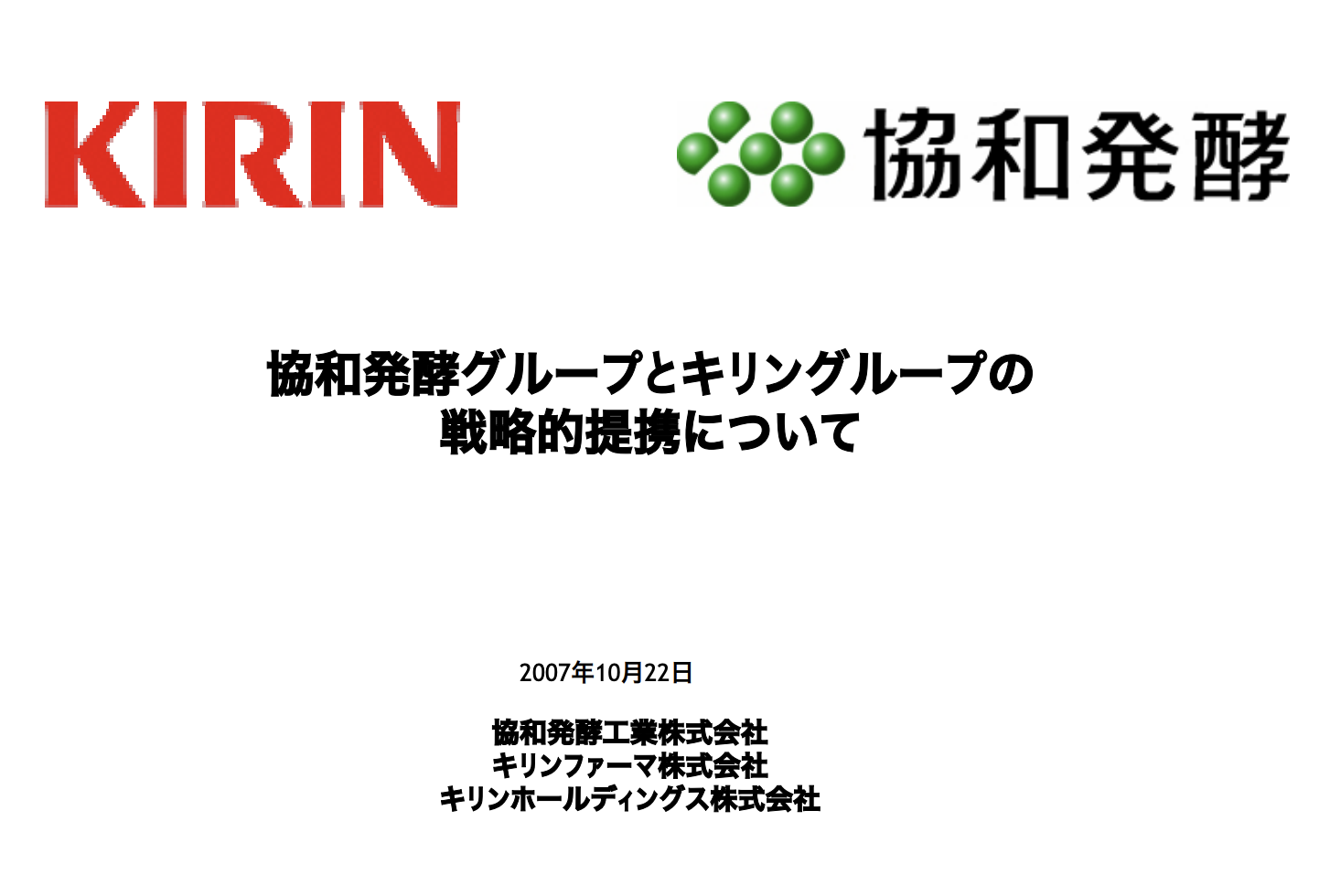
In October 2007, Kirin HD declared a TOB for Kyowa Hakko, targeting the acquisition of 50.1% in addition to the existing 27.95%. Kirin HD's aim was not the low-profitability alcoholic beverages business but the concentration of management resources on the high-margin pharmaceutical business. Additionally, Kirin HD announced plans to integrate its own pharmaceutical subsidiary 'Kirin Pharma' into Kyowa Hakko, positioning Kyowa Hakko post-acquisition as the integrated platform for the pharmaceutical business within the Kirin Group.

Kyowa Hakko expressed its consent to the TOB. Behind the acceptance were the similarity of corporate cultures based on fermentation technology, the securing of scale in antibody drug development and sales, and the merger concept that had existed since 2002. Then-President Yuzuru Matsuda stated that 'when we surveyed internally about the integration, 70-80% of employees were strongly in favor.' The TOB was completed in December 2007, and in April 2008 Kirin HD acquired 50.8% of Kyowa Hakko's shares, completing the subsidiary conversion.

ResultIntegration with Kirin Pharma and trade name change to 'Kyowa Kirin'

Following the completion of the subsidiary conversion, Kyowa Hakko made Kirin Pharma a wholly-owned subsidiary through a share exchange. The acquisition cost amounted to 477.8 billion yen, and goodwill of 191.9 billion yen was recorded. In October 2008, Kyowa Hakko absorbed and merged with Kirin Pharma, changing the trade name to 'Kyowa Hakko Kirin.' Through this integration, the pharmaceutical business of the Kirin Group was consolidated into Kyowa Hakko Kirin, and a business structure as a specialty pharma centered on antibody drugs was established.

After the integration, Kyowa Hakko Kirin, as a consolidated subsidiary of Kirin HD, further accelerated the divestiture of non-core businesses and concentration on pharmaceuticals. In 2011, Kirin Kyowa Foods was transferred to Kirin HD, and in the same year Kyowa Hakko Chemical, the chemical business, was also sold, successively divesting businesses other than pharmaceuticals. While coming under Kirin HD's umbrella brought constraints on management independence, it also put in place a management foundation for expanding global deployment and investment in the new drug pipeline, backed by the group's capital strength.

The Integration Logic Between a Beer Company and a Pharmaceutical Company Connected by Fermentation Technology

The TOB by Kirin HD for Kyowa Hakko was an acquisition executed by a beer company for the purpose of expanding its pharmaceutical business. What connected the two companies was the common technological foundation of 'fermentation technology,' and on Kyowa Hakko's side there also existed the merger concept from 2002 and a high rate of internal support. The course of events in which the alcoholic beverages, chemicals, and food businesses were successively sold after the acquisition highlights the structure in which the parent company's business strategy determines the subsidiary's portfolio and businesses judged as non-core are divested.

TestimonyYuzuru Matsuda (Kyowa Hakko, then President)

Kirin launched its pharmaceutical business by applying beer fermentation technology. They have large-scale manufacturing technology and high complementarity. We share similarity in corporate culture in that both are based on fermentation technology. When we surveyed internally about the integration, 70-80% of employees were strongly in favor. Rather, there is so little sense of discomfort that it worries me. The focus is not on the integration itself, but on aiming for world-class level.

TimelineKirin HD Acquired Kyowa Hakko via TOB — Key Events
10/2007Kirin HD declared TOB for Kyowa Hakko
10/2007Integration agreement and share exchange agreement concluded (10/22)
12/2007Tender offer commenced (10/31)
12/2007Tender offer expired; TOB completed (12/6)
4/2008Share exchange became effective (4/1)
4/2008Kyowa Hakko made Kirin Pharma a wholly-owned subsidiary
Acquisition cost (hundred million yen)4778100M JPY
10/2008Kyowa Hakko absorbed and merged with Kirin Pharma
10/2008Trade name changed to Kyowa Hakko Kirin Co., Ltd.
1/2011Kirin Kyowa Foods transferred to Kirin HD
2011
Transferred Kyowa Hakko Chemical to KJ Holdings
2011
Acquired ProStrakan Group plc of the UK
2012
Established Joint Venture with FUJIFILM
2013
Scandal Discovered at Kyowa Yuka (Fraudulent Reporting in High-Pressure Gas Equipment Inspections)
2014
Acquired Archimedes Pharma Limited of the UK
2019
4

Divestiture of Non-Focus Business: Kyowa Hakko Bio Transferred to Kirin HD

The Contradiction of 'Divesting a High-Profit Business' Determined by Parent-Subsidiary Listing

The decision to transfer a high-profit subsidiary with revenue of 78.2 billion yen and core operating profit of 8.1 billion yen to the parent company is difficult to explain from the subsidiary's standalone management rationality. What determined this decision was the capital structure of parent-subsidiary listing in which Kirin HD held 53.77%. For minority shareholders, the outflow of an earnings source carries the risk of corporate value impairment, but there existed a structural asymmetry in which they could not resist the controlling shareholder's group strategy. This is also a case demonstrating the limits of minority shareholder protection under parent-subsidiary listing.

BackgroundBusiness restructuring under Kirin HD and pressure for pharmaceutical concentration

Since coming under Kirin HD's umbrella in 2008, Kyowa Kirin had espoused concentration on the pharmaceutical business as its management policy and had sequentially divested the alcoholic beverages, chemicals, and food businesses. As of 2019, the major remaining non-pharmaceutical business was the subsidiary 'Kyowa Hakko Bio,' which manufactured amino acids and nucleic acid-related substances utilizing fermentation technology. The company had recorded revenue of 78.2 billion yen and core operating profit of 8.1 billion yen in fiscal 2018, making it a stable earnings source for Kyowa Kirin.

Meanwhile, parent company Kirin HD was promoting business portfolio restructuring across the entire group, and was requiring Kyowa Kirin to adopt a policy of concentrating management resources on the pharmaceutical business. Kirin HD was the controlling shareholder holding 53.77% of Kyowa Kirin's shares, and it was structurally difficult for Kyowa Kirin's management to object to the direction of the group strategy. The stated rationale for the sale was the judgment that operating Kyowa Hakko Bio under Kirin HD, which had deep knowledge of fermentation technology, would be more appropriate.

DecisionA decision to transfer a high-profit subsidiary to the parent company

In April 2019, Kyowa Kirin transferred all shares of its subsidiary 'Kyowa Hakko Bio' to Kirin HD for 110.7 billion yen, recording a gain on sale of 48.3 billion yen. The decision to divest a business with revenue of 78.2 billion yen and core operating profit of 8.1 billion yen was one that reduced Kyowa Kirin's standalone earnings base. However, the management's room for judgment against a request from parent company Kirin HD, which held 53.77% of shares, was structurally limited, and the management was forced into a difficult decision between the interests of minority shareholders and the parent company's strategy.

This divestiture made Kyowa Kirin's character as a single-business pharmaceutical company clear. Kyowa Hakko, which had once operated four businesses—pharmaceuticals, alcoholic beverages, chemicals, and food—had divested all businesses other than pharmaceuticals in approximately 10 years since coming under Kirin HD's umbrella. As a result of parent company-led business restructuring advancing under the parent-subsidiary listing structure, Kyowa Kirin accelerated its transformation to a Global Specialty Pharma while losing the diversity of its business portfolio.

The Contradiction of 'Divesting a High-Profit Business' Determined by Parent-Subsidiary Listing

The decision to transfer a high-profit subsidiary with revenue of 78.2 billion yen and core operating profit of 8.1 billion yen to the parent company is difficult to explain from the subsidiary's standalone management rationality. What determined this decision was the capital structure of parent-subsidiary listing in which Kirin HD held 53.77%. For minority shareholders, the outflow of an earnings source carries the risk of corporate value impairment, but there existed a structural asymmetry in which they could not resist the controlling shareholder's group strategy. This is also a case demonstrating the limits of minority shareholder protection under parent-subsidiary listing.

TimelineDivestiture of Non-Focus Business: Kyowa Hakko Bio Transferred to Kirin HD — Key Events
1/2018Kyowa Medex transferred to Hitachi Chemical
4/2019Kyowa Hakko Bio transferred to Kirin HD
Gain on sale of subsidiary shares (hundred million yen)483100M JPY
2024
Acquired Orchard Therapeutics plc of the UK
Back to Home