| Period | Type | Revenue | Profit* | Margin |
|---|---|---|---|---|
| 1950/3 | Non-consol. Revenue / Net Income | - | - | - |
| 1951/3 | Non-consol. Revenue / Net Income | - | - | - |
| 1952/3 | Non-consol. Revenue / Net Income | - | - | - |
| 1953/3 | Non-consol. Revenue / Net Income | - | - | - |
| 1954/3 | Non-consol. Revenue / Net Income | - | - | - |
| 1955/3 | Non-consol. Revenue / Net Income | - | - | - |
| 1956/3 | Non-consol. Revenue / Net Income | - | - | - |
| 1957/3 | Non-consol. Revenue / Net Income | - | - | - |
| 1958/3 | Non-consol. Revenue / Net Income | - | - | - |
| 1959/3 | Non-consol. Revenue / Net Income | - | - | - |
| 1960/3 | Non-consol. Revenue / Net Income | - | - | - |
| 1961/3 | Non-consol. Revenue / Net Income | - | - | - |
| 1962/3 | Non-consol. Revenue / Net Income | - | - | - |
| 1963/3 | Non-consol. Revenue / Net Income | - | - | - |
| 1964/3 | Non-consol. Revenue / Net Income | - | - | - |
| 1965/3 | Non-consol. Revenue / Net Income | - | - | - |
| 1966/3 | Non-consol. Revenue / Net Income | - | - | - |
| 1967/3 | Non-consol. Revenue / Net Income | - | - | - |
| 1968/3 | Non-consol. Revenue / Net Income | - | - | - |
| 1969/3 | Non-consol. Revenue / Net Income | - | - | - |
| 1970/3 | Non-consol. Revenue / Net Income | - | - | - |
| 1971/3 | Non-consol. Revenue / Net Income | - | - | - |
| 1972/3 | Non-consol. Revenue / Net Income | - | - | - |
| 1973/3 | Non-consol. Revenue / Net Income | - | - | - |
| 1974/3 | Non-consol. Revenue / Net Income | - | - | - |
| 1975/3 | Non-consol. Revenue / Net Income | - | - | - |
| 1976/3 | Non-consol. Revenue / Net Income | ¥84B | ¥8B | 9.5% |
| 1977/3 | Non-consol. Revenue / Net Income | ¥94B | ¥8B | 8.8% |
| 1978/3 | Non-consol. Revenue / Net Income | ¥105B | ¥9B | 8.9% |
| 1979/3 | Non-consol. Revenue / Net Income | ¥112B | ¥11B | 9.3% |
| 1980/3 | Non-consol. Revenue / Net Income | ¥126B | ¥13B | 10.2% |
| 1981/3 | Non-consol. Revenue / Net Income | ¥135B | ¥14B | 10.5% |
| 1982/3 | Non-consol. Revenue / Net Income | ¥147B | ¥15B | 10.4% |
| 1983/3 | Non-consol. Revenue / Net Income | ¥154B | ¥16B | 10.4% |
| 1984/3 | Non-consol. Revenue / Net Income | ¥186B | ¥18B | 9.9% |
| 1985/3 | Non-consol. Revenue / Net Income | ¥192B | ¥21B | 10.6% |
| 1986/3 | Non-consol. Revenue / Net Income | - | - | - |
| 1987/3 | Non-consol. Revenue / Net Income | - | - | - |
| 1988/3 | Non-consol. Revenue / Net Income | - | - | - |
| 1989/3 | Non-consol. Revenue / Net Income | - | - | - |
| 1990/3 | Non-consol. Revenue / Net Income | - | - | - |
| 1991/3 | Non-consol. Revenue / Net Income | - | - | - |
| 1992/3 | Non-consol. Revenue / Net Income | - | - | - |
| 1993/3 | Non-consol. Revenue / Net Income | - | - | - |
| 1994/3 | Consolidated Operating Revenue / Net Income | ¥559B | ¥23B | 4.0% |
| 1995/3 | Consolidated Operating Revenue / Net Income | ¥563B | ¥15B | 2.6% |
| 1996/3 | Consolidated Operating Revenue / Net Income | ¥551B | -¥99B | -18.0% |
| 1997/3 | Consolidated Operating Revenue / Net Income | ¥559B | ¥38B | 6.8% |
| 1998/3 | Consolidated Operating Revenue / Net Income | ¥549B | ¥32B | 5.7% |
| 1999/3 | Consolidated Operating Revenue / Net Income | ¥565B | ¥22B | 3.9% |
| 2000/3 | Consolidated Operating Revenue / Net Income | ¥574B | ¥18B | 3.2% |
| 2001/3 | Consolidated Operating Revenue / Net Income | ¥631B | ¥20B | 3.1% |
| 2002/3 | Consolidated Operating Revenue / Net Income | ¥632B | -¥71B | -11.3% |
| 2003/3 | Consolidated Operating Revenue / Net Income | ¥682B | ¥36B | 5.2% |
| 2004/3 | Consolidated Operating Revenue / Net Income | ¥680B | ¥35B | 5.1% |
| 2005/3 | Consolidated Operating Revenue / Net Income | ¥775B | ¥36B | 4.6% |
| 2006/3 | Consolidated Operating Revenue / Net Income | ¥844B | ¥56B | 6.6% |
| 2007/3 | Consolidated Operating Revenue / Net Income | ¥948B | ¥98B | 10.2% |
| 2008/3 | Consolidated Operating Revenue / Net Income | ¥788B | ¥87B | 11.0% |
| 2009/3 | Consolidated Operating Revenue / Net Income | ¥943B | ¥45B | 4.8% |
| 2010/3 | Consolidated Operating Revenue / Net Income | ¥1.0T | ¥12B | 1.1% |
| 2011/3 | Consolidated Operating Revenue / Net Income | ¥988B | ¥64B | 6.4% |
| 2012/3 | Consolidated Operating Revenue / Net Income | ¥1.0T | ¥57B | 5.5% |
| 2013/3 | Consolidated Operating Revenue / Net Income | ¥927B | ¥46B | 4.9% |
| 2014/3 | Consolidated Operating Revenue / Net Income | ¥1.1T | ¥64B | 5.9% |
| 2015/3 | Consolidated Operating Revenue / Net Income | ¥1.1T | ¥73B | 6.6% |
| 2016/3 | Consolidated Operating Revenue / Net Income | ¥1.0T | ¥83B | 8.2% |
| 2017/3 | Consolidated Operating Revenue / Net Income | ¥1.1T | ¥103B | 9.1% |
| 2018/3 | Consolidated Operating Revenue / Net Income | ¥1.2T | ¥120B | 10.0% |
| 2019/3 | Consolidated Operating Revenue / Net Income | ¥1.3T | ¥135B | 10.6% |
| 2020/3 | Consolidated Operating Revenue / Net Income | ¥1.3T | ¥148B | 11.3% |
| 2021/3 | Consolidated Operating Revenue / Net Income | ¥1.2T | ¥136B | 11.2% |
| 2022/3 | Consolidated Operating Revenue / Net Income | ¥1.3T | ¥155B | 11.4% |
| 2023/3 | Consolidated Operating Revenue / Net Income | ¥1.4T | ¥165B | 11.9% |
| 2024/3 | Consolidated Operating Revenue / Net Income | ¥1.5T | ¥168B | 11.1% |
The Mitsubishi zaibatsu acquired Marunouchi in a single purchase
The structural characteristic of the Marunouchi purchase is that wasteland judged unprofitable by the market was acquired under the pretext of maintaining government relations and transformed into an office district over 30 years. Before the opening of Tokyo Station, the market assessment of zero bidders was rational. The only condition that made this ultra-long-term investment possible was Mitsubishi zaibatsu's ability to continue absorbing losses with revenue from its core businesses of heavy industry and trade. It stands as an extreme example of advance investment from the perspective of time horizon design in real estate development.
BackgroundThe Meiji government put the Marunouchi area, formerly army land, up for sale due to fiscal difficulties
Marunouchi was land adjacent to Edo Castle (the Imperial Palace), and during the Edo period it was prime real estate lined with the residences of powerful feudal lords. After the Meiji Restoration, the feudal lord residences lost their purpose, and the Meiji government converted the vacant mansions into army barracks. However, in 1872 (Meiji 5), a large-scale fire broke out in Marunouchi, destroying most of the former feudal lord residences that had been used as barracks. Thereafter, the Marunouchi area was left as wasteland overgrown with weeds, and at the time the sale was being considered, it was a burned-out field with no connection to an office district.
In 1889, the Meiji government decided to sell Marunouchi to resolve the army's fiscal difficulties. To prevent the land adjacent to the Imperial Palace from being subdivided and falling into the hands of unintended parties, the condition was set for a single bulk sale of the vast site. The minimum bid price was set at 1.5 million yen, which was equivalent to more than three years of the City of Tokyo's annual budget. The Meiji government solicited bids from five to six prominent zaibatsu including Mitsui and Mitsubishi, but not a single bidder appeared.
The primary reason for the zero bids was the poor location conditions. At the time, no railway had opened near Marunouchi, and transportation access was extremely inconvenient. The 1888 Tokyo City Improvement Ordinance included plans for a central station (Tokyo Station) in Marunouchi, but the timing of its opening was uncertain. Tokyo Station would not actually open until 1914, 25 years after the bidding. Because the price was set at three years of the Tokyo city budget for wasteland with poor transportation access, each zaibatsu judged it to be unprofitable.
DecisionThe Mitsubishi zaibatsu decided to purchase regardless of profitability in order to maintain relations with the government
Concerned about the absence of bidders, the Meiji government approached the Mitsubishi zaibatsu through Finance Minister Masayoshi Matsukata. Heigoro Soda, Mitsubishi's general manager who was stationed in London at the time, recognized Marunouchi's potential as a business district and sent a telegram to Mitsubishi headquarters proposing the purchase. Mitsubishi's core businesses were trade, mining, finance, and heavy industry, with the Japanese government as a major client. Yanosuke Iwasaki of the founding family prioritized maintaining relations with the government and decided to purchase regardless of profitability, even though the timeline for realizing an office district was uncertain.
On March 6, 1890, the Mitsubishi zaibatsu purchased the entire Marunouchi area for 1.28 million yen. Due to the enormous investment, a lump-sum payment was not feasible, and the condition was set for payment in eight installments over 13 months. Within the company, criticism erupted: "What on earth is the purpose of buying such useless land?" Yanosuke Iwasaki is said to have responded, "I'll plant bamboo and keep tigers." The decision was a two-pronged approach: maintaining connections with the government in the short term, and developing the area as a business district in the long term.
However, development did not proceed for four years after the purchase. For the Mitsubishi zaibatsu, the core businesses were heavy industry and trade, and real estate development was positioned as a peripheral endeavor. Before the opening of Tokyo Station, office demand itself did not exist, and the land purchased for 1.28 million yen remained wasteland known as the "Mitsubishi Meadow." It would not be until 1906, 16 years after the purchase, that a department dedicated to real estate (the Real Estate and Supplies Division) would be established within Mitsubishi Goshi Kaisha.
ResultThe ultra-long-term investment bore fruit as an office district formed 30 years after the purchase
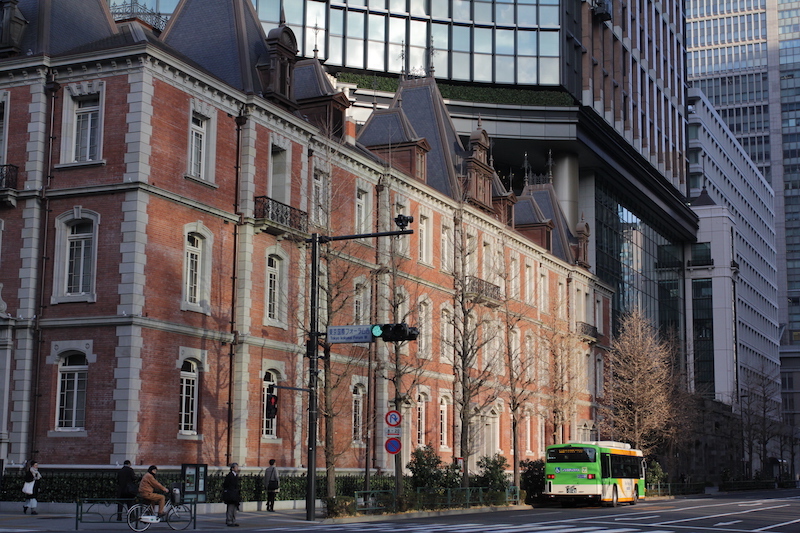
In 1894, Mitsubishi Building No. 1 was completed as the first office building. British-style brick architecture modeled after London's office districts was adopted, but rental management struggled under the poor location conditions with Tokyo Station not yet open. From 1894 to 1896, buildings up to No. 3 were completed, but no new construction took place for the next nine years, and most of the vast site remained wasteland. Full-scale development began from 1904 onward, and by 1918, 19 office buildings up to Building No. 26 were completed, forming the red-brick district.
When Tokyo Station opened in 1914, the location conditions of Marunouchi dramatically improved. The Mitsubishi zaibatsu accelerated development of zones close to Tokyo Station, and in 1923, the modern Marunouchi Building was completed in front of Tokyo Station. Approximately 30 years elapsed from the purchase to the completion of the Marunouchi Building, making it a real estate investment premised on ultra-long-term returns. As of the fiscal year ending March 2024, Mitsubishi Estate's Marunouchi business generates annual operating revenue of 380 billion yen, and the investment criticized as profitless at the time of purchase has materialized into Japan's largest office business.
The Marunouchi purchase was the largest real estate investment in Mitsubishi zaibatsu history and became a pioneering case in Japanese urban development. The wasteland acquired under the pretext of maintaining government relations was transformed into one of Japan's premier business districts through external environmental changes—the opening of Tokyo Station and the spread of corporate organizations. The fact that Mitsubishi zaibatsu's capital strength could tolerate 30 years of losses was the key condition that made this investment viable. As a result, Marunouchi became the core of Mitsubishi Estate's business foundation and has continued to generate revenue for over 130 years.
The structural characteristic of the Marunouchi purchase is that wasteland judged unprofitable by the market was acquired under the pretext of maintaining government relations and transformed into an office district over 30 years. Before the opening of Tokyo Station, the market assessment of zero bidders was rational. The only condition that made this ultra-long-term investment possible was Mitsubishi zaibatsu's ability to continue absorbing losses with revenue from its core businesses of heavy industry and trade. It stands as an extreme example of advance investment from the perspective of time horizon design in real estate development.
In October 1889, the government entrusted the City of Tokyo with putting the Marunouchi land up for bidding. (...) Five or six prominent zaibatsu were persuaded to bid, but because the land use value of Marunouchi was so low, nobody would bid at 1.5 million yen. As a last resort, through Finance Minister Masayoshi Matsukata, the purchase was urged upon Mitsubishi company president Yanosuke Iwasaki.
This happened to be just after the 1890 recession, and Mitsubishi was also greatly troubled, but the bold and broad-minded Yanosuke Iwasaki sympathized with the government's plight and resolutely accepted the offer. The date was March 6, 1890. However, even for Mitsubishi, a one-time payment was simply impossible, so the contract was concluded with the condition of eight payments over 13 months.
When word of Yanosuke's bold decision spread, the public was surprised, but those associated with Mitsubishi were even more surprised, questioning what on earth was the purpose of buying such useless land at such a high price, and criticizing the recklessness. Yanosuke calmly responded, 'I'll plant bamboo and keep tigers.' Whether the vision of today's Marunouchi was actually drawn in Yanosuke's mind at that time is impossible to know, but one can imagine that he had considerable confidence in his plans.
Completion of Mitsubishi Building No. 1 and the development of the red-brick district
The fact that Mitsubishi Goshi Kaisha positioned Marunouchi development as "miscellaneous duties" and did not establish a dedicated department for 16 years succinctly demonstrates that real estate operations were peripheral within the Mitsubishi zaibatsu's management. The approach of forming an office district step by step over 30 years, with a nine-year construction hiatus in between, was a development model unique to Mitsubishi—accepting demand uncertainty while absorbing losses with core business revenues. The opening of Tokyo Station served as the decisive factor for location improvement, prompting the transition from red-brick to RC construction.
BackgroundMitsubishi Goshi Kaisha began Marunouchi office district development as a peripheral business
In 1893, the Mitsubishi zaibatsu established Mitsubishi Goshi Kaisha, positioning trade-centered operations as the core business. The office district development of Marunouchi was treated as one of the "miscellaneous duties" handled by Mitsubishi Goshi Kaisha, and construction proceeded sporadically without a dedicated department. The "Real Estate and Supplies Division" responsible for real estate operations was not established until 1906—16 years after the purchase of Marunouchi and 12 years after the completion of Mitsubishi Building No. 1. Real estate development continued to be positioned as a secondary business within the Mitsubishi zaibatsu's management.
Four years after the Marunouchi purchase, in 1894, Mitsubishi Goshi Kaisha completed Mitsubishi Building No. 1 as its first office building. British-style brick architecture modeled after London's office districts was adopted. The site was selected along "Babasaki-mon Dori," which offered relatively high transportation convenience via streetcars. However, tenant recruitment struggled due to the fundamental disadvantage of Tokyo Station not yet being open, combined with the fact that corporate organizations were undeveloped in Japan and the salaried worker lifestyle was not yet common.
From 1894 to 1896, Mitsubishi Goshi Kaisha completed three buildings from No. 1 through No. 3. However, due to weak demand, no new construction took place for nine years from 1896 to 1904. During this period, most of the vast purchased Marunouchi site remained abandoned as the "Mitsubishi Meadow," far from being an office district. For the Mitsubishi zaibatsu, real estate was not a core business, and the policy was to secure revenue from heavy industry and trade while preserving Marunouchi as a long-term development target.
DecisionIntensively completed red-brick building clusters to form the Marunouchi office district
Mitsubishi Goshi Kaisha's full-scale development of Marunouchi began from 1904 onward. From 1904 to 1918, 19 office buildings from No. 4 through No. 26 were completed in concentrated succession. Of these, buildings up to No. 15, completed in 1912, were two- to three-story British-style red-brick buildings, and these formed the red-brick district centered on Babasaki-mon Dori. A streetscape modeled after London's office districts appeared in Marunouchi, giving concrete form to the vision of "a London" that Mitsubishi Goshi Kaisha aspired to.
With advances in construction technology, from Building No. 19 (completed in 1914) onward, construction transitioned to three- to four-story RC (reinforced concrete) or SRC (steel-reinforced concrete) structures. The transition from red-brick to RC/SRC construction was an innovation that achieved both earthquake resistance and floor space expansion. In Marunouchi, a streetscape emerged where red-brick buildings and RC structures coexisted, reflecting the transitional period of construction technology from the late Meiji to the early Taisho era.
Mitsubishi Goshi Kaisha's development of Marunouchi spanned approximately 30 years. The development pace was gradual due to the absence of a dedicated department and the management priority given to core businesses, with an approach of investing sporadically while monitoring demand trends. The approach of forming an office district step by step over 30 years, rather than in one sweeping effort, was premised on the Mitsubishi zaibatsu's capital strength and long-term perspective.
ResultThe opening of Tokyo Station fundamentally improved Marunouchi's location conditions
In 1914, the government railway (later JNR/JR) opened Tokyo Station in Marunouchi as a central station. At the time of opening, the Yamanote Line loop service had not yet started and the station functioned only as the terminal of the Tokaido Main Line, but it became a turning point that transformed Marunouchi's location conditions. Twenty-four years after the purchase, Marunouchi acquired the conditions of an office location directly connected to a railway station, and Mitsubishi Goshi Kaisha accelerated development of zones close to Tokyo Station.
With the opening of Tokyo Station, in addition to the Babasaki-mon district where the traditional red-brick district was located, modern office building construction also progressed in the area in front of Tokyo Station. Through the Taisho era, the salaried worker lifestyle began to spread, and demand for office space was steadily expanding. Mitsubishi Goshi Kaisha shifted its policy from London-inspired red-brick architecture to large-scale modern office buildings modeled after American building clusters.
In 1923, the Marunouchi Building was completed in front of Tokyo Station, and Marunouchi established its status as a modern office district. The Marunouchi Building was a large-scale office building without precedent in Japan at the time and became an icon of Taisho-era architecture. From the completion of Mitsubishi Building No. 1 (1894) to the completion of the Marunouchi Building (1923), over approximately 30 years, Marunouchi was transformed step by step from wasteland dotted with small red-brick offices into an office district lined with modern buildings.
The fact that Mitsubishi Goshi Kaisha positioned Marunouchi development as "miscellaneous duties" and did not establish a dedicated department for 16 years succinctly demonstrates that real estate operations were peripheral within the Mitsubishi zaibatsu's management. The approach of forming an office district step by step over 30 years, with a nine-year construction hiatus in between, was a development model unique to Mitsubishi—accepting demand uncertainty while absorbing losses with core business revenues. The opening of Tokyo Station served as the decisive factor for location improvement, prompting the transition from red-brick to RC construction.
Completion of the Marunouchi Building
The significance of the Marunouchi Building's completion lies in Mitsubishi's shift in architectural philosophy from London-inspired red-brick to American-style large-scale office buildings. The opening of Tokyo Station improved location conditions, and the spread of salaried worker culture made office demand manifest, triggering the transition. The completion 33 years after the Marunouchi purchase embodies Mitsubishi's development philosophy of restraining investment when demand did not exist and pivoting to large-scale investment once conditions were right.
BackgroundThe opening of Tokyo Station and growing office demand in the Taisho era necessitated modern buildings
When Tokyo Station opened in 1914, Marunouchi's transportation convenience improved dramatically. Although initially functioning only as the terminal station of the Tokaido Main Line with no connections to the Ueno direction, the establishment of the railway station gave Marunouchi the conditions of a key urban transportation hub for the first time. As the Taisho era progressed, the salaried worker lifestyle began to spread with the rise of trading companies, and demand was growing for offices where companies could consolidate their headquarters functions.
The Mitsubishi zaibatsu shifted its approach to Marunouchi office development in response to Tokyo Station's opening. Where it had previously aspired to two- to three-story red-brick buildings modeled after London, through the Taisho era it increasingly looked to American modern building clusters as the model for large-scale office construction. Red-brick buildings had limits in expanding floor space, and building enlargement was essential to accommodate growing office demand.
DecisionCompleted the Marunouchi Building in front of Tokyo Station, establishing it as the district's icon
In 1923, the Mitsubishi zaibatsu completed the "Marunouchi Building" (the first-generation Maru Building) in front of Tokyo Station. It was a full-scale large office building without precedent in an era when small-scale red-brick buildings were the norm, and it became an iconic building symbolizing the Taisho era. Leveraging its prime location in front of Tokyo Station, the Marunouchi Building's completion marked the beginning of Marunouchi's establishment as Japan's premier office district.
The completion of the Marunouchi Building, 33 years after the purchase of Marunouchi (1890), represented the culmination of the modern office development. After the formation period of the red-brick district beginning with Mitsubishi Building No. 1 (completed 1894), modern building construction responded to growing demand following the opening of Tokyo Station. The Marunouchi Building subsequently continued to function as Marunouchi's landmark and became an iconic presence of Mitsubishi's office leasing business.
The significance of the Marunouchi Building's completion lies in Mitsubishi's shift in architectural philosophy from London-inspired red-brick to American-style large-scale office buildings. The opening of Tokyo Station improved location conditions, and the spread of salaried worker culture made office demand manifest, triggering the transition. The completion 33 years after the Marunouchi purchase embodies Mitsubishi's development philosophy of restraining investment when demand did not exist and pivoting to large-scale investment once conditions were right.
Mitsubishi Estate Co., Ltd. established
The establishment and relaunch of Mitsubishi Estate demonstrate the impact that zaibatsu organizational structure and postwar institutional changes had on the real estate business. Mitsubishi Estate, which was spun off from a division of Mitsubishi Goshi Kaisha, was split into three companies during zaibatsu dissolution, but the external threat of stock accumulation targeting Yowa Real Estate triggered reintegration. The re-merger just three years after the split confirms that integrated management of Marunouchi as an asset was an indispensable precondition for business operations. The early reintegration, contrary to the policy intent of zaibatsu dissolution, was the result of the economic rationality of real estate asset consolidation overriding institutional constraints.
BackgroundSpun off the office leasing department of Mitsubishi Goshi Kaisha to establish a new company
To fully develop and expand its office development and leasing business in Marunouchi, the Mitsubishi zaibatsu (Mitsubishi Goshi Kaisha) established Mitsubishi Estate Co., Ltd. as a new company in May 1937. The office leasing business, which had been operated as the Real Estate and Supplies Division of Mitsubishi Goshi Kaisha, was carved out, and the land and buildings of the Marunouchi area were transferred to the new company to make it independent. While real estate had long been a peripheral business for the Mitsubishi zaibatsu, as Marunouchi development progressed and the business scale expanded, management by an independent corporate organization became necessary.
Mitsubishi Estate established a system for centrally managing and operating the land and buildings of Marunouchi, and was launched as a company dedicated to the Mitsubishi zaibatsu's office leasing business. Following the completion of the Marunouchi Building in 1923, Marunouchi's office building complex continued to expand, and numerous buildings from the red-brick era through modern buildings became management targets. By centrally managing these assets, the company aimed to improve the efficiency of leasing operations and established its business foundation as an office leasing specialist.
DecisionThrough a three-company split during zaibatsu dissolution and relaunching Mitsubishi Estate in 1953
After the end of World War II in 1945, pursuant to GHQ's zaibatsu dissolution policy, Mitsubishi Estate was split into three companies under the Corporate Restructuring Act in 1950. Mitsubishi Estate, Yowa Real Estate, and Kanto Real Estate were established from the former Mitsubishi Estate, and Marunouchi assets were divided and transferred to each company. During the postwar turmoil, the cohesion of the Mitsubishi group weakened, and the real estate business was forced to operate under a dispersed structure.
When Yowa Real Estate was subsequently targeted by an external stock accumulation campaign, momentum for reintegration grew within the Mitsubishi group. In 1953, Mitsubishi Estate, Yowa Real Estate, and Kanto Real Estate merged, and Mitsubishi Estate was relaunched. This reintegration came just three years after the zaibatsu dissolution split, and the system for centrally managing Marunouchi assets was restored. Through this relaunch, Mitsubishi Estate reestablished its management system for the Marunouchi-based office leasing business.
The establishment and relaunch of Mitsubishi Estate demonstrate the impact that zaibatsu organizational structure and postwar institutional changes had on the real estate business. Mitsubishi Estate, which was spun off from a division of Mitsubishi Goshi Kaisha, was split into three companies during zaibatsu dissolution, but the external threat of stock accumulation targeting Yowa Real Estate triggered reintegration. The re-merger just three years after the split confirms that integrated management of Marunouchi as an asset was an indispensable precondition for business operations. The early reintegration, contrary to the policy intent of zaibatsu dissolution, was the result of the economic rationality of real estate asset consolidation overriding institutional constraints.
Takejiro Watanabe became president
Watanabe's achievement was transforming the red-brick district into a modern office district, but his opposition to high-rises constrained Marunouchi's vertical development for an extended period. He continued to wield influence for 45 years after stepping down as president until his death at age 103, and the Maru Building reconstruction did not progress until two years before his death. The duality of revitalizing the red-brick district while resisting skyscrapers demonstrates a typical structure where the 'ossification of success experience' under long-term leadership constrains the management decisions of the next generation.
BackgroundA rank-and-file veteran employee became president of Mitsubishi Estate
In 1952, Takejiro Watanabe assumed the presidency of Mitsubishi Estate. Watanabe was a veteran employee who had risen through the ranks at Mitsubishi Estate, with years of hands-on experience in Marunouchi office development. After becoming president, Watanabe led the "Marunouchi Comprehensive Renovation Plan" starting in 1959, driving the redevelopment that would transform Marunouchi—where small Meiji-era red-brick offices were densely clustered—into a modern office district. For this achievement, Watanabe came to be called the "reviver" of Mitsubishi Estate.
The background to Watanabe's urgency to redevelop was the rejection of red-brick buildings by Western tenants. By the 1950s, an image was becoming established in Western countries that associated brick buildings with slums, and Western companies leasing space in Marunouchi began showing aversion to red-brick offices. Shaken by this situation, Watanabe decided on a comprehensive rebuilding of Marunouchi's red-brick buildings, formulating a plan to replace all Meiji-era buildings with modern offices.
DecisionOpposed high-rise construction and maintained Marunouchi's 31-meter streetscape
In the redevelopment of Marunouchi, Watanabe consistently maintained a reluctant stance toward the construction of skyscrapers. His opposition was based on aesthetic grounds—that they would overlook the Imperial Palace—and he upheld the policy of unifying Marunouchi's streetscape with mid-rise buildings of 31 meters. When competitor Mitsui Fudosan completed Japan's first skyscraper, the Kasumigaseki Building, in 1968, Mitsubishi Estate fell behind Mitsui in high-rise building development.
When Tokyo Marine, whose plot was adjacent to Mitsubishi Estate's Shin-Maru Building, planned to build a high-rise for its own headquarters, Watanabe strongly requested the cancellation of the plan. However, Tokyo Marine dismissed Mitsubishi Estate's request, noting that it was a reconstruction of their own building, and completed the Tokyo Marine Building in 1974. This "aesthetic debate" escalated into a discussion that engulfed the construction industry and the Tokyo Metropolitan Government, becoming a social issue regarding the appropriateness of high-rise buildings in Marunouchi.
ResultWatanabe's influence constrained Marunouchi's high-rise development for an extended period
In 1969, Watanabe stepped down as president to become chairman, but continued to be involved in Mitsubishi Estate's management thereafter. He became director and senior advisor in 1974, then senior advisor in 1988, and exerted influence over Mitsubishi Estate's decision-making for approximately 45 years until his death at age 103 in 1997. During this period, progress on the Maru Building reconstruction plan (high-rise conversion) was extremely slow, and it is estimated that Watanabe's anti-skyscraper stance was reflected in management decisions.
Watanabe's tenure greatly enhanced the value of Marunouchi in terms of modernizing the red-brick district. However, by continuing to avoid skyscraper construction, Mitsubishi Estate fell behind Mitsui Fudosan in high-rise development, resulting in opportunity costs from the perspective of floor space expansion and tenant revenue maximization. The formal announcement of the Maru Building reconstruction came in 1995, two years before Watanabe's death, raising questions about the merits and demerits of his long-term leadership.
Watanabe's achievement was transforming the red-brick district into a modern office district, but his opposition to high-rises constrained Marunouchi's vertical development for an extended period. He continued to wield influence for 45 years after stepping down as president until his death at age 103, and the Maru Building reconstruction did not progress until two years before his death. The duality of revitalizing the red-brick district while resisting skyscrapers demonstrates a typical structure where the 'ossification of success experience' under long-term leadership constrains the management decisions of the next generation.
Formulated the Marunouchi Comprehensive Renovation Plan
The structural characteristic of the Marunouchi Comprehensive Renovation Plan is that it simultaneously achieved the modernization of the deteriorated red-brick district and the restoration of cohesion for the Mitsubishi group weakened by zaibatsu dissolution. By preferentially leasing new buildings to group companies, Marunouchi functioned as an apparatus that physically underpinned the group's cohesion. However, the 31-meter height restriction was based on President Watanabe's aesthetic views, and also had the aspect of deferring adaptation to the skyscraper era.
BackgroundDuring the period of high economic growth, the aging of red-brick buildings became a constraint on office supply
In the 1950s, as the Japanese economy entered a period of high growth, office demand expanded rapidly. The Babasaki-mon district of Marunouchi was densely clustered with British-style red-brick offices built during the Meiji era, but the small two- to three-story buildings had limited floor space and became a bottleneck unable to accommodate growing tenant demand. The red-brick buildings had been standing for more than 60 years, and deterioration was progressing, with their facilities also failing to meet the requirements of a modern office.
Additionally, by the 1950s, an image was becoming established in Western countries that associated red-brick buildings with "slums," and Western companies tenanting in Marunouchi began showing aversion to red-brick offices. President Takejiro Watanabe was shocked by this situation and decided on a comprehensive redevelopment of the red-brick district. A drastic response of replacing all Meiji-era buildings with modern buildings was unavoidable in order to revive Marunouchi as an internationally competitive office district.
DecisionFormulated the 'Marunouchi Comprehensive Renovation Plan' targeting all red-brick buildings
In 1959, Mitsubishi Estate formulated the "Marunouchi Comprehensive Renovation Plan." It was a redevelopment plan to demolish all remaining Meiji-era red-brick buildings in Marunouchi and rebuild them as a cluster of mid-rise buildings with a unified height of 31 meters. From 1959 through the late 1960s, red-brick buildings were sequentially demolished, and Marunouchi's streetscape was transformed into a uniformly modern office building district. The background to unifying building heights at 31 meters was President Watanabe's policy of avoiding skyscraper construction that would overlook the Imperial Palace.
The newly constructed buildings were preferentially leased to Mitsubishi group companies. There was an intent to restore the cohesion of the Mitsubishi group, which had been weakened by zaibatsu dissolution, using the Marunouchi office district as the nucleus. With Mitsubishi group companies including Mitsubishi Bank, Mitsubishi Corporation, and Mitsubishi Heavy Industries establishing offices in Marunouchi, inter-group coordination was physically strengthened. Marunouchi came to function as a "place" that underpinned the centripetal force of the Mitsubishi group.
ResultModernized Marunouchi at the cost of deferring adaptation to the skyscraper era
The execution of the Marunouchi Comprehensive Renovation Plan completely transformed Marunouchi from a Meiji-era red-brick district into a modern office district. The unified 31-meter streetscape formed an orderly landscape, solidifying its status as Japan's premier business district. The preferential leasing to Mitsubishi group companies stabilized the tenant base, and Mitsubishi Estate's office leasing revenue grew steadily.
On the other hand, the 31-meter height restriction constrained floor space expansion in Marunouchi. When Mitsui Fudosan completed the high-rise Kasumigaseki Building in 1968, Mitsubishi Estate fell behind its competitor in high-rise development. The Marunouchi Comprehensive Renovation Plan addressed the modernization of the red-brick district but also resulted in deferring the next challenge of adapting to the skyscraper era.
The structural characteristic of the Marunouchi Comprehensive Renovation Plan is that it simultaneously achieved the modernization of the deteriorated red-brick district and the restoration of cohesion for the Mitsubishi group weakened by zaibatsu dissolution. By preferentially leasing new buildings to group companies, Marunouchi functioned as an apparatus that physically underpinned the group's cohesion. However, the 31-meter height restriction was based on President Watanabe's aesthetic views, and also had the aspect of deferring adaptation to the skyscraper era.
The discussion about renovating the red-brick buildings in the central area had been going on for quite some time. The planning at that time was based on a plot division suited to the Japanese economy of some year in the Meiji era, rather than the current urban planning approach, so there is one road between each of the East, Middle, and West streets. Since the Middle Street is narrow now, the plan was to take out one road on each side, widen the Middle Street by two ken on each side—four ken total—determine the builders, get approval from the metropolitan government, and start with the easiest building first, which was the Chiyoda Building beside Meiji Life Insurance. Since people are occupying the buildings, constructing new ones takes quite a bit of time, but that is the plan we have.
Tokyo Marine building reconstruction controversy
The essence of the aesthetic debate was the question of the scope of Mitsubishi Estate's authority to control Marunouchi's landscape. The company objected to the reconstruction of a building on land it did not own, but could not override the freedom to develop based on property rights. The policy of maintaining a 31-meter streetscape was grounded in Mitsubishi Estate's aesthetic views, but its limits were exposed in the face of the skyscraper era and other companies' development rights. There is also irony in the fact that land sold by Mitsubishi Goshi before the war to Tokyo Marine became the stage for the controversy.
BackgroundThe arrival of the skyscraper era through Building Standards Act amendments left Mitsubishi Estate behind
In the 1960s, advances in computer-aided structural calculations led to amendments to the Building Standards Act, enabling skyscraper construction in Japan. When Mitsui Fudosan completed Japan's first skyscraper, the Kasumigaseki Building, in April 1968, Mitsubishi Estate found itself significantly behind in high-rise development. While Mitsubishi Estate had unified Marunouchi with 31-meter mid-rise buildings through the Marunouchi Comprehensive Renovation Plan, the arrival of the skyscraper era called the validity of this policy into question.
Tokyo Marine, which owned land adjacent to Mitsubishi Estate's Shin-Maru Building, announced plans to rebuild its aging Taisho-era headquarters into a high-rise. This land had originally been owned by Mitsubishi Goshi Kaisha but was sold to Tokyo Marine before the war. Tokyo Marine's high-rise plan risked disrupting the unified 31-meter streetscape that Mitsubishi Estate had maintained, becoming the trigger for a conflict over Marunouchi's landscape.
DecisionTokyo Marine completed its high-rise building, overriding Mitsubishi Estate's opposition
Mitsubishi Estate strongly opposed Tokyo Marine's plan. It pointed out that a skyscraper appearing in Marunouchi, where the 31-meter streetscape was maintained, would overlook the Imperial Palace, and requested the cancellation of the plan. This controversy developed into the "aesthetic debate" that engulfed the construction industry and the Tokyo Metropolitan Government, becoming a social issue regarding building heights in Marunouchi.
However, for Tokyo Marine, it was a reconstruction of its own building, and there was no obligation to defer to Mitsubishi Estate's wishes. Tokyo Marine decided to proceed with the high-rise construction and completed the Tokyo Marine Building in 1974. As a concession to Mitsubishi Estate, the number of floors was reduced from the original plan. The limitations of Mitsubishi Estate's power to control Marunouchi's landscape were demonstrated, and the difficulty of continuing to avoid adaptation to the skyscraper era became apparent.
The essence of the aesthetic debate was the question of the scope of Mitsubishi Estate's authority to control Marunouchi's landscape. The company objected to the reconstruction of a building on land it did not own, but could not override the freedom to develop based on property rights. The policy of maintaining a 31-meter streetscape was grounded in Mitsubishi Estate's aesthetic views, but its limits were exposed in the face of the skyscraper era and other companies' development rights. There is also irony in the fact that land sold by Mitsubishi Goshi before the war to Tokyo Marine became the stage for the controversy.
Announced the first-generation Maru Building reconstruction plan (2002 Maru Building completion)
The primary reason the first-generation Maru Building reconstruction stalled for years was the difficulty of evicting 350 individual tenants. The possibility that Takejiro Watanabe's anti-skyscraper stance constrained management decisions cannot be ruled out. The 1995 Great Hanshin Earthquake provided a disaster prevention rationale for reconstruction, finally leading to the official announcement. The second-generation Maru Building incorporated commercial facilities under a new concept of creating a mixed-use urban district, and the redefinition of the formerly office-only Marunouchi is noteworthy.
BackgroundThe 70-year-old first-generation Maru Building's reconstruction stalled due to the barrier of 350 individual tenants
By the 1980s, the first-generation Marunouchi Building completed in 1923 in front of Tokyo Station was showing noticeable deterioration after more than 60 years. Mitsubishi Estate repeatedly formulated reconstruction plans, but eviction negotiations proved extremely difficult with 350 individual tenants including law firms occupying the building. Despite being situated on the most prime real estate in Japan in front of Tokyo Station, a deteriorating Taisho-era building was left standing, becoming the largest outstanding issue in Marunouchi's redevelopment.
The decisive factor for reconstruction was the Great Hanshin-Awaji Earthquake that struck in January 1995. The severe damage caused by the urban direct-hit earthquake heightened concerns about the seismic resistance of the first-generation Maru Building, which was more than 70 years old, and reconstruction discussions rapidly advanced from a disaster prevention perspective. In November 1995, Mitsubishi Estate officially announced the reconstruction of the first-generation Maru Building, and demolition began in 1997.
DecisionCompleted the second-generation Maru Building and redeveloped Marunouchi as a mixed-use urban district
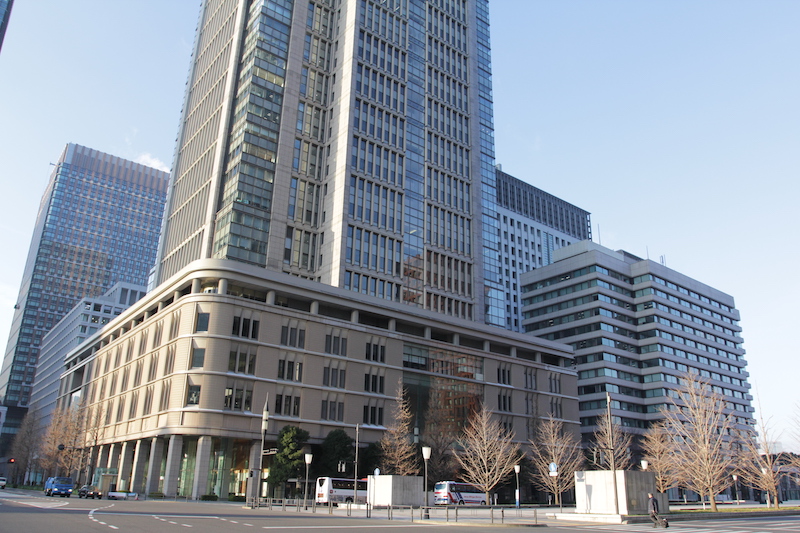
In 2002, Mitsubishi Estate completed the second-generation Marunouchi Building. While the first-generation Maru Building was a pure office building, the second generation was designed as a mixed-use building incorporating commercial facilities. Along with attracting commercial tenants to the main street of Nakadori, a policy was put forward to redevelop Marunouchi not only as a weekday office district but as a mixed-use urban area enjoyable on weekends as well.
The Maru Building reconstruction was a turning point for Mitsubishi Estate in intensifying land use in Marunouchi. Rebuilding as a high-rise significantly expanded floor space, and the combination with commercial facilities secured customer-drawing power throughout both weekdays and weekends. This represented a departure from the 31-meter mid-rise building cluster maintained by Takejiro Watanabe and marked the starting point for Mitsubishi Estate's full-scale embrace of high-rise development in Marunouchi.
The primary reason the first-generation Maru Building reconstruction stalled for years was the difficulty of evicting 350 individual tenants. The possibility that Takejiro Watanabe's anti-skyscraper stance constrained management decisions cannot be ruled out. The 1995 Great Hanshin Earthquake provided a disaster prevention rationale for reconstruction, finally leading to the official announcement. The second-generation Maru Building incorporated commercial facilities under a new concept of creating a mixed-use urban district, and the redefinition of the formerly office-only Marunouchi is noteworthy.
Launched Mitsubishi Jisho Residence; began The Parkhouse development
What is noteworthy in the process of establishing Mitsubishi Jisho Residence is that the transition from equity investment in Towa Real Estate (2005) to full subsidiary status (2009) was accelerated by the Lehman shock. What was initially management support as a minority shareholder rapidly progressed through the steps of capital increase subscription, consolidated subsidiary status, and full subsidiary status due to financial deterioration from the financial crisis. Mitsubishi Estate's strategic intent can be read in its decision to utilize the sudden change in external environment as an opportunity for business reorganization, pushing through to brand unification in one move.
BackgroundMitsubishi Estate invested in Towa Real Estate following its financial deterioration, eventually making it a subsidiary
Mitsubishi Estate invested in condominium developer Towa Real Estate in March 2005 to strengthen its residential sales business. Towa Real Estate had been listed on the Tokyo Stock Exchange since 1972, but around 2005 its performance had deteriorated and its equity ratio had declined to the 5% range. Mitsubishi Estate's investment had aspects of management support while also containing the strategic intent of expanding the scale of the residential sales business.
The Lehman Brothers shock of 2008 further worsened Towa Real Estate's performance and financial condition. In January 2008, Towa Real Estate implemented a capital increase with Mitsubishi Estate as the subscriber, making it a consolidated subsidiary. In April 2009, Mitsubishi Estate acquired 100% of the shares, making it a wholly owned subsidiary, and Towa Real Estate was delisted. The sudden change in external environment triggered by the Lehman shock accelerated the transition from equity investment to full subsidiary status.
DecisionEstablished Mitsubishi Jisho Residence and unified the residential sales brand
In January 2011, Mitsubishi Estate established Mitsubishi Jisho Residence as a wholly owned subsidiary. The residential businesses of Towa Real Estate, Mitsubishi Estate's housing division, and Mitsubishi Estate Real Estate Services' housing division were consolidated into the new company, building an integrated management system for the residential sales business. "The Parkhouse" was selected as the brand for condominium sales, inheriting and developing the existing "Park House" brand to enhance brand value.
The first property under The Parkhouse brand was "The Parkhouse Shiba-koen" (7 stories above ground), with sales scheduled for July 2011. The closest station was Kamiyacho Station on the Hibiya subway line, five minutes on foot, with planned selling prices centered around the 80 million yen range. The policy of focusing on central Tokyo locations to meet the need for living close to work was presented, and Mitsubishi Jisho Residence ramped up its condominium sales business centered on urban areas in Tokyo.
ResultThe Parkhouse became established as Mitsubishi Estate's residential sales brand
Through the 2010s, Mitsubishi Jisho Residence expanded its condominium sales business under The Parkhouse brand. The strategy of emphasizing central Tokyo locations aligned with the rising condominium market prices, building track records in both brand recognition and asset value. Within the Mitsubishi Estate group, the residential sales business gained increasing prominence as a revenue base second only to office leasing.
The process from the acquisition of Towa Real Estate to the establishment of Mitsubishi Jisho Residence was a case where an equity investment in a financially struggling company developed into full subsidiary status through the Lehman shock, ultimately culminating in a business reorganization through brand unification. Mitsubishi Estate established The Parkhouse in residential sales as a second business foundation, while maintaining the Marunouchi office leasing business as its core.
What is noteworthy in the process of establishing Mitsubishi Jisho Residence is that the transition from equity investment in Towa Real Estate (2005) to full subsidiary status (2009) was accelerated by the Lehman shock. What was initially management support as a minority shareholder rapidly progressed through the steps of capital increase subscription, consolidated subsidiary status, and full subsidiary status due to financial deterioration from the financial crisis. Mitsubishi Estate's strategic intent can be read in its decision to utilize the sudden change in external environment as an opportunity for business reorganization, pushing through to brand unification in one move.