| Period | Type | Revenue | Profit* | Margin |
|---|---|---|---|---|
| 1950/6 | Non-consol. Revenue / Net Income | - | - | - |
| 1951/6 | Non-consol. Revenue / Net Income | - | - | - |
| 1952/6 | Non-consol. Revenue / Net Income | - | - | - |
| 1953/6 | Non-consol. Revenue / Net Income | - | - | - |
| 1954/6 | Non-consol. Revenue / Net Income | - | - | - |
| 1955/6 | Non-consol. Revenue / Net Income | - | - | - |
| 1956/6 | Non-consol. Revenue / Net Income | - | - | - |
| 1957/6 | Non-consol. Revenue / Net Income | - | - | - |
| 1958/6 | Non-consol. Revenue / Net Income | - | - | - |
| 1959/6 | Non-consol. Revenue / Net Income | - | - | - |
| 1960/6 | Non-consol. Revenue / Net Income | - | - | - |
| 1961/6 | Non-consol. Revenue / Net Income | - | - | - |
| 1962/6 | Non-consol. Revenue / Net Income | - | - | - |
| 1963/6 | Non-consol. Revenue / Net Income | - | - | - |
| 1964/6 | Non-consol. Revenue / Net Income | - | - | - |
| 1965/6 | Non-consol. Revenue / Net Income | - | - | - |
| 1966/6 | Non-consol. Revenue / Net Income | - | - | - |
| 1967/6 | Non-consol. Revenue / Net Income | - | - | - |
| 1968/6 | Non-consol. Revenue / Net Income | - | - | - |
| 1969/6 | Non-consol. Revenue / Net Income | - | - | - |
| 1970/6 | Non-consol. Revenue / Net Income | - | - | - |
| 1971/6 | Non-consol. Revenue / Net Income | - | - | - |
| 1972/6 | Non-consol. Revenue / Net Income | - | - | - |
| 1973/6 | Non-consol. Revenue / Net Income | - | - | - |
| 1974/6 | Non-consol. Revenue / Net Income | - | - | - |
| 1975/6 | Non-consol. Revenue / Net Income | - | - | - |
| 1976/6 | Non-consol. Revenue / Net Income | ¥2.0T | ¥100B | 4.9% |
| 1977/6 | Non-consol. Revenue / Net Income | ¥2.3T | ¥117B | 5.1% |
| 1978/6 | Non-consol. Revenue / Net Income | ¥2.6T | ¥116B | 4.4% |
| 1979/6 | Non-consol. Revenue / Net Income | ¥2.8T | ¥102B | 3.6% |
| 1980/6 | Non-consol. Revenue / Net Income | ¥2.8T | ¥102B | 3.6% |
| 1981/6 | Non-consol. Revenue / Net Income | ¥3.3T | ¥144B | 4.3% |
| 1982/6 | Non-consol. Revenue / Net Income | ¥3.5T | ¥133B | 3.7% |
| 1983/6 | Consolidated Revenue / Net Income | ¥5.3T | ¥228B | 4.2% |
| 1984/6 | Consolidated Revenue / Net Income | ¥5.9T | ¥295B | 4.9% |
| 1985/6 | Consolidated Revenue / Net Income | ¥6.8T | ¥406B | 5.9% |
| 1986/6 | Consolidated Revenue / Net Income | ¥6.6T | ¥346B | 5.1% |
| 1987/6 | Consolidated Revenue / Net Income | ¥6.7T | ¥261B | 3.9% |
| 1988/6 | Consolidated Revenue / Net Income | ¥7.2T | ¥311B | 4.3% |
| 1989/6 | Consolidated Revenue / Net Income | ¥8.0T | ¥346B | 4.3% |
| 1990/6 | Consolidated Revenue / Net Income | ¥9.2T | ¥441B | 4.8% |
| 1991/6 | Consolidated Revenue / Net Income | ¥9.9T | ¥413B | 4.1% |
| 1992/6 | Consolidated Revenue / Net Income | ¥10T | ¥238B | 2.3% |
| 1993/6 | Consolidated Revenue / Net Income | ¥10T | ¥176B | 1.7% |
| 1994/6 | Consolidated Revenue / Net Income | ¥9.4T | ¥126B | 1.3% |
| 1995/3 | Consolidated Revenue / Net Income | ¥8.1T | ¥132B | 1.6% |
| 1996/3 | Consolidated Revenue / Net Income | ¥11T | ¥257B | 2.3% |
| 1997/3 | Consolidated Revenue / Net Income | ¥12T | ¥386B | 3.1% |
| 1998/3 | Consolidated Revenue / Net Income | ¥12T | ¥454B | 3.8% |
| 1999/3 | Consolidated Revenue / Net Income | ¥13T | ¥356B | 2.7% |
| 2000/3 | Consolidated Revenue / Net Income | ¥13T | ¥407B | 3.1% |
| 2001/3 | Consolidated Revenue / Net Income | ¥13T | ¥471B | 3.5% |
| 2002/3 | Consolidated Revenue / Net Income | ¥15T | ¥616B | 4.0% |
| 2003/3 | Consolidated Revenue / Net Income | ¥16T | ¥945B | 5.8% |
| 2004/3 | Consolidated Revenue / Net Income | ¥17T | ¥1.2T | 6.7% |
| 2005/3 | Consolidated Revenue / Net Income | ¥19T | ¥1.2T | 6.3% |
| 2006/3 | Consolidated Revenue / Net Income | ¥21T | ¥1.4T | 6.5% |
| 2007/3 | Consolidated Revenue / Net Income | ¥24T | ¥1.7T | 6.9% |
| 2008/3 | Consolidated Revenue / Net Income | ¥26T | ¥1.7T | 6.5% |
| 2009/3 | Consolidated Revenue / Net Income | ¥21T | -¥437B | -2.2% |
| 2010/3 | Consolidated Revenue / Net Income | ¥19T | ¥209B | 1.1% |
| 2011/3 | Consolidated Revenue / Net Income | ¥19T | ¥408B | 2.1% |
| 2012/3 | Consolidated Revenue / Net Income | ¥19T | ¥284B | 1.5% |
| 2013/3 | Consolidated Revenue / Net Income | ¥22T | ¥962B | 4.3% |
| 2014/3 | Consolidated Revenue / Net Income | ¥26T | ¥1.8T | 7.0% |
| 2015/3 | Consolidated Revenue / Net Income | ¥27T | ¥2.2T | 7.9% |
| 2016/3 | Consolidated Revenue / Net Income | ¥28T | ¥2.3T | 8.1% |
| 2017/3 | Consolidated Revenue / Net Income | ¥28T | ¥1.8T | 6.6% |
| 2018/3 | Consolidated Revenue / Net Income | ¥29T | ¥2.5T | 8.4% |
| 2019/3 | Consolidated Revenue / Net Income | ¥30T | ¥1.9T | 6.2% |
| 2020/3 | Consolidated Operating Revenue / Net Income (Parent) | ¥30T | ¥2.0T | 6.8% |
| 2021/3 | Consolidated Operating Revenue / Net Income (Parent) | ¥27T | ¥2.2T | 8.2% |
| 2022/3 | Consolidated Operating Revenue / Net Income (Parent) | ¥31T | ¥2.9T | 9.0% |
| 2023/3 | Consolidated Operating Revenue / Net Income (Parent) | ¥37T | ¥2.5T | 6.5% |
| 2024/3 | Consolidated Operating Revenue / Net Income (Parent) | ¥45T | ¥4.9T | 10.9% |
Toyoda Automatic Loom Works establishes an automobile division
In stark contrast to the cautious corporate culture that would later characterize the company, Toyota's founding was advanced through fait accompli, bypassing prior board approval. The capital came from selling loom patents to a British company, and Kiichiro conducted secret research in a corner of the factory for approximately three years. Internal opposition was suppressed through the founding family's stock control and President Risaburo's full commitment of funds. The automobile division grew to account for over 30% of total sales before being spun off, illustrating how the speed of decision-making was determined by governance structure.
A Background: Secretly funding automobile R&D with loom patent proceeds
The founding of Toyota Motor traces back to 1933, when Toyoda Automatic Loom Works established an automobile division within the company. Behind this move was Kiichiro Toyoda, a member of the founding family, who had recognized the potential of the automobile industry early on.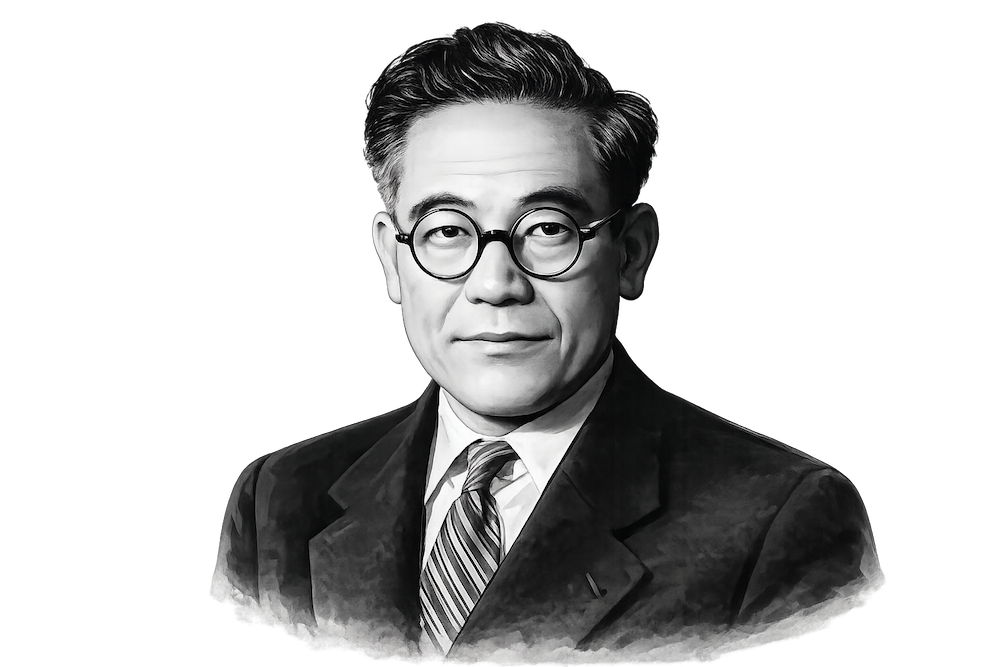 Based in Aichi Prefecture, Toyoda Automatic Loom Works had already established a solid business foundation manufacturing automatic looms for textile factories, but Kiichiro had a strong interest in automobiles as the next frontier of mechanical engineering.
In 1929, Toyoda Automatic Loom Works sold its automatic loom patents to a British company and decided to allocate the proceeds to automobile research and development. From 1930 onward, Kiichiro spent approximately three years conducting research into the market potential and technical feasibility of automobiles, but these activities were carried out with extreme caution to prevent the company's intentions from leaking internally or externally.
According to the 'Toyoda Automatic Loom Works 40-Year History,' automobile research was conducted as Kiichiro's personal project in a corner of the factory, and mass production and precision technologies were proactively adopted even at levels considered excessive for loom manufacturing at the time. President Risaburo Toyoda provided the financial backing for these efforts, generously channeling profits from the company and its affiliates into the automobile venture.
B Decision: Establishing the automobile division before board approval to create a fait accompli
In 1933, Toyoda Automatic Loom Works established an automobile division as a new internal business, marking what is considered the founding moment of Toyota Motor. In October of the same year, the company imported an American Chevrolet passenger car and began full-scale automobile development research through disassembly and analysis.
At the time in Japan, automobiles represented a complex assembly of advanced technologies centered on engines, with many unknown technical domains including materials development, presenting significant barriers to domestic production. Meanwhile, within Toyoda Automatic Loom Works, the evaluation of the automobile venture was not entirely favorable. While the stable core business of loom manufacturing could absorb losses, there was pushback against diverting those profits to the new venture.
In fact, formal approval for entering the automobile business was not granted until the extraordinary shareholders' meeting in January 1934. Kiichiro had first launched the division and advanced development, then obtained board and shareholder approval afterward. This approach was possible because the automobile venture was a founding family-led initiative, and as a result, the new business advanced as a fait accompli.
C Result: From prototype completion through Kariya factory construction to independence as Toyota Motor Co.
After approximately two years of development, the A1 prototype passenger car was completed in May 1935. However, domestic demand at the time centered on military-use trucks rather than passenger cars, and Toyota gradually shifted its focus to developing and mass-producing four-wheeled trucks.
In November 1935, the G1 truck was unveiled, and efforts to build a mass production system accelerated. Toyoda Automatic Loom Works borrowed approximately 48,000 tsubo of land owned by Chuo Boseki for automobile production and established the Kariya Automobile Assembly Plant in May 1936. This secured a dedicated production base for automobiles, significantly improving production capacity and efficiency.
Until Toyota Motor Co., Ltd. was spun off as a separate company in August 1937, the automobile business operated as a division of Toyoda Automatic Loom Works, but production and sales scale steadily expanded during this period. By fiscal year 1937, the automobile business accounted for over 30% of Toyoda Automatic Loom Works' total sales, and Toyota's founding process can be characterized as an example of a 'proactive investment-type new business' that used existing business revenues as capital to venture into a new industry.
In stark contrast to the cautious corporate culture that would later characterize the company, Toyota's founding was advanced through fait accompli, bypassing prior board approval. The capital came from selling loom patents to a British company, and Kiichiro conducted secret research in a corner of the factory for approximately three years. Internal opposition was suppressed through the founding family's stock control and President Risaburo's full commitment of funds. The automobile division grew to account for over 30% of total sales before being spun off, illustrating how the speed of decision-making was determined by governance structure.
Until the time was ripe, the utmost care was taken to ensure that these intentions did not leak externally, and all research and investigation related to automobiles was conducted secretly in a corner of the factory as Kiichiro's personal research. Furthermore, mass production and precision technologies necessary for the automobile business were adopted to the greatest extent possible, even those considered excessive for textile machine manufacturing, and their implementation was quietly pursued. In December 1929, a contract was concluded to transfer the automatic loom patents to the British firm Platt Brothers, and when the transfer proceeds came into Kiichiro's hands, research funds became abundant, and from this point research progressed rapidly. (...)
It goes without saying that Kiichiro's determination owed much to the support of President Risaburo Toyoda. The procurement of the enormous funds required by the automobile business was entirely handled by Risaburo, who, as president of both our company and Toyoda Boshoku, generously invested much of the profits earned by each company into the automobile venture.
Toyota Motor Co., Ltd. established
In 1936, the Japanese government decided on a policy to promote domestic automobile production for military expansion and selected the automobile division of Toyoda Automatic Loom Works as a recipient of government subsidies. In response, Toyota Motor Co., Ltd. was established in 1937.
Headquarters factory completed
As the automobile assembly plant (Kariya) that had been in operation since the Toyoda Automatic Loom Works era became too small, the decision was made to relocate and build a new factory. In response to an invitation from Koromo Town (now Toyota City), approximately 2 million square meters of land was acquired as factory grounds in 1935 — 50 times the scale of the existing Kariya Automobile Assembly Plant.
In November 1938, the Koromo Plant (now the headquarters factory) was completed, and mass production of four-wheeled automobiles, primarily trucks, began.
Three factories spun off (DENSO founded)
What deserves attention is the severity of Nippon Denso's founding conditions. Use of the Toyota trade name was prohibited, repayment of 140 million yen in debt was demanded, and workforce reductions were forced immediately after establishment. This distancing paradoxically fostered independence and led to unique technology accumulation through the Bosch technical partnership. The result of spinning off the electrical equipment business that the finished vehicle manufacturer could no longer handle was the emergence of a highly specialized parts manufacturer and the formation of a division of labor between vehicle assembly and components. This is a paradoxical structure where unintended specialization became a source of competitive advantage.
A Background: War reparation cuts and the Enterprise Reconstruction Act forced Toyota to restructure
In the immediate aftermath of World War II, the 'Special Measures for War Reparations Act' and the 'Enterprise Reconstruction and Reorganization Act' were promulgated in 1946, aimed at transitioning from a wartime to a peacetime economy. The termination of war reparations caused the financial positions of many major companies to deteriorate sharply, and corporate restructuring and spin-offs were being pursued under the reconstruction act.
Toyota Motor Co., Ltd. was no exception. Having been involved in military production, the company was keenly aware of the possibility of being designated for dissolution under the reconstruction act. Combined with restrictions such as designation as a restricted company or an excessively concentrated enterprise, the paramount challenge was how to ensure the parent company's survival and achieve early management independence under the harsh postwar regulatory environment.
When the designation as an excessively concentrated enterprise was lifted in January 1949, Toyota began formulating its reconstruction plan in earnest. The basic policy was to preserve Toyota Motor Co. as the surviving entity and carry out restructuring within the minimum scope permitted by the reconstruction act. As part of this plan, the concept of spinning off some domestic factories as second companies took concrete shape.
B Decision: Spinning off three underperforming factories (electrical equipment, textiles, enamelware) as separate companies
The factories targeted for spin-off were the electrical equipment factory and Kariya South Plant in Kariya City, and the Nakagawa Plant in Nakagawa Ward, Nagoya. The electrical equipment factory manufactured automotive electrical components and radiators, the Kariya South Plant handled textile operations, and part of the Nakagawa Plant produced enamelware.
These factories were not necessarily core operations within Toyota Motor Co. and faced challenges in profitability and business prospects. Toyota therefore decided to spin off the electrical equipment factory as Nippon Denso Co., Ltd., the Kariya South Plant as Minsei Spinning Co., Ltd., and the enamelware division of the Nakagawa Plant as Aichi Horo Co., Ltd.
This reconstruction plan was submitted to the government in April 1949 and approved in November of the same year. On December 16, 1949, Nippon Denso Co., Ltd. and Aichi Horo Co., Ltd. were established through Toyota's in-kind contributions, and Minsei Spinning Co., Ltd. was launched in May 1950. Notably, Nippon Denso inherited the unprofitable electrical equipment business and personnel that had become unmanageable for Toyota, and was established under the harsh condition that it was not permitted to use the Toyota trade name.
C Result: Nippon Denso grew into a core group company through Korean War demand and Bosch partnership
Nippon Denso faced severe management challenges from its inception and implemented large-scale workforce reductions in 1950. However, the Korean War special procurement boom that erupted shortly thereafter provided a tailwind, and the company found a path to recovery against the backdrop of expanding demand for electrical components. In addition to its original dynamo and other electrical component businesses, Nippon Denso introduced advanced technologies such as fuel injection pumps through a technical partnership with Germany's Bosch in 1953, steadily expanding its business domains.
Subsequently, Nippon Denso broadened its product lineup to include ignition systems, instrumentation, cooling and air conditioning components, and grew as a parts manufacturer supplying not only Toyota but other automakers as well. Eventually renamed DENSO, it developed into a core company of the Toyota Group. Meanwhile, Minsei Spinning later became Toyota Boshoku and increasingly focused on automotive parts, establishing itself as an important member of the group.
Aichi Horo, which inherited the former Nakagawa Plant, was liquidated within a short period, though the business itself was transferred to successor companies. Including these varied outcomes, the 1949 spin-off of three factories was not mere organizational cleanup for Toyota but a painful decision staking the company's management independence and survival.
As a result, this separation supported the reconstruction of Toyota Motor Co. while simultaneously serving as the starting point for the formation of the Toyota Group in later years. The founding of Nippon Denso, in particular, foreshadowed the division of labor between finished vehicle manufacturers and highly specialized parts manufacturers, and is regarded as a critical turning point that underpinned Toyota's postwar competitiveness.
| Former factory | Successor company | Established | Notes |
| Electrical Equipment Factory (Kariya) | DENSO | Dec 16, 1949 | Grew as a parts manufacturer |
| Kariya South Plant (Kariya) | Toyota Boshoku | May 15, 1950 | Grew as a parts manufacturer |
| Nakagawa Plant (Nagoya) | Aichi Horo | Dec 16, 1949 | Went bankrupt in 1951 |
- Former factory
- Electrical Equipment Factory (Kariya)
- Successor company
- DENSO
- Established
- Dec 16, 1949
- Notes
- Grew as a parts manufacturer
What deserves attention is the severity of Nippon Denso's founding conditions. Use of the Toyota trade name was prohibited, repayment of 140 million yen in debt was demanded, and workforce reductions were forced immediately after establishment. This distancing paradoxically fostered independence and led to unique technology accumulation through the Bosch technical partnership. The result of spinning off the electrical equipment business that the finished vehicle manufacturer could no longer handle was the emergence of a highly specialized parts manufacturer and the formation of a division of labor between vehicle assembly and components. This is a paradoxical structure where unintended specialization became a source of competitive advantage.
Since we had come to have a connection with electrical equipment, I resolved to take it on and try running it. When I looked at the handover, however, there was about 140 million yen in debt owed to Koromo (headquarters). In my mind, I had lightly assumed this debt would be on an indefinite, pay-when-you-can basis, but President Toyoda said, 'This debt was not given to Denso — it was lent, so don't forget that,' driving the point home. On top of that, he gave the strict order: 'You have no social credibility whatsoever, and as long as you operate on Toyota's credit, I cannot have you depleting Toyota's reputation. Furthermore, I would like you to refrain from using the Toyota name in your company name.'
These were truly harsh words, but they were natural from President Toyoda's perspective, and to this day those words remain an unforgettable source of encouragement for us. At that point, I realized I was in an extremely difficult position, but precisely because of that, my determination grew all the stronger.
Workforce reduction and manufacturing-sales separation for reconstruction
The essence of the crisis was a structure where stalled sales revenue collection consumed manufacturing funds. The manufacturing-sales separation was an institutional design to sever this commingling of funds — fundamentally different from mere headcount reduction. Founder Kiichiro bore responsibility for the workforce reductions and resigned, with successor Taizo Ishida directing the implementation. Sumitomo Bank's refusal to lend left a lasting motivation for building a financial constitution independent of external borrowing. The structure was one of time lag: rationalization and institutional reform came first, and the Korean War special procurement subsequently made the results manifest.
A Background: Dodge Line recession stalled sales and monthly installment defaults squeezed cash flow
In the immediate postwar period, Toyota Motor Co. had recovered from air raid damage and was restarting with truck production as its core, but the situation changed dramatically in 1949. The GHQ's economic stabilization policy (Dodge Line) tightened money supply, and under the ultra-austere budget, industry fell into severe capital shortage — the so-called Dodge Recession.
In the automobile industry, demand for standard trucks slowed, dealers refused to take delivery, and inventory piled up. Furthermore, while material prices rose incrementally, automobile price revisions lagged due to regulatory controls, and the gap between cost and selling price squeezed margins. As the market shifted to free sales and became buyer-dominant, installment sales surged and collection terms deteriorated. The burden of covering bounced payments fell heavily on the manufacturing side, and cash flow became increasingly tight.
From spring 1949 onward, declining factory utilization and stalling payment collections progressed simultaneously, pushing the company to the brink of bankruptcy without financial support.
B Decision: Voluntary retirement of 1,600 workers and manufacturing-sales separation to segregate funds
To break the deadlock, management determined that personnel cost reduction was unavoidable and put forward a restructuring plan centered on soliciting voluntary retirement from approximately 1,600 workers. This was a painful measure involving workforce reduction, and employee opposition was strong, escalating into labor disputes. Management decided to proceed with the reductions under the reality that 'the company cannot survive without financial support,' and negotiations were prolonged.
Since the root cause of the cash flow crisis was the stagnation of sales revenue collection, the basic restructuring policy was to 'establish a system that can clearly separate sales funds from manufacturing funds.' The goal was to reform the structure in which funds flowing into factories were being consumed to cover sales financing shortfalls, clarify fund usage, and resolve the financial sector's distrust.
Following this policy, the separation of manufacturing and sales (kohan bunri) was pursued, and in April 1950, the sales division was spun off as Toyota Motor Sales Co., Ltd. The aim was to institutionalize installment sales, maintain sales discipline, and run production and sales in alignment with market trends. Simultaneously, thorough cost reduction and rationalization were intensified on the manufacturing side, making the restructuring an all-out effort to simultaneously reorganize 'personnel, organization, and sales financing.'
The dispute ultimately moved toward settlement, and voluntary retirement applications exceeded the target. Agreements were also reached on wage reductions, organizational restructuring, and reemployment assistance, reconstructing the labor-management framework for overcoming the crisis.
During this process, founder Kiichiro Toyoda chose to resign as president, taking responsibility for the workforce reductions, and management underwent a major transition. His successor, Taizo Ishida from Toyoda Automatic Loom Works, took command of the implementation phase of reconstruction.
On the financial front, while private banks showed caution toward lending, coordinated financing was arranged through the mediation of the Bank of Japan, securing year-end settlement funds. On the other hand, Sumitomo Bank's refusal to lend left a strong impression on Toyota, and the assessment that 'they cannot be relied upon in times of need' became entrenched within the company. This experience became a motivation for pursuing a constitution that does not depend on external borrowing, encouraging the later pursuit of zero-debt management, while Sumitomo Bank lost future major business opportunities as a result.
C Result: Korean War procurement demand rapidly revealed the fruits of rationalization and institutional reform
The greatest tailwind that arrived before the restructuring measures could take full effect was the Korean War in 1950. The U.S. military positioned Japan as a procurement base and rapidly increased orders for military trucks. Toyota received orders for 1,000 trucks for the U.S. military in July 1950 and 2,329 in August, accumulating large volumes of orders in a short period.
This special procurement demand caused factory utilization rates to surge, diluted fixed cost burdens, and significantly improved cash flow. A period where price revisions became possible also coincided, making it easier to reflect material and component price increases in selling prices, and profitability rapidly shifted toward recovery.
As a result, the crisis that emerged in spring 1949 was reshaped into a 'structure that would not collapse' through: (1) workforce reductions including voluntary retirement, (2) manufacturing-sales separation for fund transparency and sales financing redesign, and (3) thorough cost reduction. The Korean War special procurement then provided the decisive fuel of 'utilization rate recovery.' The painful rationalization and institutional reforms came first, and the external tailwind rapidly converted them into results — therein lay the essence of the reconstruction at that time.
The essence of the crisis was a structure where stalled sales revenue collection consumed manufacturing funds. The manufacturing-sales separation was an institutional design to sever this commingling of funds — fundamentally different from mere headcount reduction. Founder Kiichiro bore responsibility for the workforce reductions and resigned, with successor Taizo Ishida directing the implementation. Sumitomo Bank's refusal to lend left a lasting motivation for building a financial constitution independent of external borrowing. The structure was one of time lag: rationalization and institutional reform came first, and the Korean War special procurement subsequently made the results manifest.
U.S. Toyota begins operations
Began exporting the Crown to North America
Motomachi Plant established
What deserves attention in the Motomachi Plant construction decision is the investment time horizon. At the time, passenger car demand was centered on the wealthy and taxis at roughly 5,000 units per month, yet the buildings were designed for 10,000-unit monthly capacity. Full-scale motorization did not arrive until the 1966 Corolla, meaning the proactive investment involved approximately seven years of 'waiting.' The execution speed of completing construction in 11 months from groundbreaking, combined with the decision to invest 2.3 billion yen without confirmed demand, can be positioned as a turning point that established the approach of defining markets from the supply side.
A Background: An era when passenger cars remained expensive durables and no dedicated mass-production plant existed
Throughout the 1950s, passenger cars in Japan remained expensive consumer durables, with primary customers limited to the wealthy, taxi companies, and physicians. For Toyota, thorough cost reduction and the establishment of a mass production system were essential to popularize passenger cars among ordinary households.
Production at the time centered on mixed lines shared with trucks, and an efficient production system dedicated to passenger cars had not been established. From 1956 onward, as automobile demand expanded rapidly, Toyota pursued equipment upgrades targeting monthly production of 10,000 units, but the Koromo Plant was becoming increasingly cramped with limited room for future expansion.
The Toyopet Corona launched in 1957 was produced using outsourced body panels, but in-house production would be inevitable for future models. With development of the next model progressing, the construction of a new passenger car-dedicated plant integrating body manufacturing, painting, and final assembly emerged as a critical challenge for long-term competitiveness.
B Decision: Investing 2.3 billion yen to build Japan's first passenger car-dedicated plant on the former Tokai Aircraft site
The site selected for the new plant was the former Tokai Aircraft Koromo Plant grounds, located approximately 2.5 km northwest of the Koromo Plant. Through disposal of state-owned land and acquisitions, approximately 100,000 tsubo of land was secured by March 1959.
In July 1958, the 'Dobashi Plant (provisional name) Construction Committee' was established under Director Shoichiro Toyoda, and the new plant was planned as Japan's first passenger car-dedicated factory. Production models were the Crown and new Corona, with planned output of 5,000 units per month, though the buildings were designed to accommodate future monthly production of 10,000 units. Total construction costs reached approximately 2.3 billion yen — an extremely bold investment decision for the time.
This plan carried the risk of low utilization rates if demand forecasts proved wrong, representing a major gamble in business terms. Nevertheless, under President Taizo Ishida's decision, construction proceeded, progressing at an exceptional pace from the groundbreaking ceremony in September 1958.
C Result: Completed in 11 months from groundbreaking, rapidly achieving monthly production of 10,000 units
In May 1959, the new plant was named 'Motomachi Plant.' Phase 1 construction was completed by the end of July — just 11 months after groundbreaking — and on August 8, the first Crown rolled off the line. This marked the full-scale operation of Japan's first passenger car-dedicated plant, dramatically increasing Toyota's passenger car production capacity.
The Motomachi Plant introduced equipment with a strong emphasis on mass production, notably large press lines and conveyor systems connecting body manufacturing, painting, and assembly in a continuous flow. Material handling innovations that utilized the factory's three-dimensional space significantly improved production efficiency. Monthly production of 10,000 units was achieved in December 1959, realizing the first step toward an established mass production system.
The completion of the Motomachi Plant marked a turning point where Toyota broke ahead in an era when domestic manufacturers were otherwise on equal footing. Subsequently, starting with the Crown and Corona, production models and scale expanded, and the Motomachi Plant became the core of Toyota's passenger car mass production and technology accumulation. The 1959 Motomachi Plant construction represented a proactive investment anticipating the full-scale motorization of Japan (which materialized through the Corolla launch in the late 1960s), and is highly regarded as a foundation supporting Toyota's long-term growth.
What deserves attention in the Motomachi Plant construction decision is the investment time horizon. At the time, passenger car demand was centered on the wealthy and taxis at roughly 5,000 units per month, yet the buildings were designed for 10,000-unit monthly capacity. Full-scale motorization did not arrive until the 1966 Corolla, meaning the proactive investment involved approximately seven years of 'waiting.' The execution speed of completing construction in 11 months from groundbreaking, combined with the decision to invest 2.3 billion yen without confirmed demand, can be positioned as a turning point that established the approach of defining markets from the supply side.
Kanban system introduced
The motivation for the Toyota Production System traces back to the 1,600-worker layoffs of 1950. The constraint of increasing production capacity without adding people drove the pursuit of Just-in-Time and the kanban system. Implementation was led by Taiichi Ohno, who transferred from Toyoda Automatic Loom Works and eliminated the personalized artisan craftsmanship remaining in factories, thoroughly enforcing standardization so anyone could perform work uniformly. The structure where painful experience became a constraint that shaped production philosophy contains lessons applicable to manufacturing broadly.
A Background: After 1,600 layoffs, the challenge of raising output without adding headcount emerged
The production technology known as the Toyota Production System was established through a bottom-up process of refining production techniques in automobile factories from the 1950s through the 1960s. While founder Kiichiro Toyoda was the one who recognized the importance of production technology, it was the workers on the factory floor who crystallized it into what became the Toyota Production System.
For Toyota Motor, having just endured the painful experience of laying off 1,600 workers in 1950, there was a strong consciousness about running factory operations smoothly without increasing headcount as much as possible. In this sense, the bitter experience of large-scale layoffs served as motivation for establishing the Toyota Production System.
B Decision: Taiichi Ohno eliminated artisan craftsmanship and enforced standardization enabling uniform production by anyone
At Toyota Motor, Taiichi Ohno played a pivotal role in establishing production methods such as 'Just-in-Time' and the 'Kanban System.' Ohno was transferred from Toyoda Automatic Loom Works to Toyota Motor, where he expelled the 'black-box artisan craftsmanship' that remained in the automobile factories. He devoted his time to standardizing production techniques so that anyone could produce automobiles uniformly.
Ohno served as the de facto head of production technology at Toyota Motor and exerted enormous influence on the formation of the company's culture. He was reportedly feared by factory floor workers as 'the Old Man.'
The motivation for the Toyota Production System traces back to the 1,600-worker layoffs of 1950. The constraint of increasing production capacity without adding people drove the pursuit of Just-in-Time and the kanban system. Implementation was led by Taiichi Ohno, who transferred from Toyoda Automatic Loom Works and eliminated the personalized artisan craftsmanship remaining in factories, thoroughly enforcing standardization so anyone could perform work uniformly. The structure where painful experience became a constraint that shaped production philosophy contains lessons applicable to manufacturing broadly.
Takaoka Plant completed (Corolla-dedicated)
The strategic significance of the Takaoka Plant lies in how it changed the nature of competition with Nissan. Before the Corolla, the passenger car market share battle was a competition of sales capability, but the construction of a dedicated plant capable of 20,000 units monthly shifted the contest to the scale and speed of capital investment. It was a gamble that risked excess capacity if demand missed, but the one-plant-one-model concentration enabled thorough cost reduction, simultaneously securing supply capacity and price competitiveness. The management posture of leading investment ahead of demand became the starting point for Toyota's establishing mass production superiority.
A Background: Rapid expansion of passenger car demand during high growth intensified the sales competition with Nissan
In the 1960s, the Japanese economy achieved unprecedented high growth, with rising incomes and expanding personal consumption progressing simultaneously. As home appliance penetration plateaued, the public's aspirations shifted to the '3Cs (Car, Cooler, Color TV),' and automobiles in particular became a symbolic presence that transformed lifestyles.
Passenger car demand grew rapidly, expanding from 590,000 units in 1965 to 2.37 million units in 1970. The number of registered vehicles exceeded 10 million in 1967, and developments such as road improvement and the opening of the Meishin Expressway (1965) ushered in the 'highway era.' Cars transformed from assets of the wealthy to practical tools within reach of working households and the self-employed.
Simultaneously, Nissan and Toyota were locked in an intense market share battle in the passenger car market. With import liberalization (1965) as a backdrop, pressure to strengthen international competitiveness intensified, and each company rushed to establish mass production systems, reduce prices, and improve performance. Toyota had introduced the Publica, but it had not grown as expected, and the recognition strengthened that a new mass-market car — affordable yet aspirational — was needed to trigger genuine motorization.
Against this backdrop, the Corolla was developed as a new model positioned between the 800cc Publica and 1,500cc-class Corona, targeting family car demand.
B Decision: Building the Corolla-dedicated Takaoka Plant to establish a one-plant-one-model mass production system
In 1966, Toyota launched the mass-market passenger car 'Corolla' and simultaneously brought online the Takaoka Plant as a Corolla-dedicated factory.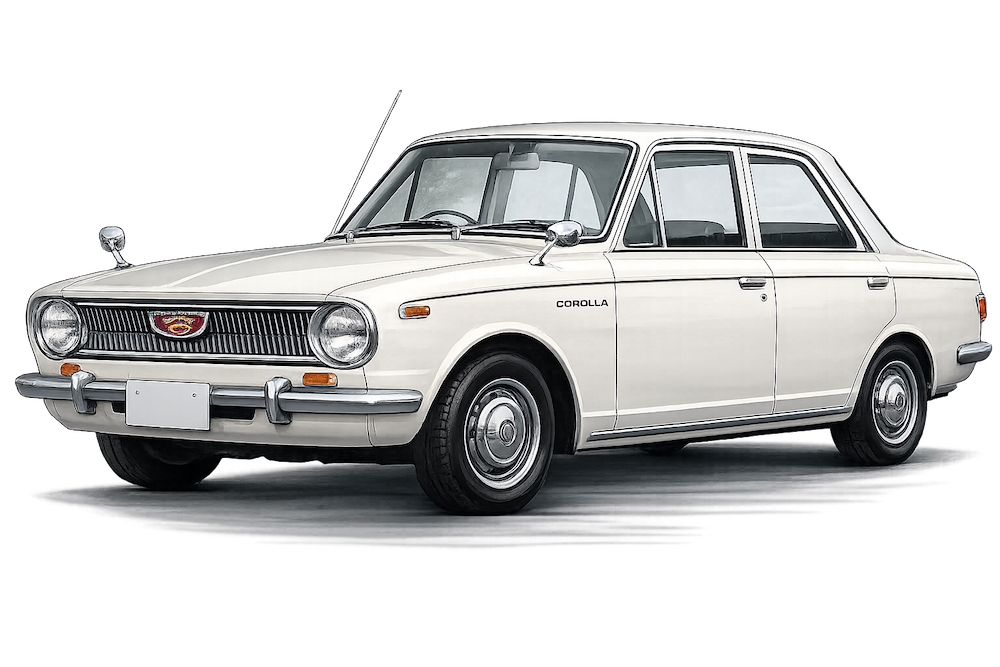 The one-plant-one-model concentration strategy carried the risk of excess capacity if demand proved wrong, but was also a bold gamble aimed at achieving thorough cost reduction through mass production.
Land acquisition for the Takaoka Plant began in May 1965, and a construction committee was established in December of the same year. Construction proceeded from January 1966, with the plant designed for monthly production of 20,000 units, though the Phase 1 completion set initial capacity at 16,000 units per month, with plans for staged expansion matching production ramp-up. A vision for eventually becoming a fully integrated plant from pressing through final assembly was also established.
On the vehicle side, the Corolla adopted the newly developed K-type engine (1,077cc), with 'the luxury of an extra 100cc' as its selling point. Innovations in new mechanisms and production preparation methods were also refined, pursuing a car that was 'passing grade in every aspect' as a mass-market vehicle.
C Result: Mass production of cars within ordinary people's reach determined the outcome of the capital investment race with Nissan
Phase 1 construction of the Takaoka Plant was completed in September 1966, with body assembly, painting, final assembly, and a test course all in place. In the body process, numerous welding stations were introduced, and a loop-line system using jig carts on a circular conveyor significantly improved work efficiency and precision. In the painting process, state-of-the-art automatic painting equipment was adopted, simultaneously improving corrosion resistance, uniformity, workability, and cost reduction.
In production management, an online control system using electronic computers was introduced, enabling centralized management of process instructions, inventory, and operational status from a central control room. This integrated optimization of equipment and management functioned as a system for making the Corolla 'cheaply, reliably, and in large volumes,' and the Corolla effectively became the first car in Japan to mass-produce a passenger car that 'ordinary people could realistically reach for.'
After launch, the Corolla won broad support through nationwide launch events, and demand expanded rapidly. When supply could not keep pace, Toyota embarked on construction of a second assembly plant in 1967, expanding press and body processes in line with the production ramp-up. This series of decisions linked investment proactively ahead of demand emergence, and as the share battle with Nissan shifted from a 'sales competition' to a 'mass production capacity and capital investment competition,' it became a key factor in Toyota's establishing superiority.
As a result, the Takaoka Plant's 'one-plant-one-model' system achieved dramatic cost reductions, simultaneously enhancing price competitiveness and supply capacity. The Corolla did not merely ride the wave of motorization — it established that wave as actual demand, becoming the catalyst that changed lifestyles and the social landscape. At the same time, the Takaoka Plant's operation clarified the winning formula in the capital investment competition with Nissan, delivering the decisive blow in the passenger car market share contest that tilted it in Toyota's favor.
The strategic significance of the Takaoka Plant lies in how it changed the nature of competition with Nissan. Before the Corolla, the passenger car market share battle was a competition of sales capability, but the construction of a dedicated plant capable of 20,000 units monthly shifted the contest to the scale and speed of capital investment. It was a gamble that risked excess capacity if demand missed, but the one-plant-one-model concentration enabled thorough cost reduction, simultaneously securing supply capacity and price competitiveness. The management posture of leading investment ahead of demand became the starting point for Toyota's establishing mass production superiority.
Solo local production begins in the U.S.
What deserves attention in the solo North American entry is the staged risk-taking approach that utilized the GM joint venture NUMMI as a validation ground. By accumulating know-how in production management and labor relations at NUMMI and gaining confidence that manufacturing operations could succeed in North America, the decision for solo entry was made. In Kentucky, all employees were newly hired from people with no automobile experience, with quality equivalent to Japanese production set as an absolute requirement. Job creation and local parts procurement also contributed to easing U.S.-Japan trade friction, making it an irreversible turning point where Toyota put down roots in North American society.
A Background: Supply shortages from voluntary export restraints grew beyond what the NUMMI joint venture could absorb
In the early 1980s, Toyota was fundamentally reassessing the nature of its business operations in the North American market. After negotiations with Ford Motor for a joint venture fell through in 1981, General Motors (GM) approached Toyota about a partnership, and the concept of joint production took concrete shape as a symbol of U.S.-Japan industrial cooperation. At the time, voluntary export restraints on Japanese cars to the U.S. were in effect, criticism of Japanese cars remained strong, and there were movements in the U.S. Congress to establish local content legislation.
NUMMI, established under these circumstances, contributed to U.S. job creation and the revitalization of the parts industry, while also serving as an important base for Toyota to learn firsthand about local production in North America. Know-how in production management, labor relations, and quality manufacturing was accumulated, building the foundation for a full-scale manufacturing operation in North America. Meanwhile, sales of Toyota vehicles in North America were expanding rapidly, and it became clear that joint production alone could not meet future demand.
By the mid-1980s, North American sales had reached approximately 1 million units annually, and supply shortages due to voluntary export restraints had become severe. Consequently, the recognition grew within Toyota that solo entry through local production was unavoidable in order to independently secure supply volumes and clearly demonstrate contribution to the local economy.
B Decision: Selecting Kentucky from 29 state applications and deciding to build a solo plant
In February 1985, Toyota established a North American production study team within its Overseas Business Division and began comprehensive examination encompassing everything from local production to sales. At an extraordinary board meeting in July, the decision was made to establish solo factories in the United States and Canada, and the plan was formally announced. The plan called for building production capacity of approximately 200,000 units annually in the U.S. and 50,000 units annually in Canada by 1988.
In August, the 'North American Business Preparation Office' was established, and a North American Project Committee of executives was also set up. Site selection used an open application process, with proposals received from 29 U.S. states and 8 Canadian provinces. The preparation office conducted multifaceted analysis of parts procurement, logistics, electricity, labor, public safety, and state government incentives, with executives personally visiting sites for inspection.
As a result, in December 1985, Kentucky was selected as the U.S. factory site. Though the state had no track record with automobile plants, the state government's strong recruitment posture and site conditions were highly valued. In January 1986, Toyota formally began solo local production in North America, and that same month established Toyota Motor Manufacturing, U.S.A., Inc. (TMM) in Kentucky.
C Result: TMM became the core North American production base, establishing itself in local communities through economic contribution
TMM was Toyota's first full-scale solo production company in North America, launched leveraging the experience gained at NUMMI. All employees were newly hired, and with the assumption that they had no automobile manufacturing experience, human resource development emphasized fundamentals. Establishing a production culture that prioritized quality above all was considered the greatest challenge.
In March 1988, the TMM first plant was completed, and the Camry production system was put in place. Achieving quality equivalent to Japanese-made vehicles was an absolute requirement, and state-of-the-art equipment including flexible body lines capable of future multi-model production was introduced. TMM thereby began fulfilling its role as the core production base for the North American market.
Subsequently, as demand in the North American market continued to expand, production capacity was further enhanced, and TMM's second plant was completed in April 1994. The establishment and expansion of TMM represented more than mere capacity increases — it was also an effort to contribute to the regional economy through job creation and local procurement of parts. Solo local production that began in Kentucky in 1986 became a turning point where Toyota put down deep roots in North American society, and came to be highly regarded as the foundation supporting subsequent North American business expansion.
What deserves attention in the solo North American entry is the staged risk-taking approach that utilized the GM joint venture NUMMI as a validation ground. By accumulating know-how in production management and labor relations at NUMMI and gaining confidence that manufacturing operations could succeed in North America, the decision for solo entry was made. In Kentucky, all employees were newly hired from people with no automobile experience, with quality equivalent to Japanese production set as an absolute requirement. Job creation and local parts procurement also contributed to easing U.S.-Japan trade friction, making it an irreversible turning point where Toyota put down roots in North American society.
Lexus launched in North America
To dispel the image of Toyota as a mass-market brand in North America, Toyota decided to develop its luxury vehicle brand 'Lexus' for the North American market
Prius launched
The structurally important aspect of Prius development is the single point where management raised the initial 1.5x fuel efficiency target to 2x. Setting a level unachievable through incremental engine efficiency improvements made the adoption of a hybrid system technically inevitable. The electrification research knowledge accumulated intermittently since 1968 converged here, crystallizing as THS. The causal structure where the level of target-setting determines technology selection only functions in domains where research accumulation already exists — a point that warrants attention.
A Background: From gas turbine research in 1968 to setting the goal of doubling fuel efficiency
The origins of Toyota's hybrid vehicle (HV) development trace back to 1968. Kennya Nakamura, the chief engineer who had led the development of the first Crown, initiated research on a new powertrain system utilizing gas turbine engines. At the time, no secondary battery existed that could meet the performance requirements for HVs, and this effort was suspended in the early 1980s, but the research experience from this period became the foundation for later electrification technology.
In 1993, heightened internal discussion about 'the car of the 21st century' triggered the full-scale development that would lead to the Prius. That year, the G21 Project was launched under Chief Engineer Takeshi Uchiyamada, with the goal of achieving a dramatic improvement in fuel efficiency as a next-generation vehicle. Initially, a 1.5x improvement through engine efficiency gains was envisioned, but management set a higher target of 2x fuel efficiency, forcing a reassessment of the technical direction.
In 1995, the adoption of a hybrid system was determined as the only realistic means to achieve the 2x fuel efficiency target, and the policy of making the production vehicle a hybrid became clear. In 1997, the Toyota Hybrid System (THS), a series-parallel configuration, was completed, and at the end of that year, the first-generation Prius was launched as the world's first mass-produced hybrid passenger car.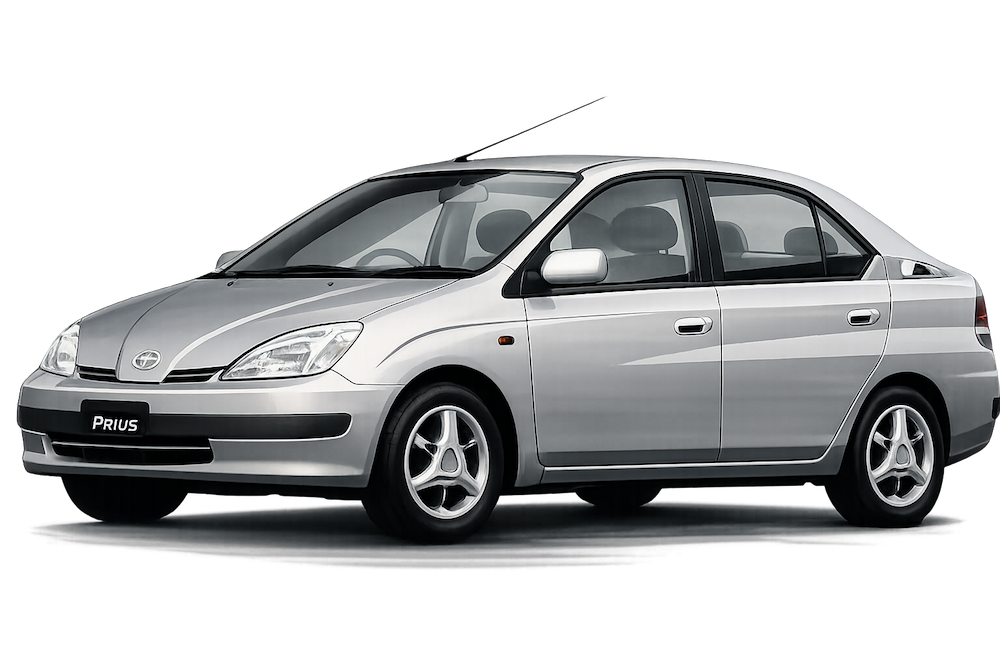
B Decision: THS II adoption and model lineup expansion transformed HV from experimental product to global commodity
In 2000, a minor change to the first-generation Prius improved both power and fuel performance, and sales were launched in the North American and European markets. This strengthened the Prius's positioning from a Japan-only experimental model to a global product.
In September 2003, the fully redesigned second-generation Prius was launched, adopting THS II with a voltage boost converter that dramatically increased motor output. With advances in balancing driving performance and environmental performance, the Prius gained recognition as a mass-produced car combining practicality and product appeal, becoming synonymous with hybrid vehicles.
During the same period, Toyota accelerated the expansion of HV models following the Prius. In 2001, the Estima Hybrid and Crown Mild Hybrid were introduced, and in 2003, HV technology was extended to diesel engine trucks. In 2005, the Harrier Hybrid SUV (marketed overseas as the Lexus RX400h) was launched, expanding HV applications from passenger cars to commercial vehicles and SUVs.
C Result: Expansion of overseas production bases and surpassing cumulative 3 million units established HV as a mass-production technology
The HV strategy centered on the Prius also progressed in globalizing its production system. In 2005, knock-down production of the Prius began in China, and in 2006, production of the Camry Hybrid was launched at the Kentucky plant in the U.S. Production bases subsequently expanded to Thailand, Australia, China, and the UK, building a supply system aligned with regional demand.
HV deployment policies were presented at Toyota Environmental Forums in 2006 and 2008, with plans to expand to annual production of 1 million units by the early 2010s and targets to offer HV versions across all passenger car models by around 2020. In sales, cumulative figures reached 1 million in 2007, 2 million in 2009, and 3 million in 2011, as HVs shifted in positioning from specialized technology to mass-production technology.
The history of the Prius is the history of Toyota elevating environmental technology from the research stage to the mass-production and mass-adoption stage. Beyond the success of a single model, the Prius represents a significant turning point as a product that accelerated the electrification of the entire automobile industry.
The structurally important aspect of Prius development is the single point where management raised the initial 1.5x fuel efficiency target to 2x. Setting a level unachievable through incremental engine efficiency improvements made the adoption of a hybrid system technically inevitable. The electrification research knowledge accumulated intermittently since 1968 converged here, crystallizing as THS. The causal structure where the level of target-setting determines technology selection only functions in domains where research accumulation already exists — a point that warrants attention.
TME established to oversee all of Europe
Three European oversight companies (TMME, TMEM, TME) were consolidated into TME. Aimed at improving manufacturing and sales efficiency across Europe
Emergency profitability improvement measures implemented
What deserves attention in the response to the 436.9 billion yen loss is the weighting judgment applied to each expense category. Cost improvements of 340 billion yen, 36% capital expenditure reduction, and work-sharing were measures to stop the short-term bleeding, whereas R&D spending in environment and safety was maintained as continued investment. Rather than cutting all items uniformly, selectively preserving areas tied to future competitiveness is the structural characteristic. The company field-tested how far each cost item could be adjusted during demand fluctuations, transforming the crisis into an occasion for cost structure redesign.
A Background: Lehman shock resulted in first net loss in 60 years — 436.9 billion yen since end of WWII
The 2008 Lehman Brothers collapse impacted not only the global financial system but also the real economy, particularly the durable goods industries. The emblematic outcome was Toyota Motor's net loss of 436.9 billion yen for fiscal year ending March 2009. This was the first red ink in approximately 60 years since the postwar financial crisis, demonstrating that even Toyota — perceived as a 'company that rarely goes into the red' — was not immune, and broadly signaling to society the severity of the economic downturn.
B Decision: Emergency measures centered on 340 billion yen in cost reduction and 36% capital expenditure cut
What is important in examining Toyota's management response is not the loss itself but the specific countermeasures that followed. For fiscal year ending March 2010, the company pursued a cross-cutting review of major items including manufacturing costs, fixed costs, R&D, and general expenses under the framework of 'emergency profitability improvement.'
First, cost reduction. As shown in the financial briefing materials of the time, VA (value analysis) activities were strengthened, expanding from 15 to 50 target models, and factory cost reviews and VI activity results at model changeovers were pursued. This positioned the company to achieve approximately 340 billion yen in cost improvements for fiscal year ending March 2010, built up through improvements across design, procurement, and production processes.
Second, fixed cost reduction. Capital expenditure restraint was particularly significant, with capex for fiscal year ending March 2009 falling 36% year-over-year to 830 billion yen. Depreciation expenses also declined by approximately 70 billion yen accordingly. This represented an adjustment of investment levels to align the cost structure with the demand environment during a downturn.
Third, the treatment of R&D expenditure. R&D spending was not subject to drastic cuts, and continued investment was maintained in areas tied to medium-to-long-term competitiveness such as environment, energy, and safety. Meanwhile, cost containment was pursued through improved development process efficiency — a judgment that balanced short-term cost reduction with preparation for the future.
Fourth, review of general expenses, selling costs, and labor costs. General expenses such as travel and promotional costs were scrutinized item by item, and selling costs were allocated with awareness of priority areas. On the labor front, work-sharing was introduced to balance employment preservation with operational efficiency.
C Result: A crisis response that balanced short-term cost cutting with continued future investment
These initiatives were not solely aimed at short-term earnings recovery but also represented a process of confirming the room for cost structure adjustment during demand fluctuations. The Lehman-era losses became an occasion for Toyota to reassess its management constraints, and are considered to have had a lasting influence on subsequent management decisions.
As a result, Toyota's fall into losses had the aspect of a temporary performance deterioration, but it was also an event accompanied by a process of reviewing cost structure and investment decisions — its significance extends beyond simple performance evaluation.
What deserves attention in the response to the 436.9 billion yen loss is the weighting judgment applied to each expense category. Cost improvements of 340 billion yen, 36% capital expenditure reduction, and work-sharing were measures to stop the short-term bleeding, whereas R&D spending in environment and safety was maintained as continued investment. Rather than cutting all items uniformly, selectively preserving areas tied to future competitiveness is the structural characteristic. The company field-tested how far each cost item could be adjusted during demand fluctuations, transforming the crisis into an occasion for cost structure redesign.
Transition to in-house company system
The key issue in introducing the in-house company system is how to balance recovery of decision-making speed through decentralization with maintaining company-wide optimization. In an organization of 10 million-unit scale, decision-making had become buried in cross-departmental coordination along functional lines, and accountability for each product had grown ambiguous. Reorganizing management units along product axes and enabling planning through production to be completed within each company was a direct solution to this problem. The notable point that the system was introduced not as a completed form but on the premise of adjustment through operational experience suggests that no single solution exists for governing a giant organization.
A Background: Decision-making delays and unclear accountability emerged in a vertically siloed organization at the 10 million-unit scale
In 2016, Toyota Motor undertook a major overhaul of its management structure by introducing the 'in-house company system.' The background was a growing awareness of slowing decision-making amid changes in the business environment and organizational expansion. As global sales reached the 10 million-unit scale, the traditional functionally organized, vertically siloed structure made it increasingly difficult to respond quickly to product-specific and regional challenges, and accountability became unclear. Additionally, the broadening of technology domains including CASE, electrification, and safety technology heightened the importance of cross-functional judgments spanning development, production, and sales, further driving the need for institutional reform. In this context, a structure was sought that would reorganize management units along product lines and enable decision-making closer to the front lines.
B Decision: Reorganizing management units by vehicle type and technology domain, integrating planning through production
The core of the in-house company system was to establish 'product-axis companies' organized by vehicle type and technology domain, each with clearly defined responsibilities and authority. Specifically, these included Compact Car, Mid-Size, Lexus, CV, Powertrain, Connected, and others, each structured to oversee planning through development and production as an integrated unit. This aimed to enable decisions that previously required time-consuming cross-departmental coordination to be completed within individual company units. By decomposing the organization that had built up along functional lines, the intent was to create an environment where engineers could directly engage with their product's value and make decisions with a sense of ownership. Meanwhile, functions requiring company-wide optimization such as R&D and human resource development were retained on the head office side, balancing decentralization and integration.
C Result: While product-unit accountability clarified, balancing with company-wide optimization emerged as a new challenge
Following the introduction of the in-house company system, accountability for each product became clearer at Toyota, and awareness of linking product planning with development intensified. In particular, decisions at model changeovers and in product strategy increasingly took place at the company unit level, bringing the granularity of discussion closer to the product. On the other hand, as decentralization progressed, new challenges emerged around maintaining company-wide consistency and resource allocation. Therefore, the in-house company system was positioned not as a completed form but as a framework to be refined through operational experience. Overall, this system represented an initiative conscious of the transition from an 'organization premised on growth' to an 'organization that adapts to change,' and can be understood as Toyota's attempt to redesign its management approach with full awareness of its own scale and complexity.
The key issue in introducing the in-house company system is how to balance recovery of decision-making speed through decentralization with maintaining company-wide optimization. In an organization of 10 million-unit scale, decision-making had become buried in cross-departmental coordination along functional lines, and accountability for each product had grown ambiguous. Reorganizing management units along product axes and enabling planning through production to be completed within each company was a direct solution to this problem. The notable point that the system was introduced not as a completed form but on the premise of adjustment through operational experience suggests that no single solution exists for governing a giant organization.
Battery business integration with Panasonic
What deserves attention in Toyota's battery strategy is the supply structure design that maintains two companies of different character — PPES and PEVE — in parallel. PPES is a joint venture incorporating Panasonic's battery technology, structured as a business entity that supplies customers beyond Toyota. PEVE, on the other hand, is a converted wholly owned subsidiary of a former JV with a track record in HV batteries, handling EV and PHV needs in a near-in-house capacity. This dual structure that avoids single-source dependency while securing technological breadth represents a distributed approach to battery procurement in the electrification era.
A Background: Advancement of electrification made batteries a core mobility component, creating urgent need for stable supply
Toyota Motor and Panasonic signed a business integration agreement and joint venture agreement for prismatic automotive battery operations in January 2019, and established the joint venture 'Prime Planet Energy & Solutions (PPES)' in April 2020. Both companies shared the recognition that with the advancement of electrification, batteries are core mobility components that play an important role in addressing environmental challenges. PPES was tasked with the development, manufacturing, and sales of high-capacity, high-output prismatic lithium-ion batteries, all-solid-state batteries, and other next-generation batteries for vehicles, with a business structure premised on stable supply to a broad range of customers beyond just Toyota. The equity split was Toyota 51%, Panasonic 49%, giving Toyota management leadership while incorporating Panasonic's battery technology expertise.
B Decision: Dual battery supply structure through PPES establishment and PEVE full subsidiary conversion
Meanwhile, in 2024, Toyota indicated plans to convert Prime Earth EV Energy (PEVE), which had primarily produced batteries for hybrid vehicles, into a wholly owned subsidiary. PEVE was established in 1996 as a joint venture between Toyota and the former Matsushita Group, with Toyota's ownership stake subsequently increased as the hybrid vehicle market expanded. After full subsidiary conversion, PEVE will also handle EV and plug-in hybrid vehicle (PHV) battery production in addition to hybrid vehicles, building a mass production system spanning battery types. Panasonic continues to focus on cylindrical battery operations while maintaining cooperation in prismatic batteries through PPES. Toyota has set plans to significantly expand battery production capacity by 2030, building a battery supply structure adapted to its electrification strategy by maintaining both PPES and PEVE in parallel.
What deserves attention in Toyota's battery strategy is the supply structure design that maintains two companies of different character — PPES and PEVE — in parallel. PPES is a joint venture incorporating Panasonic's battery technology, structured as a business entity that supplies customers beyond Toyota. PEVE, on the other hand, is a converted wholly owned subsidiary of a former JV with a track record in HV batteries, handling EV and PHV needs in a near-in-house capacity. This dual structure that avoids single-source dependency while securing technological breadth represents a distributed approach to battery procurement in the electrification era.