| Period | Type | Revenue | Profit* | Margin |
|---|---|---|---|---|
| 1996/3 | Non-consol. Revenue / Net Income | ¥0B | ¥0B | - |
| 1997/3 | Non-consol. Revenue / Net Income | ¥0B | ¥0B | 5.5% |
| 1998/3 | Non-consol. Revenue / Net Income | ¥1B | ¥0B | 5.0% |
| 1999/3 | Non-consol. Revenue / Net Income | ¥2B | ¥0B | 9.5% |
| 2000/3 | Non-consol. Revenue / Net Income | ¥6B | ¥1B | 20.2% |
| 2001/3 | Non-consol. Revenue / Net Income | ¥13B | ¥3B | 22.5% |
| 2002/3 | Consolidated Revenue / Net Income | ¥31B | ¥6B | 18.6% |
| 2003/3 | Consolidated Revenue / Net Income | ¥59B | ¥12B | 20.3% |
| 2004/3 | Consolidated Revenue / Net Income | ¥76B | ¥25B | 32.7% |
| 2005/3 | Consolidated Revenue / Net Income | ¥118B | ¥37B | 31.0% |
| 2006/3 | Consolidated Revenue / Net Income | ¥174B | ¥47B | 27.0% |
| 2007/3 | Consolidated Revenue / Net Income | ¥213B | ¥58B | 27.2% |
| 2008/3 | Consolidated Revenue / Net Income | ¥262B | ¥63B | 23.8% |
| 2009/3 | Consolidated Revenue / Net Income | ¥266B | ¥75B | 28.1% |
| 2010/3 | Consolidated Revenue / Net Income | ¥280B | ¥84B | 29.8% |
| 2011/3 | Consolidated Revenue / Net Income | ¥292B | ¥92B | 31.4% |
| 2012/3 | Consolidated Revenue / Net Income | ¥302B | ¥101B | 33.2% |
| 2013/3 | Consolidated Revenue / Net Income | ¥343B | ¥115B | 33.5% |
| 2014/3 | Consolidated Revenue / Net Income | ¥409B | ¥130B | 31.7% |
| 2015/3 | Consolidated Revenue / Net Income | ¥428B | ¥134B | 31.2% |
| 2016/3 | Consolidated Revenue / Net Income | ¥652B | ¥172B | 26.4% |
| 2017/3 | Consolidated Revenue / Net Income | ¥854B | ¥133B | 15.5% |
| 2018/3 | Consolidated IFRS Revenue / Net Income | ¥897B | ¥134B | 14.9% |
| 2019/3 | Consolidated IFRS Revenue / Net Income | ¥955B | ¥78B | 8.1% |
| 2020/3 | Consolidated IFRS Revenue / Net Income | ¥1.1T | ¥88B | 8.3% |
| 2021/3 | Consolidated IFRS Revenue / Net Income | ¥1.2T | ¥89B | 7.3% |
| 2022/3 | Consolidated IFRS Revenue / Net Income | ¥1.6T | ¥92B | 5.8% |
| 2023/3 | Consolidated IFRS Revenue / Net Income | ¥1.7T | ¥189B | 11.3% |
Author's Insights
When Manabu Miyasaka became CEO in April 2012, outgoing president Hiroshi Inoue said: 'Lately I think I might be the only one not carrying a mobile phone' and 'it stays in my bag and has become a phone just for outgoing calls.' The fact that the president who led Yahoo for 16 years was not a daily smartphone user is cited as a symbol placing organizational stagnation on the individual. However, the structural question to ask is: 'Why was this situation able to continue for 16 years?'
The structure was created by the success experience of the high-growth period from 1997. The portal that expanded from 5 million daily PV to 150 million daily PV by 2001 controlled advertising price-setting power and achieved high operating margins. This logic of 'maximize PV and revenue follows' optimized the organization's evaluation criteria, investment decisions, and hiring standards entirely toward expanding PC-oriented PV. Focusing on mobile appeared to the optimized machine as a foreign object.
However, Yahoo did recognize mobile but actually did not prioritize it. In 2000, it acquired PIM (Denden-tai) for approximately ¥5 billion to test the possibilities. The mobile service 'Dosule!' did not take hold, but Kentaro Kawabe and Shin Murakami, who had come from PIM, remained at Yahoo. However, they were not promoted to the management core until 12 years later—after the transition to the Miyasaka administration in 2012. The problem was not lack of recognition, but the structure in which the success of the existing model postponed the promotion of change agents.
Thus came three consecutive years of stagnant revenue growth from FY2008 to FY2011. This stagnation did not appear suddenly, but was an accumulation of the tendency of an organization optimized for success experience to not directly face gradual changes in premises. The fact that Miyasaka's administration completely replaced management with 'being a smartphone enthusiast as a prerequisite' paradoxically showed that the cause of the stagnation lay not in individuals but in the evaluation and promotion mechanisms created by the previous administration. What the 16-year long-term administration produced was not a specific technology judgment error, but the structure in which an 'organization that protects winning patterns' marginalizes 'talent that changes winning patterns.'
The LINE integration by Z Holdings (ZHD), launched in October 2019, was described through the logic of scale expansion: 'Japan's largest portal and Asia's largest messenger combining to create a true super app.' However, four years after integration, in October 2023, ZHD was dissolved and forced to re-merge as 'LINEYahoo.' The two-stage reorganization that did not complete in one integration shows something the logic of scale expansion overlooked.
To begin with, the substantive motivation for the integration was not 'scale' but 'cessation of attrition.' From 2018 onward, PayPay and LINE Pay repeated ¥10 billion-scale return campaigns, and the combined deficit of both companies ballooned. The picture of two companies in the same capital sphere bleeding each other in the same market was not rational, and the first concrete outcome obtained through integration was 'cessation of competition,' not aggressive growth. However, since it was announced externally with a narrative of scale expansion, this defensive character became obscured. And the design of 'equal integration (50:50)' chosen to maintain that narrative structurally slowed the pace of organizational integration. In equal integration, both sides attempt to protect existing interests, so brands, headquarters, and organizational culture continue to coexist, and the sorting of overlapping services is deferred.
As a result, the depicted synergies generally took time to materialize. LINE Pay was forced to gradually consolidate into PayPay, and the 'equal' banner collapsed. LINE Bank began development in 2020, but Fujitsu's system failed; after migration to a Korean company package, it continued to struggle connecting to the Zengin System, repeatedly delaying its opening. Furthermore, the design that cited LINE's overseas expansion as one rationale for integration also lost a part of integration's necessity when the brand rights were purchased from the former US Yahoo, making 'Yahoo's solo overseas expansion also possible.'
Thus in 2023, ZHD was dissolved and re-merged as LINEYahoo, with management leadership shifting to LINE-side talent. The initial dynamics of 'Yahoo absorbing LINE' were reversed. Numerically, scale expansion was achieved—it became the largest domestic platform integrally holding EC, advertising, and payments. But the gap in EC competition with Rakuten and Amazon has not narrowed, and the advertising market continues under Google and Meta duopoly. If scale expansion did not become leverage changing the quality of competition, the question to ask is not 'should they not have integrated?' but 'did not a narrative too large—scale expansion—for a defensive purpose distort the correct design?'
Founded Yahoo Japan Corporation
Yahoo Japan Corporation's founding was not merely a Japanese introduction of an overseas brand, but embedded a contract structure paying 3% of gross profit as royalties to US Yahoo, while SoftBank holding 60% of voting rights secured management control on the domestic side. The design of royalty consideration tied to gross profit meant that royalty burden would increase as the business grew, becoming a constraint on long-term profit structure. Meanwhile, the capital design allowing domestic management control enabled business expansion tailored to the Japanese market and formed the foundation for subsequent proprietary evolution.
BackgroundFounded as a joint venture with US Yahoo
In the mid-1990s, the internet was entering a period of rapid adoption centered on the United States. SoftBank deepened its Silicon Valley connections through acquisitions such as Ziff Davis, and in the process noticed the growth potential of Yahoo, a Stanford University-born venture. Within Japan, comprehensive Japanese-language search portals were immature, and there was significant room to gain first-mover advantage.
Masayoshi Son invested in US Yahoo while proposing to advance deployment in the Japanese market through a joint venture structure. As a result, in January 1996, Yahoo Japan Corporation was established with 60% SoftBank investment and 40% US Yahoo investment. Starting with capital of ¥200 million, the company prepared to utilize the US Yahoo brand and technology.
DecisionSecuring brand use and management control
For establishment, a license agreement was concluded with US Yahoo, securing exclusive rights to use the 'Yahoo!' trademark in the Japanese market. The consideration was a contract to pay 3% of gross profit as royalties, notable for being tied to the overall company's sales rather than limited to search services.
Meanwhile, a capital structure was adopted where SoftBank held 60% of voting rights, securing management control on the domestic side. Hiroshi Inoue from SoftBank assumed the role of Representative Director, clearly establishing a system for operating the business tailored to the Japanese market while utilizing US Yahoo's technology and brand.
ResultFoundation formed for Japan-specific evolution
Through the joint venture establishment, Yahoo Japan Corporation established a structure that, while being a Japanese deployment base for US Yahoo, operated in practice as a SoftBank-led internet company. This capital design became the foundation enabling subsequent domestic proprietary service expansion and rapid decision-making.
While bearing the constraint of royalty obligations, the foundation was established to grow presence in Japan's portal market using brand power and early entry advantage as weapons. The subsequent expansion into advertising, EC, and other businesses has its starting point in this 1996 capital and contract design at founding.
| Date | Career | Notes |
| 1957/2 | Born | |
| 1979 | Sword Computer Systems | Joined |
| 1987/11 | SoftBank Research Institute | Joined |
| 1996/1 | Yahoo Japan Corporation | Director |
| 1996/7 | Yahoo Japan Corporation | Representative Director President |
| 2012/3 | Yahoo Japan Corporation | Resigned as President |
| 2017/4 | Deceased | Traffic accident in California |
- Date
- 1957/2
- Career
- Born
Yahoo Japan Corporation's founding was not merely a Japanese introduction of an overseas brand, but embedded a contract structure paying 3% of gross profit as royalties to US Yahoo, while SoftBank holding 60% of voting rights secured management control on the domestic side. The design of royalty consideration tied to gross profit meant that royalty burden would increase as the business grew, becoming a constraint on long-term profit structure. Meanwhile, the capital design allowing domestic management control enabled business expansion tailored to the Japanese market and formed the foundation for subsequent proprietary evolution.
Launch of Yahoo! Japan search service
What deserves attention in Yahoo! Japan's launch is not the search technology itself but the choice of a directory-type model that manually classified and registered Japanese-language sites. The technical entry barrier was low, but it was a structure where those who first accumulated comprehensive site information monopolized traffic. Furthermore, by bundling daily life information such as news and weather beyond search alone, PV was stably expanded, establishing a position that could lead advertising rates. Holding the advertising rate-setting power of approximately ¥0.7 per PV became the origin of the subsequent high-profit structure.
BackgroundLaunch of Japanese-language search
In April 1996, Yahoo Japan Corporation began providing the Japanese-language directory-type search service 'Yahoo! Japan.' The internet at the time was in its nascent period, and systematic organization of Japanese-language websites had not advanced. Search engines were also immature, and users had no means to reach target information.
To realize directory-type search, it was necessary to manually classify and register Japanese-language sites. Yahoo commissioned Indigo Corporation for this work, mobilizing student part-time workers to carry out registration. Manual preparation continued right up to launch, constructing the Japanese-language search infrastructure.
DecisionMaximizing PV and advertising model
After service launch, Yahoo expanded content beyond search by adding news and weather information through alliances, aiming to transform into a portal visited daily. Rather than search alone, by bundling daily-access content, the company adopted a policy of stably increasing access numbers.
Advertising was set as the revenue source, with PV maximization as the clear management metric. Advertising rates were approximately ¥0.7 per PV, and impression-guarantee products and long-term placement discount products were introduced. The simple model of increasing access and selling advertising space was thoroughly implemented.
ResultSecuring overwhelming PV
Through the integration of search and daily life information content, Yahoo! Japan rapidly expanded its user base. In 1997 it achieved 5 million daily PV, and in 2000 reached 100 million daily PV, growing into one of Japan's largest portals. It established an oligopolistic position and evolved into a medium with pricing power.
As a result, the advertising business achieved a high-profit structure, recording advertising sales of ¥12.2 billion and operating profit of ¥9.3 billion in the fiscal year ending March 2002. The launch of Japanese-language search and the PV-priority strategy became a decisive turning point forming Yahoo's revenue foundation.
| Date | PV | Notes |
| July 1997 | 5 million PV/day | 2nd year of service |
| June 1998 | 10 million PV/day | |
| January 1999 | 20 million PV/day | |
| January 2000 | 50 million PV/day | 5th year of service |
| July 2000 | 100 million PV/day | |
| March 2001 | 150 million PV/day |
- Date
- July 1997
- PV
- 5 million PV/day
- Notes
- 2nd year of service
What deserves attention in Yahoo! Japan's launch is not the search technology itself but the choice of a directory-type model that manually classified and registered Japanese-language sites. The technical entry barrier was low, but it was a structure where those who first accumulated comprehensive site information monopolized traffic. Furthermore, by bundling daily life information such as news and weather beyond search alone, PV was stably expanded, establishing a position that could lead advertising rates. Holding the advertising rate-setting power of approximately ¥0.7 per PV became the origin of the subsequent high-profit structure.
Yahoo! JAPAN's service started in April '96. To be ready for that launch, we hired about 100 part-time workers and kept looking at the web around the clock. Indigo's first job was this Yahoo! JAPAN work. And while working on Yahoo! JAPAN, I was thinking 'What will the world look like when something like this (the web) becomes commonplace?' and 'What will we do when the Yahoo! work is done?'
However, I never received financial support or anything like that from SoftBank. My brother (Masayoshi Son) hates that sort of thing. So SoftBank should have transacted with us just like any other normal company.
Japan's users will increase to 30 million in 2-3 years. If that's the case, those who will join are the majority. Our goal is to have these new 20 million people also choose Yahoo, maintain our top viewership rating, and generate revenue through advertising.
Launch of Yahoo! Shopping and Yahoo! Auctions services
There is a structural implication in the contrasting trajectories traced by two businesses simultaneously deployed from the same traffic base. In mall-type shopping, operational capabilities such as logistics and sales support determined competitiveness, and traffic alone could not build advantage over Rakuten or Amazon. Meanwhile, in auctions, network effects worked strongly, and early entry through the free strategy succeeded in locking in users. Yahoo's EC expansion is a case study showing that success or failure depends on what business structure massive traffic is connected to.
BackgroundRising enthusiasm for e-commerce
Around 1999, expectations for electronic commerce through the internet were rapidly growing in Japan. Rakuten Ichiba started service in 1997, and the concept that even individual stores and small businesses could have online stores had begun to spread. As internet infrastructure improved, consumer behavior of comparing and purchasing products online was also gradually becoming common, and EC entry had become an unavoidable strategic challenge for major portal operators.
Yahoo at the time had traffic of tens of millions to 100 million daily PV, and was also considering diversification from its advertising-dependent revenue structure. There was an expectation that connecting massive traffic to retail sales could establish a new revenue source, while the question of how to differentiate as a late entrant with Rakuten already ahead was also a challenge.
DecisionSimultaneous deployment of Shopping and Auctions
In September 1999, Yahoo launched 'Yahoo! Shopping,' starting with 17 stores and approximately 15,000 products centered on major retailers such as Askul and Ishibashi Musical Instruments. The company prioritized recruiting branded stores and emphasized the reliability of a comprehensive mall. Meanwhile, the awareness of 'defeat Rakuten' was shared internally, and a policy of rapidly expanding scale as a late entrant was set.
In the same year, 'Yahoo! Auctions' was also launched, entering the CtoC market. Considering the trend of PayPal dominating the auction market in the US, it was judged necessary to secure a user base before US entry into Japan. A strategy was adopted of rapidly absorbing both sellers and buyers by keeping listing fees free until March 2001.
ResultThe two businesses took contrasting paths
Yahoo! Shopping was initially limited in product variety due to its brand-focused store recruitment policy, falling behind Rakuten and Amazon in selection. Furthermore, with Rakuten strengthening store support through a sales force and Amazon improving the customer experience through logistics investment, Yahoo could not build a decisive advantage through traffic alone, and inferiority continued throughout the 2000s.
On the other hand, Yahoo! Auctions acquired an overwhelming user base through the free strategy and established an oligopolistic position in the domestic auction market. In April 2001, it transitioned to monetization by introducing a ¥280/month identity verification system, developing into a high-growth, high-profit business. Shopping and Auctions traced contrasting trajectories, with long-term impact on Yahoo's EC strategy.
| FY | Revenue (a) | Operating Profit (b) | Margin (b)/(a) |
| FY2002 | ¥5.03B | ¥640M | 12.8% |
| FY2003 | ¥6.58B | ¥870M | 13.2% |
| FY2004 | ¥10.58B | ¥3.86B | 3.7% |
| FY2005 | ¥15.9B | ¥1.74B | 10.9% |
- FY
- FY2002
- Revenue (a)
- ¥5.03B
- Operating Profit (b)
- ¥640M
- Margin (b)/(a)
- 12.8%
| FY | Revenue (a) | Operating Profit (b) | Margin (b)/(a) |
| FY2001 | ¥2.41B | ¥2.32B | 96.0% |
| FY2002 | ¥11.08B | ¥8.35B | 75.3% |
| FY2003 | ¥20.82B | ¥15.48B | 74.3% |
| FY2004 | ¥27.3B | ¥17.79B | 65.1% |
| FY2005 | ¥35.93B | ¥21.46B | 59.7% |
- FY
- FY2001
- Revenue (a)
- ¥2.41B
- Operating Profit (b)
- ¥2.32B
- Margin (b)/(a)
- 96.0%
There is a structural implication in the contrasting trajectories traced by two businesses simultaneously deployed from the same traffic base. In mall-type shopping, operational capabilities such as logistics and sales support determined competitiveness, and traffic alone could not build advantage over Rakuten or Amazon. Meanwhile, in auctions, network effects worked strongly, and early entry through the free strategy succeeded in locking in users. Yahoo's EC expansion is a case study showing that success or failure depends on what business structure massive traffic is connected to.
The measure for not being abandoned by companies that successfully leverage the internet for sales—that is the 'Shopping' business that Yahoo is currently focusing on most.
In this field, Rakuten, which has gathered more than 4,000 large and small stores, boasts Japan's largest sales. But for Yahoo, maintaining the growth in current page views 'requires being absolutely number one in Japan' in terms of shopping site traffic (Yahoo President Hiroshi Inoue). On the wall of the company's shopping project office, a banner reading 'Defeat Rakuten' is posted, and 30 employees representing about 10% of the company are in close daily contact with 100 registered companies.
At Yahoo's largest auction service, the number of listed items exceeded 2 million as of December 11 this year. It has swelled to approximately 20 times the scale of one year ago. In the booming internet auction market, Yahoo is far ahead of rivals in terms of users and transaction amounts. In the second tier, Rakuten's 'Flea Market Auction' has about 70,000 listings, and DeNA's 'Bidders' has about 30,000 listings. Yahoo's listing count has reached 30 to 70 times that of competitors.
Merged with P.I.M. Corporation (Denden-tai)
PIM's merger is a typical example of an acquisition difficult to evaluate on business results alone. The mobile service 'Dosule!' did not take hold, and roles within the company became ambiguous immediately after the merger. However, PIM alumni such as Kentaro Kawabe and Shin Murakami remained at Yahoo and were promoted to the core in the 2012 management overhaul. Even when PMI shows no short-term results, there are cases where internal accumulation of human assets becomes a driver of long-term strategic transformation. This demonstrates the limits of measuring acquisition value only by business profit and loss.
BackgroundArrival of the mobile internet era
NTT DoCoMo launched i-mode in February 1999, and by the end of March 2000 subscriptions had exceeded 5.6 million. The ability to browse the internet on mobile phones completely transformed conventional PC-centered internet usage, showing the potential of the mobile internet as a new market. A carrier-led official site model was forming, and information access via mobile phones was rapidly increasing, especially among younger generations.
Yahoo at the time boasted overwhelming PV in the PC portal space, but had no clear winning strategy in the mobile domain. How a portal company could demonstrate its presence in a structure where carriers held the reins was unclear, and cooperation with or absorption of external mobile-specialized ventures had become a leading option.
DecisionAbsorbing the student venture
In September 2000, Yahoo merged with P.I.M. Corporation. The merger ratio was 1.00 for Yahoo to 0.056 for PIM, with PIM's valuation at approximately ¥5 billion. For a student-founded venture, this was a large valuation at the time and attracted market attention. It had the strong character of an advance investment anticipating full-scale entry into the mobile domain.
PIM had developed the mobile content service 'Dosule!,' quickly acquiring 30,000 users. Yahoo's Kwan Sato and others evaluated its potential and decided on a merger incorporating the entire organization. Young talent including Kentaro Kawabe and Shin Murakami also transferred to Yahoo, drawing expectations as core candidates for mobile strategy.
ResultThe business stalled, but the talent remained
However, in the mobile market, carriers such as NTT DoCoMo and KDDI held the reins, and Yahoo could not establish a clear position. Dosule! could not find direction and ended, failing to achieve results as a PIM business. Immediately after the merger, roles within the company became ambiguous, and it is said to have entered a period of effective stagnation.
Nevertheless, the talent remained at Yahoo, and when Manabu Miyasaka became president in 2012, Kawabe and Murakami were promoted to management core positions. As a result, a structure was formed in which PIM alumni led Yahoo's reforms in the 2010s. The mobile-oriented thinking itself was prescient, and with a time lag it influenced the organization's direction.
PIM's merger is a typical example of an acquisition difficult to evaluate on business results alone. The mobile service 'Dosule!' did not take hold, and roles within the company became ambiguous immediately after the merger. However, PIM alumni such as Kentaro Kawabe and Shin Murakami remained at Yahoo and were promoted to the core in the 2012 management overhaul. Even when PMI shows no short-term results, there are cases where internal accumulation of human assets becomes a driver of long-term strategic transformation. This demonstrates the limits of measuring acquisition value only by business profit and loss.
The number of mobile phone users who can connect to the internet is rapidly increasing. What drove this is Japanese youth culture and manufacturers' excellent manufacturing technology. In the 21st century, usage from mobile devices may spread around the world. (Abbreviated)
The movement to use these rapidly spreading mobile phones as a gateway to the internet was ignited by NTT DoCoMo's 'i-mode' service, which started this February. The i-mode service is a service that enables internet connection from newly developed i-mode compatible mobile phones. In addition to email use, it provides services such as mobile banking for bank transfers, viewing news and stock information, and information services for fortune-telling and ticket booking. Since the service began on February 22, the number of i-mode subscription contracts has been skyrocketing.
Declared 'explosive speed' management
The background of Yahoo's 2012 management overhaul was the problem that the success experience as a PC portal had structured the delay in smartphone response. An organization supported by daily PV exceeding 100 million and high advertising revenues tilted toward optimizing the existing model and postponed advance investment in the mobile domain. As expressed by President Hiroshi Inoue himself saying 'I might be the only one not carrying a mobile phone,' the CEO's literacy and organizational culture had become factors blocking transformation. To break the inertia created by the 16-year long-term administration, generational change and comprehensive overhaul of the decision-making structure were chosen.
BackgroundStagnation from PC-centric focus
Hiroshi Inoue, who became president in 1996, elevated Yahoo to a domestic top company centered on portals and advertising. However, from 2009 onward, adequate response to the rapid spread of smartphones could not be made, and growth decelerated. Particularly in the mobile domain, Yahoo fell behind, and stagnating sales were compounded by declining advertising rates and the rise of new entrants.
From FY2008 to FY2011, revenue growth stagnated and the momentum of the once highly profitable company faded. Masayoshi Son of SoftBank, a major shareholder, judged that the existing structure could not adapt to the smartphone era and decided on a president change and executive overhaul. It was a phase where transformation speed was prioritized over management continuity.
Inoue served as president for 16 years, but the delay in mobile strategy was undeniable. Son chose to clarify management accountability and pass the baton to a new generation. Yahoo faced its first genuine generational change and strategic transformation since its founding.
DecisionRejuvenation and pledging explosive speed
In April 2012, by Masayoshi Son's appointment, Manabu Miyasaka (then 44) became CEO. Inoue completely stepped down with the June shareholders' meeting, and management control transferred to the new administration. Miyasaka, who had joined in 1997 and worked on profitable businesses such as Auctions and News, was a practitioner promoted from within, a bold reform through internal promotion.
Simultaneously, the executive officer structure was overhauled nearly in its entirety. Reappointments were extremely limited, and a formation centered on young people selected with 'being a smartphone enthusiast' as the standard was assembled. Mobile-oriented talent such as Kentaro Kawabe and Shin Murakami were placed in core positions, and the center of gravity of decision-making shifted at once.
Miyasaka immediately after taking office declared 'explosive speed management' and decisively simplified approval processes. The aim was to restore speed to the organization that had ballooned to approximately 5,000 people, with a cultural transformation toward thorough delegation of authority and rapid execution. The catchphrase spread through media and was recognized internally and externally as a symbol of reform.
ResultSelection, focus, and reallocation
The pillar of reform was 'concentrated investment in strong services.' Of approximately 150 services existing in 2012, it was judged that competitive ones were limited to about 20, and managers were granted strong personnel authority to redeploy people. Weak services were sorted through reduction or partnership, and management resources were directed toward smartphone-focused flagship businesses.
In Shopping and points, the self-reliant approach was reconsidered, and in June 2012 a capital and business alliance was concluded with CCC to advance cooperation with T-Point. Also partnering with Askul to supplement logistics functions, the direction shifted toward utilizing external resources. The helm shifted from comprehensive in-house deployment to reconstruction premised on cooperation.
Explosive speed management was not merely a slogan but involved changes in organizational culture and resource allocation. Thereafter, Yahoo accelerated expansion of smartphone-compatible services and established the foundation for deploying a re-growth strategy spanning advertising, EC, and payments. It was a turning point where the management generational change was tied to strategic transformation.
| Date | Position | Category |
| 1967/11 | - | Born |
| 1992/4 | U.P.U. Co., Ltd. | Joined |
| 1997/6 | Yahoo Japan Corporation | Joined |
| 2002/1 | Yahoo Japan Corporation | Media Division Head |
| 2009/4 | Yahoo Japan Corporation | Executive Officer |
| 2012/4 | Yahoo Japan Corporation | CEO Executive Officer |
| 2012/6 | Yahoo Japan Corporation | Representative Director President |
| 2018/6 | Yahoo Japan Corporation | Director Chairman |
| 2019/6 | Yahoo Japan Corporation | Resigned |
| 2019/9 | Tokyo Metropolitan Government | Vice Governor |
- Date
- 1967/11
- Position
- -
- Category
- Born
| Name | Executive Officer | Division | Category |
| Manabu Miyasaka | CEO | Representative Director President | New appointment |
| Kentaro Kawabe | COO | Media Business Division Head | New appointment |
| Toshiki Oya | CFO | - | New appointment |
| Masatsugu Shitachi | Executive Officer | BS Business Division Head | New appointment |
| Koji Sakamoto | Executive Officer | Consumer Business Division Head | New appointment |
| Kazuto Ataka | Executive Officer | Business Strategy Division Head | New appointment |
| Tetsuya Nishimaki | Executive Officer | Operations Division Head | Reappointed |
| Tomoaki Tanida | Executive Officer | R&D Division Head | New appointment |
| Shin Murakami | Executive Officer | Chief Mobile Officer | New appointment |
- Name
- Manabu Miyasaka
- Executive Officer
- CEO
- Division
- Representative Director President
- Category
- New appointment
| Date | Service Name | Category |
| 2012/6 | Yahoo! Recipes | Discontinuation announced |
| 2012/6 | Yahoo! Kukuru (Curation) | Discontinuation announced |
| 2012/10 | Yahoo! Avatar | Discontinued |
| 2013/12 | Yahoo! Encyclopedia | Discontinued |
- Date
- 2012/6
- Service Name
- Yahoo! Recipes
- Category
- Discontinuation announced
The background of Yahoo's 2012 management overhaul was the problem that the success experience as a PC portal had structured the delay in smartphone response. An organization supported by daily PV exceeding 100 million and high advertising revenues tilted toward optimizing the existing model and postponed advance investment in the mobile domain. As expressed by President Hiroshi Inoue himself saying 'I might be the only one not carrying a mobile phone,' the CEO's literacy and organizational culture had become factors blocking transformation. To break the inertia created by the 16-year long-term administration, generational change and comprehensive overhaul of the decision-making structure were chosen.
With more than 5,000 people across the group, it won't change overnight. However, Yahoo's original DNA was a speedy organizational culture, so I'm saying let's remember that. In the course of past growth, lots of checklists were created and approval stamps increased. It moved in the direction of improving work precision, but it's not speedy. Internally, we're expressing it as going with 'explosive speed.'
What exists in Yahoo! JAPAN now is something we built ourselves over 16-17 years. To go to the next step, we need to advance while destroying some of it, but I thought maybe someone a little calmer than me is needed, as I have a bit too much affection. I think management has a balance of offense and defense, but if I continue like this, the defense side will become somewhat heavier. I think we can't grow greatly while winning in competition unless we place a bit more weight on offense. I thought it would be best to pass the baton to the younger generation for that purpose. (Abbreviated)
Recently I think I might be the only one not carrying a mobile phone. It stays in my bag and has become a phone just for outgoing calls, and social services are somehow beyond me and I can't fully use them.
The current management's average age is 53, but this time the executive team has Miyasaka-san at 44, with an average age of 41. The average age itself becomes younger. There are many people who are mentally young even as they age, but having said that, in the internet industry, young people at competitors are constantly bringing out new techniques. Also, users of those services are younger in age. With this in mind, I had been talking with President Inoue for some time that we should maintain a certain level of youthfulness. There are anxious aspects to passing the baton to the young executive team, but my current feeling is wanting to bet on them.
In selecting executives, being a smartphone enthusiast was a prerequisite. Beyond that, I consciously selected those who are comparatively fond of change and that type of person. As for positions, I call it casting. Positions tend to become fixed. In a movie, the actors' roles change when the title changes, don't they? Now we have to shoot a new movie called smartphones, so I made the casting match that.
Recently I had been hearing voices saying that Yahoo has slightly lost the wildness and sense of speed of the old days, that it's become like a large corporation. If that's true, we have to correct it. Particularly in heading out to the smartphone internet continent, we need to grasp what is happening outside the company faster than anyone else, decide on it faster than anyone, and execute it. We need to raise the speed of this cycle further.
We currently have 150 services in total, but the ones truly supported by customers are about 20. I'm focusing on polishing these. The service managers there can poach people from within the company freely, take whoever they want.
What to do with the other services. We have already announced that 'Yahoo! Recipes' will be closed within the year and a business alliance concluded with Cookpad. The complete integration of points with Culture Convenience Club (CCC) is also proceeding. In short, until now Yahoo accepted being number two or number three, but from now we won't. Unless we're number one, we'll either stop or partner with number one. I'm approaching this with that kind of strictness.
Yahoo! Shopping store listing fees made free
The 2013 free listing was a decision to fundamentally change the revenue structure even at the cost of short-term revenue decline. While Rakuten adopted a SaaS-type model securing revenue through monthly store fees and sales royalties, Yahoo shifted to a design of eliminating store entry barriers to maximize product and store counts, and recovering through in-mall advertising. Stores able to purchase advertising were limited to a portion of the total, but the expansion of distribution scale itself raised the platform's value. It was a shift to a strategy of differentiating through marketplace depth rather than winning EC on one's own.
BackgroundUrgently needed rebuilding of struggling EC business
Yahoo! Shopping, started in 1999, had long been at a disadvantage under the offensive of Rakuten and Amazon. Even after the 2012 explosive speed management, inadequate competitiveness in the shopping domain remained as a challenge for Yahoo, and fundamental reform was demanded. In July 2013, Takao Ozawa was appointed as Executive Officer Shopping Company Head, establishing a structure for leading the rebuilding.
Ozawa had a career of founding the used goods trading service BizSeek, selling it to Rakuten, and then serving as an executive officer there. A talent well-versed in EC practice and management, he was deployed by President Miyasaka specifically to the competitive front line. Having experience with EC at Rakuten in the past raised issues of good faith, but it was a personnel decision prioritizing business rebuilding.
DecisionNew strategy of free store listing
In October 2013, Yahoo announced 'e-commerce revolution,' deciding to make Yahoo! Shopping's monthly store listing fees and sales royalties free. It was a bold measure eliminating fixed and variable costs, aiming to expand the number of products by lowering store entry barriers. Payment fees were only reduced but not eliminated, but it was effectively a price disruption.
Simultaneously, store listing fees and listing fees for Yahoo! Auctions were also made free, as a countermeasure against the growing Mercari. President Miyasaka expected revenue impact of tens of billions of yen per quarter but prioritized expanding total transaction value. It was positioned as a structural reform to convert revenue sources from fees to advertising.
ResultSurge in stores and advertising monetization
After the announcement of free listing, the number of stores on Yahoo! Shopping rapidly increased from approximately 20,000 to approximately 80,000. The increase in number of products improved the mall's appeal and led to improved traffic. The foundation was established to shift from the conventional SaaS-type revenue model to a model centered on advertising sales.
The main buyers of advertising were registered stores, purchasing advertising space for the purpose of improving exposure within the mall. However, stores able to actually utilize advertising were limited to a portion of the total, said to be about 10% as of 2017. Nevertheless, the expansion of distribution scale became an achievement symbolizing Yahoo's EC strategy transformation.
| Date | Affiliation | Position |
| 1972/2 | - | Born |
| 1995 | Waseda University Faculty of Law | Graduated |
| 1999 | BizSeek | Founded |
| 2001 | Rakuten | Joined (via company sale) |
| 2003 | Rakuten | Executive Officer |
| 2006 | Rakuten | Resigned |
| 2011 | Crocos Inc. | Executive Officer? |
| 2012/9 | Yahoo Japan Corporation | Joined (via company sale) |
| 2013/7 | Yahoo Japan Corporation | Executive Officer (Shopping Company Head) |
| 2018/4 | Yahoo Japan Corporation | Senior Executive Officer |
| 2019/6 | Z Holdings | Director Senior Executive Officer |
| 2019/6 | Yahoo Japan Corporation (ZHD subsidiary) | Director Senior Executive Officer COO |
| 2022/4 | Yahoo Japan Corporation (ZHD subsidiary) | Representative Director President |
| 2023/9 | Yahoo Japan Corporation (ZHD subsidiary) | Resigned as President |
- Date
- 1972/2
- Affiliation
- -
- Position
- Born
| Item | Before revision | After revision |
| Store listing fee > Initial fee | ¥21,000 | ¥0 |
| Store listing fee > Monthly fee | ¥25,000 | ¥0 |
| Sales royalty | 1.7%–6.0% | 0% |
- Item
- Store listing fee > Initial fee
- Before revision
- ¥21,000
- After revision
- ¥0
| FY | Transaction Value | Advertising Revenue | Product Count |
| FY2013 | ¥250.9B | ¥900M | 90 million products |
| FY2014 | ¥266.3B | ¥1.1B | 160 million products |
| FY2015 | ¥378.6B | ¥2.6B | 200 million products |
| FY2016 | n/a | ¥5.4B | 270 million products |
- FY
- FY2013
- Transaction Value
- ¥250.9B
- Advertising Revenue
- ¥900M
- Product Count
- 90 million products
The 2013 free listing was a decision to fundamentally change the revenue structure even at the cost of short-term revenue decline. While Rakuten adopted a SaaS-type model securing revenue through monthly store fees and sales royalties, Yahoo shifted to a design of eliminating store entry barriers to maximize product and store counts, and recovering through in-mall advertising. Stores able to purchase advertising were limited to a portion of the total, but the expansion of distribution scale itself raised the platform's value. It was a shift to a strategy of differentiating through marketplace depth rather than winning EC on one's own.
One day, President Manabu Miyasaka called me.
'I want you to do EC.'
'That's different from what was agreed.'
'I know it's different from what was agreed. This is a request with that understanding.'—
Having become head of EC from Yahoo's executive officer, I was summoned by Masayoshi Son.
'Yahoo's E-commerce won't work as it is.'
Acquired Ikyu
The consolidation of Askul had strategic rationality in EC strengthening, but exposed the question of how far a controlling shareholder could intervene in management under parent-subsidiary listing. The conflict over the transfer of the LOHACO business was resolved with the rejection of Askul's president's reappointment at the 2019 shareholders' meeting, effectively implementing the controlling shareholder's dismissal of the president. The impression spread in the market that the controlling shareholder's intentions were prioritized over minority shareholder interests, developing to the point where the Japan Association of Corporate Directors published a statement of opinion. It is a symbolic case where EC strategy supplementation and corporate governance alignment were questioned.
BackgroundLimits of EC without logistics
Throughout the 2000s, Yahoo had demonstrated presence in the CtoC domain through 'Yahoo Auctions,' but fell behind Rakuten and Amazon in the BtoC retail domain. Particularly, Amazon had raised delivery quality through massive investment in proprietary logistics bases, and Rakuten was also promoting a logistics integration plan, with the axis of EC competition shifting from 'traffic power' to 'logistics power.' Yahoo had daily traffic exceeding 100 million PV, but did not have its own base for stably and quickly delivering products.
When Manabu Miyasaka became president in 2012, EC strengthening was positioned as a priority agenda alongside the smartphone shift. However, building a logistics network from zero requires time and capital, and considering revenue responsibilities as a listed company, sole investment was not rational. So Yahoo explored a strategy of supplementing logistics functions through partnerships with existing players rather than a self-reliant approach.
Askul emerged as the target. Askul had a nationwide 6-base logistics network built through BtoB mail order, and in 2012 had started the daily goods EC 'LOHACO.' For Yahoo, there was the potential to build a counter-axis against the Amazon-type model by receiving Askul's logistics functions and product procurement capability in exchange for providing traffic and payment infrastructure.
DecisionAdditional acquisition making it a consolidated subsidiary
Yahoo invested ¥32.9 billion through a third-party allotment of new shares to Askul in April 2012, acquiring approximately 42% on a voting rights basis. This launched a business and capital partnership, establishing a structure for jointly promoting expansion of the LOHACO business. Initially it was a picture of pursuing synergy through cooperation while maintaining independence as an equity-method affiliate.
However, as EC competition intensified, it was judged that more rapid decision-making and capital injection were needed for LOHACO's growth. So in June 2015, Yahoo decided to implement additional investment and make Askul a consolidated subsidiary. The 'parent-subsidiary listing' format was chosen where Askul remained listed while making it a subsidiary, a structure that maintained market fundraising functions while increasing control.
This decision was a management decision with EC strengthening as the top priority, but simultaneously embedded governance issues. The issue of how far a controlling shareholder like Yahoo could align the interests of minority shareholders was a harbinger that would become a future focus.
ResultManagement conflict and governance issues surfacing
In 2017, a fire occurred at Askul's logistics base, and the LOHACO business took a blow. Amazon also strengthened its daily goods domain, and price competition and logistics investment competition intensified further. LOHACO grew sales but continued operating losses, and because it was a consolidated subsidiary, it also affected Yahoo's performance.
From 2018 onward, Yahoo proposed transfer or restructuring of the LOHACO business, but Askul management refused this. Eventually at the 2019 shareholders' meeting, reappointment of Askul's president was rejected, resulting in management intervention being executed by the parent company. During this process, 'parent-subsidiary listing governance' became a subject of social discussion, and the Japan Association of Corporate Directors also published a statement of opinion.
As a result, Yahoo maintained its control over Askul, but market doubts were raised about governance posture. The capital policy aimed at EC strengthening had rationality as logistics strategy supplementation, but surfaced the issues of minority shareholder protection and controlling shareholder responsibility. The Askul consolidation became a symbolic case where growth strategy and corporate governance intersected.
The consolidation of Askul had strategic rationality in EC strengthening, but exposed the question of how far a controlling shareholder could intervene in management under parent-subsidiary listing. The conflict over the transfer of the LOHACO business was resolved with the rejection of Askul's president's reappointment at the 2019 shareholders' meeting, effectively implementing the controlling shareholder's dismissal of the president. The impression spread in the market that the controlling shareholder's intentions were prioritized over minority shareholder interests, developing to the point where the Japan Association of Corporate Directors published a statement of opinion. It is a symbolic case where EC strategy supplementation and corporate governance alignment were questioned.
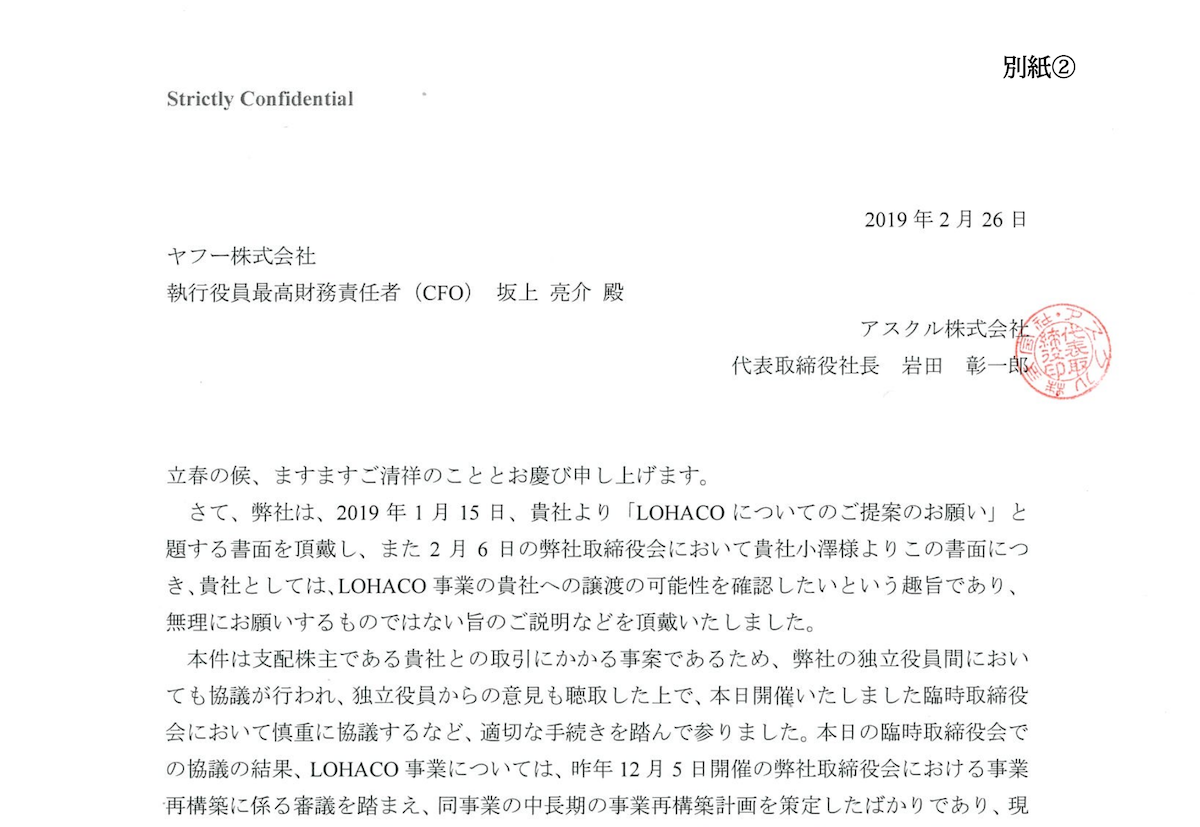
Our company and Yahoo concluded a business and capital partnership agreement in April 2012, and Yahoo became our largest shareholder holding approximately 42.47% (currently approximately 45%) of voting rights. Also, as a business under this business and capital partnership, our company launched BtoC mail order LOHACO. After that, in May 2015, the business and capital partnership agreement was revised triggered by Yahoo's IFRS consolidation of our company, and continues to the present.
In January 2019, there was a request from Yahoo to our company to consider whether the LOHACO business could be transferred to Yahoo, and if so, the various conditions. The following month, our company decided and responded through deliberation by the Independent Directors' Committee and Board of Directors that we would not make a proposal for transfer to Yahoo.
On June 27 of the same year, Yahoo President Kawabe visited our company and expressed his intention to demand President Iwata's resignation and that Yahoo would oppose President Iwata's reappointment at our company's ordinary shareholders' meeting on August 2. Our company, following our company's prescribed procedures including deliberation by the Nomination and Compensation Committee, resolved at our July Board of Directors to propose reappointment of all current directors based on the Nomination and Compensation Committee's proposal.
Our company, over the past half year, considering that the differences in management philosophy between our company and Yahoo, the loss of the spirit of equal partnership agreed upon in the business and capital partnership agreement, and the infringement of independence as a listed company have become pronounced, believes that it has become impossible to achieve the goal of successfully developing individual EC together with Yahoo that was originally intended to be realized by this partnership relationship, and has notified Yahoo of our intention to apply for dissolution of this partnership relationship.
Changed company name to Z Holdings. Management integration with LINE
The management integration of Yahoo and LINE aimed to stop the attrition war of PayPay and LINE Pay deficits and redesign EC, advertising, and payments integrally. However, by advocating equal integration, brands and organizations continued to coexist, and the manifestation of integration effects was delayed. While LINE Pay gradually lost presence and consolidated into PayPay, part of the integration rationale also retreated through purchase of brand rights from former US Yahoo. Ultimately a second re-merger as LINEYahoo was needed in 2023, showing the structure of a two-stage reorganization that did not complete in one integration.
BackgroundIntensifying competition in payments and slowing organic growth
From 2018 onward, in Japan's QR code payment market, PayPay launched by SoftBank and Yahoo, and LINE Pay deployed by LINE, competed fiercely investing massive promotional budgets. PayPay rapidly expanded users through large-scale cashback campaigns, while LINE also invested marketing costs in response, with both companies posting losses of ¥10 billion scale and falling into an attrition war. The market expanded but the profit structure remained impaired.
At the same time, Yahoo Japan Corporation's standalone performance was struggling. Consolidated sales expanded through consolidation of Askul and Ikyu, but organic growth of existing services was limited. The shift from advertising-dependent structure did not progress, and the gap with Rakuten and Amazon in EC also did not close. A picture of growth depending on M&A rather than self-generated growth was becoming clear.
As a result, for SoftBank Group, the picture of its subsidiaries Yahoo and LINE competing in the same domain and both expanding losses was not rational. It had entered a phase where competitive advantage could not be built without simultaneously achieving scale expansion and cost reduction through integration of payments, advertising, and EC. The choice between continuing competition or redesigning through integration was being forced.
DecisionLINE and Yahoo integrate management to launch ZHD
In October 2019, Yahoo Japan Corporation changed its company name to Z Holdings and announced management integration with LINE. The integration adopted a holding company structure rather than absorption merger, with a structure placing Yahoo and LINE under it. The effective integration ratio was set at 50:50, with a design formally emphasizing equality.
After integration, the joint investment company of SoftBank and NAVER held approximately 65% of Z Holdings shares, and the general shareholder ratio was limited to approximately 35%. This secured management stability while embedding the issues of declining stock liquidity and concentration of controlling shareholder influence. The balance between governance as a listed company and parent company intentions became a questioned structure.
Also, Yahoo's brand use was limited to domestic due to a license agreement with US Yahoo, and overseas expansion on its own had constraints. LINE had an overseas user base, and by depicting a division of roles of 'Yahoo domestically, LINE overseas' through integration, a concept was shown to effectively bypass the license constraint. Simultaneously resolving competition cessation and structural problems was the aim.
ResultOrganizational integration took time
Even after management integration, Yahoo and LINE continued to maintain brands, headquarters functions, and organizational culture, with the manifestation of integration effects limited. Sorting of overlapping services proceeded cautiously, and even management department integration took time. In the payments domain, LINE Pay's presence gradually declined and consolidation into PayPay advanced, and the initially equal structure changed substantially.
Furthermore, with brand rights purchased from the former US Yahoo, Yahoo's solo overseas expansion also became theoretically possible, and part of the integration rationale at the time of integration retreated. As a result, the integration carried a stronger character of competition cessation and capital restructuring rather than immediate synergy creation. It had a distinctly defensive integration character rather than growth acceleration.
In 2023, merger of ZHD subsidiaries Yahoo and LINE was decided, and 'LINEYahoo' was born. Management leadership also shifted to LINE-side talent, and the former Yahoo-led structure receded into the background. Integration did not complete in one round but became a process of repeated reorganization. It became a case demonstrating the difficulty of large-scale platform integration and the superiority of capital logic.
The management integration of Yahoo and LINE aimed to stop the attrition war of PayPay and LINE Pay deficits and redesign EC, advertising, and payments integrally. However, by advocating equal integration, brands and organizations continued to coexist, and the manifestation of integration effects was delayed. While LINE Pay gradually lost presence and consolidated into PayPay, part of the integration rationale also retreated through purchase of brand rights from former US Yahoo. Ultimately a second re-merger as LINEYahoo was needed in 2023, showing the structure of a two-stage reorganization that did not complete in one integration.