| Period | Type | Revenue | Profit* | Margin |
|---|---|---|---|---|
| 1986/3 | Non-consol. Revenue / Net Income | - | - | - |
| 1987/3 | Non-consol. Revenue / Net Income | - | - | - |
| 1988/3 | Non-consol. Revenue / Reported Income | ¥3B | ¥0B | 0.0% |
| 1989/3 | Non-consol. Revenue / Reported Income | ¥3B | ¥1B | 16.1% |
| 1990/3 | Non-consol. Revenue / Reported Income | ¥3B | ¥0B | 2.9% |
| 1991/3 | Non-consol. Revenue / Reported Income | ¥5B | ¥1B | 10.6% |
| 1992/3 | Non-consol. Revenue / Reported Income | ¥8B | ¥2B | 24.0% |
| 1993/3 | Non-consol. Revenue / Net Income | ¥13B | ¥3B | 26.1% |
| 1994/3 | Non-consol. Revenue / Net Income | - | - | - |
| 1995/3 | Non-consol. Revenue / Net Income | - | - | - |
| 1996/3 | Non-consol. Revenue / Net Income | - | - | - |
| 1997/3 | Non-consol. Revenue / Net Income | ¥27B | ¥2B | 8.9% |
| 1998/3 | Non-consol. Revenue / Net Income | ¥21B | ¥2B | 8.2% |
| 1999/3 | Consolidated Revenue / Net Income | ¥25B | ¥3B | 10.9% |
| 2000/3 | Consolidated Revenue / Net Income | ¥27B | - | - |
| 2001/3 | Consolidated Revenue / Net Income | ¥28B | ¥4B | 15.1% |
| 2002/2 | Consolidated Revenue / Net Income | ¥33B | ¥6B | 17.4% |
| 2003/2 | Consolidated Revenue / Net Income | ¥39B | ¥4B | 10.5% |
| 2004/2 | Consolidated Revenue / Net Income | ¥46B | ¥4B | 8.2% |
| 2005/2 | Consolidated Revenue / Net Income | ¥54B | ¥4B | 8.1% |
| 2006/2 | Consolidated Revenue / Net Income | ¥66B | ¥11B | 16.0% |
| 2007/2 | Consolidated Revenue / Net Income | ¥78B | ¥10B | 12.8% |
| 2008/2 | Consolidated Revenue / Net Income | ¥89B | ¥11B | 11.8% |
| 2009/2 | Consolidated Revenue / Net Income | ¥97B | ¥11B | 11.3% |
| 2010/2 | Consolidated Revenue / Net Income | ¥114B | ¥14B | 12.6% |
| 2011/2 | Consolidated Revenue / Net Income | ¥127B | ¥18B | 14.3% |
| 2012/2 | Consolidated Revenue / Net Income | ¥141B | ¥16B | 11.0% |
| 2013/2 | Consolidated Revenue / Net Income | ¥159B | ¥17B | 10.7% |
| 2014/2 | Consolidated Revenue / Net Income | ¥188B | ¥20B | 10.5% |
| 2015/2 | Consolidated Revenue / Net Income | ¥214B | ¥24B | 11.3% |
| 2016/2 | Consolidated Revenue / Net Income | ¥238B | ¥26B | 10.9% |
| 2017/2 | Consolidated Revenue / Net Income | ¥239B | ¥28B | 11.8% |
| 2018/2 | Consolidated Revenue / Net Income | ¥254B | ¥30B | 11.6% |
| 2019/2 | Consolidated Revenue / Net Income | ¥267B | ¥30B | 11.3% |
| 2020/2 | Consolidated Revenue / Net Income | ¥272B | ¥30B | 10.9% |
| 2021/2 | Consolidated Revenue / Net Income | ¥220B | ¥19B | 8.7% |
| 2022/2 | Consolidated Revenue / Net Income | ¥244B | ¥17B | 7.0% |
| 2023/2 | Consolidated Revenue / Net Income | ¥290B | ¥30B | 10.4% |
| 2024/2 | Consolidated Revenue / Net Income | ¥344B | ¥40B | 11.6% |
Established Kokusai Boeki Shoji Co., Ltd.
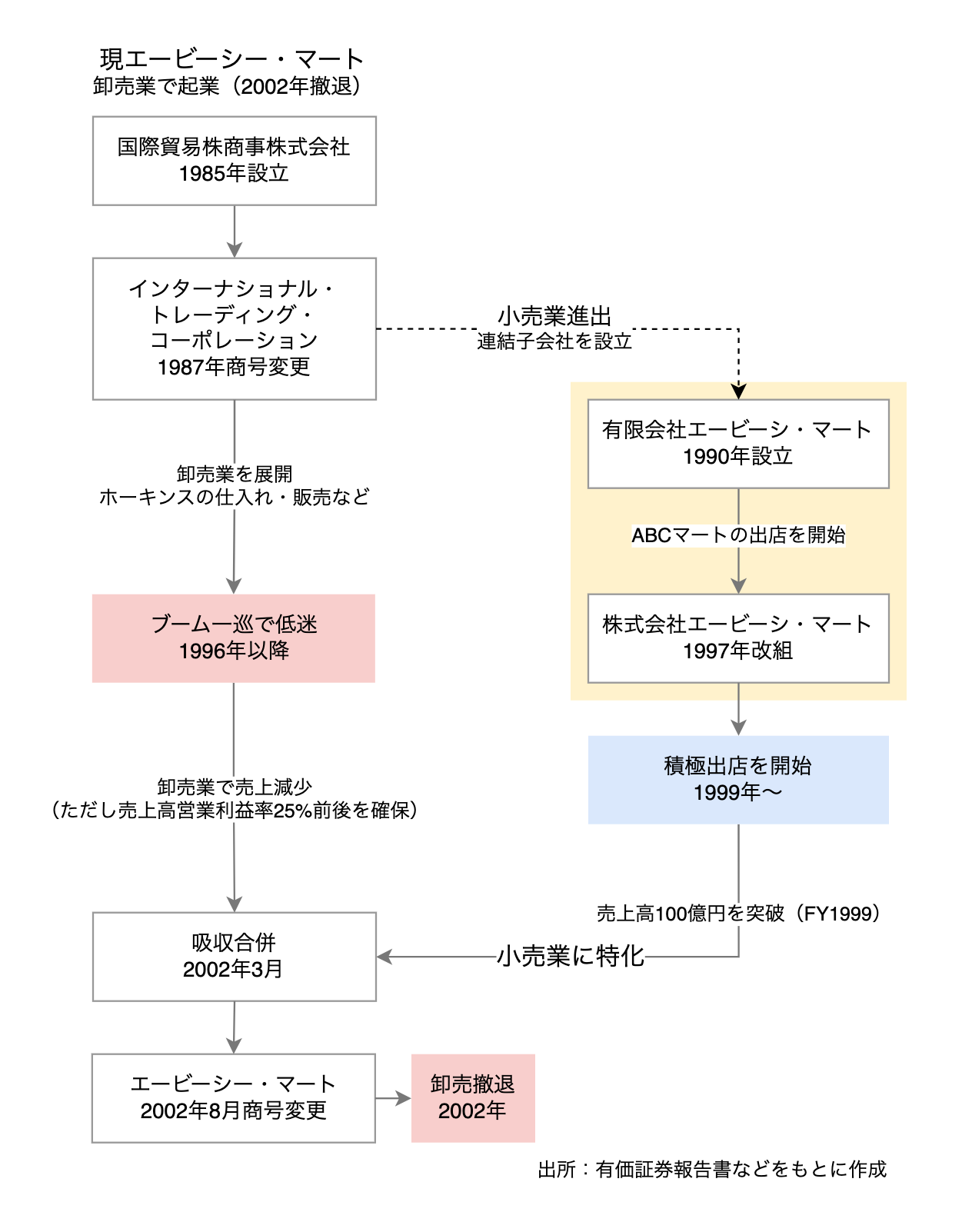
Kokusai Boeki Shoji, established by Masahiro Miki at age 29, started as a wholesale business and accumulated exclusive domestic distribution rights for Western brands including Hawkins, Cosby, and Vans. This position as a 'wholesaler holding its own distribution rights' provided the advantage of monopolizing product supply while competing with other retailers when ABC-MART was established as a retail subsidiary in 1990. The brand assets built during the wholesale era and the production system in South Korea were the origin that structurally enabled the later transformation into an SPA retail chain.
BackgroundMasahiro Miki entered casual wear imports against the backdrop of post-Plaza Accord yen appreciation
In June 1985, Masahiro Miki (then 29 years old) resigned from his employer and established 'Kokusai Boeki Shoji Co., Ltd.' to go independent. He engaged in the import sales and wholesale of casual wear sold in the West, handling men's products such as leather jackets. Targeting young people in their 20s, his customers were retailers such as Marui.
The Plaza Accord of 1985 drove yen appreciation and dollar depreciation, creating an environment where Western imports that had been expensive for Japanese consumers became relatively affordable. This change in the exchange rate environment represented a structural tailwind for Miki's import wholesale business. In 1987, the company changed its trade name to 'International Trading Corporation (ITC),' adopting a name that was easier for overseas suppliers to understand.
However, management during the founding period was far from smooth. Around September 1986, approximately one year after founding, the company struggled with business development as apparel sales stagnated, resulting in inventory of 1,800 items including leather jackets. The structural exposure to fashion trend volatility risks as a wholesaler was evident from the earliest stage.
DecisionGrowth strategy focused on wholesale and securing exclusive distribution rights for Western brands
At the time of founding, Miki adopted a policy of focusing on 'wholesale' and did not own retail stores. By specializing in wholesale, the approach was to diversify inventory risk and expand sales channels. After experiencing inventory problems shortly after starting the business, Miki is estimated to have recognized that 'securing stable product supply sources' was the lifeline of the wholesale business.
Based on this recognition, Miki moved to acquire exclusive domestic distribution rights for multiple Western brands. In 1986, he obtained the exclusive distribution rights for 'Hawkins,' a leather shoe brand that was popular among young people in London. He subsequently secured distribution rights for brands such as 'Cosby' and 'Vans,' which were unknown in Japan at the time. By holding exclusive distribution rights, he built an exclusionary position where competitors could not be supplied with the products.
This accumulation of exclusive distribution rights would later become the foundation of product strength when ITC built its own production system (SPA transformation) and further entered the retail business. The structure of a wholesaler holding distribution rights for its own brands was the foundation enabling vertically integrated business development independent of external product suppliers.
ResultBusiness model transformation from the two-company structure of ITC (wholesale) and ABC-MART (retail)
ITC expanded its performance as a wholesaler centered on Hawkins sales, achieving revenue of 4.7 billion yen and declared income of 500 million yen in FY1991. Throughout the 1990s, it attracted attention as a 'fast-growing and highly profitable unlisted company.' Meanwhile, in 1990 ITC established the consolidated subsidiary 'ABC-MART, Ltd.' and entered the retail business.
The business structure of the 1990s was a two-company system where the core wholesale business was operated by ITC and the diversified retail business by ABC-MART. However, while the wholesale business saw growth decelerate as the American casual boom ran its course, ABC-MART's retail business entered a growth trajectory. As a result, in 2002 ITC absorbed and merged with ABC-MART, changed its trade name to 'ABC-MART,' and specialized in the retail business.
Although ABC-MART's founding year as a legal entity traces back to 1985 (ITC's establishment), the start of ABC-MART as a retail business was in 1990. The trajectory of transforming the business model from wholesale to retail, using exclusive brand distribution rights as a weapon, constitutes the core of ABC-MART's founding history.
Kokusai Boeki Shoji, established by Masahiro Miki at age 29, started as a wholesale business and accumulated exclusive domestic distribution rights for Western brands including Hawkins, Cosby, and Vans. This position as a 'wholesaler holding its own distribution rights' provided the advantage of monopolizing product supply while competing with other retailers when ABC-MART was established as a retail subsidiary in 1990. The brand assets built during the wholesale era and the production system in South Korea were the origin that structurally enabled the later transformation into an SPA retail chain.
Since our establishment in 1985, we have aimed to 'offer world-standard quality at world-standard prices.' Rather than simply importing overseas products, our purpose has been to enrich people's lives by proposing the lifestyle associated with those products.
Acquired exclusive domestic distribution rights for Hawkins
Hawkins was popular among London's youth but completely unknown in Japan, which was precisely why the exclusive distribution rights had not yet been acquired. Miki secured monopoly rights for the Japanese market at a stage when no competitors existed, through an approach of seeing the product at a local store and directly negotiating with the manufacturer. This sourcing model of 'preemptively securing brands that are trending overseas but have not yet landed in Japan' was also applied to Cosby and Vans, becoming the source of ITC's product strength.
BackgroundSpotting a leather shoe brand popular among London's youth
On a trip to London for casual wear purchasing, Masahiro Miki noticed young people casually wearing Hawkins leather shoes paired with jeans. At the time, Hawkins had established itself as a trendy brand in London, but was completely unknown in Japan.
The fashion style that would become popular in Japan as 'American casual' in the late 1980s had not yet arrived at this point. As Miki himself stated, 'At the time, there were no shoes in Japan that combined fashion and practicality,' he identified a gap in the Japanese market and judged that selling Hawkins domestically had future potential.
DecisionWent directly from a local store to Hawkins to negotiate exclusive distribution rights
After seeing Hawkins leather shoes at a local store, Miki went directly to the Hawkins company to negotiate the acquisition of exclusive distribution rights for Japan. Because the brand was unknown in Japan, distribution rights for the Japanese market had not yet been acquired, leaving room for negotiation. Miki's enthusiasm was conveyed, and in 1986 a contract for exclusive distribution rights for Hawkins was concluded.
In acquiring the exclusive distribution rights, Miki also obtained a production license for Japan. This made it possible to establish the foundation for SPA (Specialty store retailer of Private label Apparel), handling production and sales consistently under the company's own management, going beyond mere import sales.
ResultHawkins became the flagship product and the business structure tilted toward shoes
With the start of Hawkins handling, ITC's revenue composition shifted from casual wear to leather shoes. It was Hawkins sales that supported ITC's revenue expansion, and the business that had handled 'casual wear in general' at founding gradually shifted its focus to 'men's casual shoes.'
In addition to Hawkins, exclusive distribution rights for Western brands such as 'Cosby' and 'Vans' were also acquired, but none reached the sales scale of Hawkins. The increasing dependence on Hawkins supported ITC's earnings while also containing the risk of concentration on a single brand. This risk would materialize when the American casual boom ended in the late 1990s.
Hawkins was popular among London's youth but completely unknown in Japan, which was precisely why the exclusive distribution rights had not yet been acquired. Miki secured monopoly rights for the Japanese market at a stage when no competitors existed, through an approach of seeing the product at a local store and directly negotiating with the manufacturer. This sourcing model of 'preemptively securing brands that are trending overseas but have not yet landed in Japan' was also applied to Cosby and Vans, becoming the source of ITC's product strength.
At age 29, while visiting London for product purchasing, President Miki was captivated by the sight of young people striding confidently in 'Hawkins.'
'At the time, there were no shoes in Japan that combined fashion and practicality. I intuitively felt these were the shoes that young people in Japan needed.'
That year, President Miki had established Kokusai Boeki Shoji (now International Trading Corporation = ITC), and the following year he acquired the exclusive distribution rights for Hawkins, making a name as a shoe import trading company.
Pursued global shoe SPA and started production in South Korea
ITC built an SPA outsourcing production of Hawkins to Italy and South Korea, maintaining a 24% profit margin while implementing a 30% price reduction. As the first mover to build a global SPA in casual shoes, it established a unique domestic position capable of simultaneously satisfying quality and price. By holding both exclusive distribution rights and production licenses, it completed a system integrating three elements—brand power, production capability, and price competitiveness—within the company.
BackgroundBuilding a low-price sales system through global production outsourcing
From 1990, Masahiro Miki pursued an SPA model by building a global production system (outsourcing model) to keep retail prices low in the Japanese domestic market. Casual wear production was outsourced to Italy, and casual shoe production to South Korea. ITC acquired production licenses in addition to domestic distribution rights for brands like Hawkins, promoting SPA transformation by taking responsibility for its own production system.
At the time, companies building a global SPA in the casual shoe domain were rare, making ITC a first mover. However, in apparel, Uniqlo (Fast Retailing) had been a first mover in SPA construction, making ITC a latecomer in the overall industry context.
DecisionAchieved both a 30% price reduction and 24% profit margin through SPA
Through SPA construction, ITC established a system to supply 'Hawkins' at low prices to the Japanese domestic market. ITC was in a dominant position as the only Japanese company able to supply products satisfying both quality and price in men's casual shoes, simultaneously securing high growth and high profitability. In 1993, the company made the decision to reduce Hawkins' retail prices by 30%, further strengthening price competitiveness.
In terms of performance, the company achieved revenue of 4.7 billion yen and declared income of 500 million yen in FY1991, and revenue of 7.5 billion yen and declared income of 1.8 billion yen in FY1992. These were exceptionally high profit margins for the wholesale industry, and from around 1993 ITC began attracting industry attention as a 'fast-growing and highly profitable unlisted company.'
ITC built an SPA outsourcing production of Hawkins to Italy and South Korea, maintaining a 24% profit margin while implementing a 30% price reduction. As the first mover to build a global SPA in casual shoes, it established a unique domestic position capable of simultaneously satisfying quality and price. By holding both exclusive distribution rights and production licenses, it completed a system integrating three elements—brand power, production capability, and price competitiveness—within the company.
'Japanese shoe stores are decisively behind. They either sell nothing but cheap products, or line their shelves exclusively with brands so expensive your eyes pop out—it's all uniform. My impression is that they don't see what consumers truly need.'
Opened the first ABC-MART store and entered the retail business
The first ABC-MART store opened in Ueno Ameyoko, and the company adopted an unusual dominant strategy of placing multiple stores in the same district—four Ameyoko stores generating 1.8 billion yen and three Shibuya stores generating 1.4 billion yen. The background enabling a 7.2% operating margin despite a cautious opening pace of only 25 directly operated stores as of 2000 lay in product strength from brands with exclusive distribution rights and concentrated store placement in central Tokyo youth gathering districts. This model became the foundation for the aggressive SC expansion from 1999 onward.
BackgroundThe necessity and contradiction of a wholesaler entering retail on its own
In 1990, ITC established the consolidated subsidiary 'ABC-MART, Ltd.' and entered the retail business. Behind ITC's move into retail from its wholesale core was the structural constraint that wholesalers inevitably depend on retailers' selling capability. By handling retail directly, the company could manage brand promotion and customer touchpoints at the point of sale.
However, a wholesaler entering retail was an act of directly competing with other retailers who were the wholesaler's customers. Normally this would carry the risk of deteriorating customer relationships, but because ITC held exclusive distribution rights for brands like Hawkins, other retailers had no choice but to purchase from ITC. These exclusive distribution rights constituted the exceptional condition that allowed a wholesaler to enter retail.
For the retail market entry, ITC and ABC-MART were operated as separate legal entities. The two-company structure where ITC continued to handle wholesale while subsidiary ABC-MART developed the retail business was designed to minimize the impact on the existing wholesale operations.
DecisionEstablishing youth-oriented retail through dominant store placement in Ueno Ameyoko and Shibuya
In February 1990, ABC-MART simultaneously opened four stores: 'Head Office (Ueno Ameyoko),' 'Store No. 1 (Ueno Ameyoko),' 'GALLOP Ueno Store,' and 'GALLOP Shibuya Store.' Ueno Ameyoko was well-known as a youth shopping district, and ABC-MART also targeted young men. As of FY1998, the four Ameyoko stores secured combined revenue of 1.8 billion yen.
Following Ameyoko, the company focused on Shibuya. In 1991, it opened the Shibuya store (373 sq.m), with ten times the sales floor area of the head office, followed by the Tokyu Main Street and Center-gai store in 1993, and the Spain-zaka store in 1999, concentrating stores in the Shibuya district. The three Shibuya stores secured combined revenue of 1.4 billion yen, adopting an unusual store placement policy where multiple ABC-MART locations competed within the same district.
Regarding nationwide expansion, the company took a cautious stance, with only 25 directly operated stores as of July 2000. Until 1999, the basic approach was concentrated store placement in central Tokyo (Shibuya, Shinjuku, Ikebukuro, Ueno), prioritizing brand awareness through dominant positioning. Revenue was steadily expanded at a pace of several new stores per year.
ResultEstablished a business base as a high-profit retailer with 7.2% operating margin
In FY1996, ABC-MART secured revenue of 4.3 billion yen and operating profit of 310 million yen (operating margin of 7.2%), achieving a high level of profitability for a retailer. Brand awareness through dominant store placement and inventory minimization through high product turnover supported profitability.
By FY1998, ABC-MART's revenue reached 8 billion yen. The four Ameyoko stores (1.8 billion yen) and three Shibuya stores (1.4 billion yen) accounted for 40% of the total, reflecting a highly concentrated composition. The track record of youth shoe sales at street-level stores in central Tokyo became the foundation for the next phase of aggressive expansion into shopping centers.
The success of ABC-MART's retail business also became a factor driving the business model transformation away from ITC's wholesale operations. As the retail business entered a growth trajectory while wholesale growth decelerated, the 2002 decision for business integration and retail specialization was structurally driven.
The first ABC-MART store opened in Ueno Ameyoko, and the company adopted an unusual dominant strategy of placing multiple stores in the same district—four Ameyoko stores generating 1.8 billion yen and three Shibuya stores generating 1.4 billion yen. The background enabling a 7.2% operating margin despite a cautious opening pace of only 25 directly operated stores as of 2000 lay in product strength from brands with exclusive distribution rights and concentrated store placement in central Tokyo youth gathering districts. This model became the foundation for the aggressive SC expansion from 1999 onward.
Aired Hawkins TV commercials featuring Takuya Kimura
Backed by high profitability of 3.7 billion yen in declared income, the company invested 4 billion yen in TV commercials featuring Takuya Kimura, achieving revenue of 26.8 billion yen in FY1996. However, the mass TV exposure consumed Hawkins' demand in a short period, leading to revenue stagnation after the boom's end. The European expansion also failed and was liquidated. This experience made the limitations of the single-brand-dependent wholesale model apparent and became the precursor to Miki's decision to transform the business model toward ABC-MART retail.
BackgroundMajor investment in TV commercials backed by annual profits of 3.7 billion yen
By 1995, ITC had secured annual profits (on a declared income basis) of 3.7 billion yen through the construction of its SPA model. With the establishment of a high-profitability structure, the company began aggressive investment in advertising from 1995 to expand Hawkins' brand recognition.
For ITC at the time, Hawkins was the revenue pillar in Japan, but its brand awareness was still limited. If nationwide recognition could be achieved through TV commercials, it was expected to contribute not only to sales promotion at wholesale customer retail stores but also to improving the customer-drawing power of ABC-MART, the company's own retail format.
DecisionCast Takuya Kimura and invested 4 billion yen in advertising expenses
In November 1995, the company began airing Hawkins TV commercials featuring SMAP's Takuya Kimura. The use of a major celebrity brought annual advertising expenses to 4 billion yen. The effect of expanding Hawkins' awareness through the commercials was significant, and ITC's revenue in FY1996 reached 26.8 billion yen.
However, the mass exposure through TV commercials resulted in exhausting Hawkins' demand in a short period. After the commercial run ended, the boom ran its course, and while ITC maintained profit margins around 25% from FY1996 onward, revenue shifted to a declining trend. In 1998, the company established G.T.HAWKINGS in Europe with the aim of expanding Hawkins overseas, but performance did not gain traction, and the entity was liquidated in 2001 with an extraordinary loss of 360 million yen recorded.
Backed by high profitability of 3.7 billion yen in declared income, the company invested 4 billion yen in TV commercials featuring Takuya Kimura, achieving revenue of 26.8 billion yen in FY1996. However, the mass TV exposure consumed Hawkins' demand in a short period, leading to revenue stagnation after the boom's end. The European expansion also failed and was liquidated. This experience made the limitations of the single-brand-dependent wholesale model apparent and became the precursor to Miki's decision to transform the business model toward ABC-MART retail.
Began aggressive ABC-MART expansion targeting shopping centers
The 1999 policy shift converted the SC market expansion driven by the Large-Scale Retail Store Law revision into nationwide expansion through tenant openings. Starting from 25 street-level stores in central Tokyo, the company rapidly increased store count through aggressive openings at SCs nationwide including LaLaport and Minami-Machida GM. The SPA product strength cultivated during the street-level store era, sales-floor-driven product planning, and regular-employee-centered store operations became differentiating factors as an SC tenant, laying the foundation for the later 1,000-store domestic system.
BackgroundExpansion of the SC market due to Large-Scale Retail Store Law revision and ABC-MART's turning point
In July 1999, ABC-MART decided on a policy of aggressively opening stores targeting shopping centers, raising the opening pace compared to the previous rate and announcing 10 new stores per year. This marked ABC-MART's shift from dominant positioning in central Tokyo to nationwide expansion.
At the time, the revision of the Large-Scale Retail Store Law had effectively liberalized the opening of large retail stores in Japan, and the rise of large shopping centers such as Aeon Mall was anticipated. By opening as tenants in SCs, ABC-MART was approaching an environment where it could access consumers nationwide while forgoing the investment of building its own customer-drawing facilities.
Until then, ABC-MART had operated 25 stores centered on street-level locations in central Tokyo, building brand awareness through a dominant strategy in youth gathering districts such as Ueno Ameyoko and Shibuya. The policy shift to SC openings was accompanied by a change expanding the target demographic from young men to a broad consumer base.
DecisionFull-scale SC openings at LaLaport and Minami-Machida GM, with sales-floor-driven product planning
As full-scale SC stores, the company opened the Funabashi LaLaport store and Minami-Machida GM store in April 2000. By December 2000, store openings were launched in earnest at SCs nationwide, including Fujisawa OPA, Riverside Mall Gifu, and Canard Rakuhoku. The shift in store format from street-level to SC tenant became the catalyst for significantly accelerating ABC-MART's growth speed.
In product development, the company emphasized insights gained from the sales floor, building a system where employees stood on the sales floor to feel shoe trends firsthand and connect them to planning. Miki stated, 'The only way is to listen to customers' voices on the sales floor and feel it with your own senses,' thoroughly pursuing a policy of discovering 'the next best sellers' through frontline intuition rather than data alone. Planned products were manufactured at contract production facilities through the SPA system, inheriting the vertically integrated structure cultivated during the ITC era.
In the SG&A composition, emphasis was placed on advertising expenses (approximately 10% of revenue) and personnel costs. The reason for high personnel costs was the policy of hiring store staff as regular employees rather than part-time workers. However, as of the end of February 2006, the average salary was 3.18 million yen with an average age of 26 years and 11 months, indicating low salary levels despite the regular employee focus.
ResultABC-MART's national chain expansion accelerated alongside SC market growth
With the full-scale launch of SC-oriented openings, ABC-MART's store count expanded rapidly from 25 stores in 1999, continuing at a pace of several dozen stores per year throughout the 2000s. More than half of all stores became SC-oriented, creating a dynamic where ABC-MART's openings accelerated alongside the rush of new SC construction.
Opening as SC tenants was a model that required less initial investment compared to street-level stores and could leverage the customer-drawing power of SCs. ABC-MART leveraged its SPA-based product strength and brand awareness cultivated through dominant positioning to achieve stable customer traffic as an SC tenant.
Aggressive investment in advertising and regular-employee-centered store operations maintained the quality of ABC-MART's customer service at a consistent level, but the average salary level of 3.18 million yen left structural challenges for sustainable human resource retention in the retail industry.
The 1999 policy shift converted the SC market expansion driven by the Large-Scale Retail Store Law revision into nationwide expansion through tenant openings. Starting from 25 street-level stores in central Tokyo, the company rapidly increased store count through aggressive openings at SCs nationwide including LaLaport and Minami-Machida GM. The SPA product strength cultivated during the street-level store era, sales-floor-driven product planning, and regular-employee-centered store operations became differentiating factors as an SC tenant, laying the foundation for the later 1,000-store domestic system.
The cycle of hit products is extremely fast now. Numerical sales data tells you the current best sellers, but it doesn't tell you the next best sellers. To find pre-hit products, the only way is to listen to customers' voices on the sales floor and feel it with your own senses. That's why all our employees go out to the sales floor, constantly absorbing information.
Actually, since we started doing this, various ideas have emerged in planning meetings, and consensus-building has become faster. I think the result is that we've been able to stay a step ahead of trends.