| Period | Type | Revenue | Profit* | Margin |
|---|---|---|---|---|
| 1950/12 | Non-consol. Revenue / Net Income | - | - | - |
| 1951/12 | Non-consol. Revenue / Net Income | - | - | - |
| 1952/12 | Non-consol. Revenue / Net Income | - | - | - |
| 1953/12 | Non-consol. Revenue / Net Income | - | - | - |
| 1954/12 | Non-consol. Revenue / Net Income | - | - | - |
| 1955/12 | Non-consol. Revenue / Net Income | ¥24B | ¥1B | 3.9% |
| 1956/12 | Non-consol. Revenue / Net Income | ¥24B | ¥1B | 4.4% |
| 1957/12 | Non-consol. Revenue / Net Income | ¥28B | ¥1B | 3.8% |
| 1958/12 | Non-consol. Revenue / Net Income | ¥33B | ¥1B | 3.2% |
| 1959/12 | Non-consol. Revenue / Net Income | ¥38B | ¥1B | 3.1% |
| 1960/12 | Non-consol. Revenue / Net Income | ¥46B | ¥2B | 3.5% |
| 1961/12 | Non-consol. Revenue / Net Income | ¥65B | ¥2B | 3.1% |
| 1962/12 | Non-consol. Revenue / Net Income | ¥69B | ¥2B | 3.0% |
| 1963/12 | Non-consol. Revenue / Net Income | ¥77B | ¥2B | 2.2% |
| 1964/12 | Non-consol. Revenue / Net Income | ¥87B | ¥2B | 1.8% |
| 1965/12 | Non-consol. Revenue / Net Income | ¥89B | ¥2B | 1.8% |
| 1966/12 | Non-consol. Revenue / Net Income | ¥91B | ¥2B | 2.0% |
| 1967/12 | Non-consol. Revenue / Net Income | ¥108B | ¥2B | 1.9% |
| 1968/12 | Non-consol. Revenue / Net Income | ¥116B | ¥2B | 1.8% |
| 1969/12 | Non-consol. Revenue / Net Income | ¥125B | ¥2B | 1.8% |
| 1970/12 | Non-consol. Revenue / Net Income | ¥133B | ¥2B | 1.5% |
| 1971/12 | Non-consol. Revenue / Net Income | ¥137B | ¥2B | 1.3% |
| 1972/12 | Non-consol. Revenue / Net Income | ¥148B | ¥2B | 1.0% |
| 1973/12 | Non-consol. Revenue / Net Income | ¥162B | ¥1B | 0.8% |
| 1974/12 | Non-consol. Revenue / Net Income | ¥160B | ¥2B | 0.9% |
| 1975/12 | Non-consol. Revenue / Net Income | ¥191B | ¥2B | 1.0% |
| 1976/12 | Non-consol. Revenue / Net Income | ¥175B | ¥2B | 1.1% |
| 1977/12 | Non-consol. Revenue / Net Income | ¥208B | ¥3B | 1.4% |
| 1978/12 | Non-consol. Revenue / Net Income | ¥244B | ¥4B | 1.4% |
| 1979/12 | Non-consol. Revenue / Net Income | ¥251B | ¥3B | 1.2% |
| 1980/12 | Non-consol. Revenue / Net Income | ¥277B | ¥3B | 1.2% |
| 1981/12 | Non-consol. Revenue / Net Income | ¥330B | ¥4B | 1.1% |
| 1982/12 | Non-consol. Revenue / Net Income | ¥348B | ¥4B | 1.1% |
| 1983/12 | Non-consol. Revenue / Net Income | ¥362B | ¥4B | 1.0% |
| 1984/12 | Non-consol. Revenue / Net Income | ¥380B | ¥4B | 1.1% |
| 1985/12 | Non-consol. Revenue / Net Income | - | - | - |
| 1986/12 | Non-consol. Revenue / Net Income | - | - | - |
| 1987/12 | Non-consol. Revenue / Net Income | - | - | - |
| 1988/12 | Non-consol. Revenue / Net Income | - | - | - |
| 1989/12 | Non-consol. Revenue / Net Income | - | - | - |
| 1990/12 | Non-consol. Revenue / Net Income | - | - | - |
| 1991/12 | Consolidated Revenue / Net Income | ¥557B | ¥3B | 0.5% |
| 1992/12 | Consolidated Revenue / Net Income | ¥577B | ¥3B | 0.5% |
| 1993/12 | Consolidated Revenue / Net Income | ¥602B | ¥3B | 0.5% |
| 1994/12 | Consolidated Revenue / Net Income | ¥664B | ¥3B | 0.4% |
| 1995/12 | Consolidated Revenue / Net Income | ¥663B | ¥2B | 0.3% |
| 1996/12 | Consolidated Revenue / Net Income | ¥666B | ¥4B | 0.5% |
| 1997/12 | Consolidated Revenue / Net Income | ¥659B | -¥25B | -3.8% |
| 1998/12 | Consolidated Revenue / Net Income | ¥606B | -¥11B | -1.9% |
| 1999/12 | Consolidated Revenue / Net Income | ¥573B | ¥4B | 0.7% |
| 2000/12 | Consolidated Revenue / Net Income | ¥564B | ¥1B | 0.2% |
| 2001/12 | Consolidated Revenue / Net Income | ¥557B | ¥4B | 0.7% |
| 2002/12 | Consolidated Revenue / Net Income | ¥512B | ¥1B | 0.2% |
| 2003/12 | Consolidated Revenue / Net Income | ¥480B | ¥2B | 0.5% |
| 2004/12 | Consolidated Revenue / Net Income | ¥495B | ¥5B | 0.9% |
| 2005/12 | Consolidated Revenue / Net Income | ¥454B | ¥4B | 0.7% |
| 2006/12 | Consolidated Revenue / Net Income | ¥435B | ¥2B | 0.5% |
| 2007/12 | Consolidated Revenue / Net Income | ¥449B | ¥6B | 1.2% |
| 2008/12 | Consolidated Revenue / Net Income | ¥415B | ¥8B | 1.8% |
| 2009/12 | Consolidated Revenue / Net Income | ¥388B | ¥5B | 1.1% |
| 2010/12 | Consolidated Revenue / Net Income | ¥389B | ¥11B | 2.7% |
| 2011/12 | Consolidated Revenue / Net Income | ¥449B | ¥3B | 0.7% |
| 2012/12 | Consolidated Revenue / Net Income | ¥492B | ¥5B | 1.0% |
| 2013/12 | Consolidated Revenue / Net Income | ¥510B | ¥9B | 1.8% |
| 2014/12 | Consolidated Revenue / Net Income | ¥519B | ¥0B | 0.0% |
| 2015/12 | Consolidated Revenue / Net Income | ¥534B | ¥6B | 1.1% |
| 2016/12 | Consolidated Revenue / Net Income | ¥542B | ¥9B | 1.7% |
| 2017/12 | Consolidated Revenue / Net Income | ¥552B | ¥11B | 1.9% |
| 2018/12 | IFRS Revenue / Net Income | ¥494B | ¥9B | 1.7% |
| 2019/12 | IFRS Revenue / Net Income | ¥492B | ¥4B | 0.8% |
| 2020/12 | IFRS Revenue / Net Income | ¥435B | -¥16B | -3.7% |
| 2021/12 | IFRS Revenue / Net Income | ¥437B | ¥12B | 2.8% |
| 2022/12 | IFRS Revenue / Net Income | ¥478B | ¥5B | 1.1% |
| 2023/12 | IFRS Revenue / Net Income | - | - | - |
Author's Insights
Yebisu Beer was born in 1890 at the Ebisu brewery, grew its sales primarily in urban areas, and recorded industry-leading shipments by 1896. In prewar Tokyo, particularly in the shitamachi (downtown) districts, 'Yebisu' was deeply rooted as a drinking experience, with the place name 'Ebisu' itself deriving from this beer—a testament to its extraordinary brand penetration. However, after the company breakup in 1949, Nippon Beer president Kiyoshi Shibata sealed away the prewar heritage brands 'Sapporo' and 'Yebisu,' choosing instead to enter the market with the new brand 'Nippon Beer.' The ideal of building a nationally unified brand befitting the postwar new order was prioritized, but consumers and distributors purchased based on past memory, and the company failed to win brand-loyal purchases. Internally, this was mocked as 'Shibata's great miscalculation,' but correcting the policy took time. The Sapporo trademark was revived in 1957, and Yebisu in 1971. During the 22-year seal, Kirin and Asahi built up supply capacity and distribution networks, and Sapporo's market share fell below 25% in 1968, settling around 20% through the 1970s. This share structure has not moved for the subsequent half century.
The greatest loss from Shibata's decision was not merely the share numbers but the loss of the organizational will to 'go on the offensive with beer.' Once the third-place position became entrenched, the capital expenditure, advertising costs, and distribution expansion required to challenge for the top became excessive relative to the current revenue base. The cost of attacking upward from 20% is incomparable to the cost of maintaining the lead. This asymmetry transformed the beer business from an 'offensive core' into a 'business to maintain.' Even when Yebisu was revived in 1971 and earned high brand-loyal purchase rates as the epitome of premium beer, the structure did not change. Yebisu had high margins but limited volume, while the mass-market Sapporo Beer continued to lag behind Kirin and Asahi in head-on competition. A structure in which the two brands coexisted—each carrying its own weaknesses rather than complementing each other—became fixed.
The existence of Yebisu provided Sapporo's beer business with a distinctive buffering effect. As long as it maintained a certain position in the premium market, a state of 'losing but not devastated' continued. Because Yebisu existed, the explanation that 'the beer business is profitable' held, and fundamental competitive strategy reviews were continually deferred. Brand strength functioned as a buffer that preserved the business's half-hearted positioning. And unable to go on the offensive in beer, Sapporo decided in 1986 to close the Ebisu brewery and redevelop the site, shifting the center of gravity of management toward real estate.
The paradox of Yebisu demonstrates a structure in which brand value and business scale do not necessarily correlate. Having a strong brand and being able to convert that into market share expansion are separate capabilities. And tracing this paradox to its origin leads back to Shibata's 1949 decision. The market position lost by sealing away the two major brands Yebisu and Sapporo for 22 years was never recovered even after their revival. The postwar era's greatest brand misjudgment structurally determined 70 years of third-place share, creating a situation where the strongest brand functioned as the most troublesome status-quo preservation device. 'Shibata's great miscalculation' was an expression used within Sapporo at the time, not an outside evaluation. Yet that a decision so named internally structurally determined the fate of Sapporo as a company is difficult to deny.
The process by which Sapporo became a real estate company was less a strategic choice than the convergence of stagnation in the beer business and a factory site selected 100 years earlier. In 1889, Japan Beer Brewing Company built a brewery in Shibuya-mura (present-day Mita, Meguro-ku). It was a rational location choice at the time, considering water sources and logistics, but over 100 years Tokyo expanded and the area around the factory urbanized. By the 1980s, there was no room for expansion and production efficiency had declined. Meanwhile, the beer business was stagnating at around 20% market share with no earnings base to support aggressive investment. In 1986, Sapporo decided to close the Ebisu brewery and redevelop the site. A business design was adopted premised on retention rather than sale, earning rental income from office and commercial facilities. When Yebisu Garden Place opened in 1994, the real estate business began generating stable cash flows. Eventually, the real estate business came to account for more than half of consolidated profits, and a structure in which real estate earnings masked the beer business's stagnation became entrenched.
In 2007, US-based Steel Partners made an acquisition proposal for Sapporo. What Steel took issue with was the low capital efficiency despite holding large amounts of real estate, and the preservation of unprofitable businesses. The gap between the market value of held assets and equity market capitalization represented clear room for improvement from an external investor's perspective. Sapporo's response was not to address the problem but to defend. It maintained its takeover defense measures and concluded a 'strategic business and capital alliance' with Morgan Stanley. The substance was a tactic to sell 15% of Yebisu Garden Place shares to a Morgan Stanley-affiliated fund for ¥50 billion, diluting the real estate value to reduce Steel's acquisition incentive. The acquisition was blocked, but in 2012 Sapporo repurchased the Yebisu GP shares from Morgan Stanley for ¥40.5 billion and dissolved the alliance. The effective cost of defense was not small, and the business structure remained entirely unchanged.
In 2023, 3D Investment made a shareholder proposal to Sapporo. The concerns were virtually identical to Steel's 16 years earlier. The structure where real estate earnings mask the core business's low profitability, the distortions in capital allocation and governance. The party raising the issues changed, but the issues being raised did not. What Sapporo did in the interim was acquire Pokka in 2011 and overseas beer companies in 2006 and 2022, but Pokka recorded ¥11 billion in equipment impairment in 2020, and the overseas beer business also failed to transform the group's earnings structure. As long as real estate continued generating stable earnings, the core business's low profitability continued to be tolerated in the form of 'consolidated profitability.'
What Sapporo's 16 years demonstrate is the reality that external problem-raising alone does not change a company's structure. Both Steel and 3D were accurate in their observations. However, even upon receiving activist criticism, what management chose was defense and deferral. Behind this was the fact that the stable cash flows generated by real estate continued to provide the condition that 'the company won't collapse even without change.' During these 16 years, Sapporo never once undertook a redesign of its business portfolio. The absence of a sense of crisis was the biggest problem, and what kept the sense of crisis absent was the stability of real estate earnings. Stability impedes transformation. Whether the power to break this cycle can emerge from within will likely determine Sapporo's next decade.
Established Dai Nippon Breweries
The 1906 three-company merger was an industrial reorganization to settle overheated competition, creating an oligopoly that concentrated approximately 77% of the domestic beer market in a single company. The coexistence of multiple brands and a nationwide supply system contributed to market stability, and a two-company structure with Kirin was maintained throughout the prewar period. However, postwar, this concentrated structure was targeted for economic democratization and led to the breakup into Asahi Breweries and Nippon Beer. The rationality of market integration provided the grounds for its own dissolution.
BackgroundFormation of the Meiji-era beer industry and the three-company rivalry
Japanese beer brewing began in 1876 with the Kaitakushi Beer Brewery established by the Meiji government as part of its Hokkaido colonization efforts. The government invited technicians from Germany to begin state-run production, and this brewery was later privatized and reorganized in 1887 as Sapporo Beer Company under the Okura zaibatsu. Sapporo Beer early on opened distribution channels to Tokyo and successfully cultivated Hokkaido-grown hops, establishing its foundation as a first mover in both raw materials and production.
In Tokyo in 1889, Japan Beer Brewing Company built a brewery in Shibuya-mura (present-day Mita, Meguro-ku) and launched 'Yebisu Beer' the following year. Yebisu penetrated the market tied to urban consumption and recorded industry-leading shipments by 1896. In Osaka, Osaka Beer developed 'Asahi Beer' from its Suita base, capturing demand in the Kansai region.
Thus by the late Meiji period, a structure emerged in which three companies centered on Sapporo, Tokyo, and Osaka divided the market by region. However, as new entrants and capital expenditure competition accompanied demand expansion, maintaining profitability and managing investment burdens became challenges for each company.
Decision1906: Market reorganization through a three-company merger
In March 1906, Sapporo Beer, Japan Beer, and Osaka Beer merged to establish Dai Nippon Breweries Co., Ltd. This merger was not a pursuit of scale but an industrial reorganization aimed at settling an overheated competitive structure and stabilizing supply and profitability.
The merger unified production bases stretching from Hokkaido to Kansai, building a supply and sales system covering the entire nation. The wide geographic distribution of factories enhanced logistics efficiency and market reach, establishing the largest beer company in Japan in both volume and coverage.
The major brands 'Sapporo,' 'Yebisu,' and 'Asahi' were not consolidated but maintained in parallel according to region and consumer segment. Operating multiple brands within a single company and absorbing demand fluctuations internally was the defining characteristic of the post-merger business structure.
ResultEstablishment of an oligopoly and the consequence of postwar breakup
Through the three-company merger, Dai Nippon Breweries came to hold approximately 77% of the domestic beer market, with competition effectively limited to Kirin Beer alone. Holding the three major brands under its umbrella, the company maintained control over production and distribution throughout the prewar period.
This concentration brought supply stability and capital expenditure efficiency, but also carried the aspect of suppressing market competition. During wartime, beer became subject to rationing, and in 1943 brand usage was discontinued, as Dai Nippon Breweries was incorporated into the controlled economy.
Postwar, this market concentration became a target of economic democratization. Although Dai Nippon Breweries was not a zaibatsu, the Excessive Concentration of Economic Power Elimination Law was applied due to its high market concentration in beer, a nationally consumed product, and in 1949 it was split into Asahi Breweries and Nippon Beer. The merger aimed at market stability followed a trajectory where it formed the premise for its own dissolution.
The 1906 three-company merger was an industrial reorganization to settle overheated competition, creating an oligopoly that concentrated approximately 77% of the domestic beer market in a single company. The coexistence of multiple brands and a nationwide supply system contributed to market stability, and a two-company structure with Kirin was maintained throughout the prewar period. However, postwar, this concentrated structure was targeted for economic democratization and led to the breakup into Asahi Breweries and Nippon Beer. The rationality of market integration provided the grounds for its own dissolution.
Launched Nippon Beer
The 1949 breakup was an institutional decision based on occupation policy, and Nippon Beer restarted as a new company inheriting the two major brands Sapporo and Yebisu. However, by entering the market as 'Nippon Beer' rather than using the legacy brands, the connection to consumer memory was severed. While Kirin expanded distribution with its existing brand intact, Nippon Beer fell behind and share declined steadily. Including the organizational structure that could not override the president's decision, this was the move that structurally determined Sapporo's entrenchment in third place.
BackgroundDai Nippon Breweries' market dominance and postwar deconcentration
Dai Nippon Breweries, established through the 1906 three-company merger, was an oligopolistic enterprise holding approximately 77% of the domestic beer market throughout the prewar period. With the major brands 'Sapporo,' 'Yebisu,' and 'Asahi' under its umbrella, its integrated system of nationwide production and sales resulted in a structure that limited competition to Kirin Beer alone.
Postwar, GHQ adopted a policy of fostering competitive environments in economic operations and suppressing market concentration in specific enterprises. Although Dai Nippon Breweries was not a zaibatsu, its high concentration in the beer market—a nationally consumed product—was deemed problematic, and it was designated for application of the Excessive Concentration of Economic Power Elimination Law.
Under the occupation policy, the efficiency achieved through market integration was redefined as concentration that should be separated. For Dai Nippon Breweries, it was a juncture requiring the dismantling of the integrated operating model built over many years and competing in the market as individual post-breakup companies.
DecisionSeptember 1949: Breakup of Dai Nippon Breweries into two companies
On September 1, 1949, Dai Nippon Breweries was dissolved, and two companies—Asahi Breweries and Nippon Beer—were launched. This was not a voluntary reorganization but an institutional decision based on occupation policy.
In the breakup, production facilities were allocated by region. Nippon Beer inherited the Meguro, Kawaguchi, Sapporo, and Nagoya factories, with eastern Japan and Hokkaido as its base. Asahi Breweries inherited the Suita, Nishinomiya, and Hakata factories, adopting a structure centered on western Japan. Production capacity was divided roughly equally.
Regarding brands, Nippon Beer inherited 'Sapporo Beer' and 'Yebisu Beer,' while Asahi Breweries inherited 'Asahi Beer.' Management resources that had been complementary under the integrated structure would now need to demonstrate competitive strength independently after the breakup.
ResultNew brand introduction and the starting point of share decline
After the breakup, Nippon Beer did not immediately use the prewar-recognized 'Sapporo' and 'Yebisu' brands, instead entering the market with the new brand 'Nippon Beer.' The intent was to build a new nationally unified brand, but the name—unconnected to prewar memories—failed to penetrate with both consumers and distributors.
At the point of sale, explaining the relationship to the former brands created friction, and awareness building took time. Meanwhile, Kirin Beer maintained its single prewar brand and expanded distribution focused on the household market, with the gap between the two companies widening as demand structures shifted.
As a result, Nippon Beer's domestic market share continued to decline, reaching 27.1% and third place in the industry by 1956. Even after reviving the Sapporo Beer trademark in 1957, this ranking remained fixed, and the 1949 breakup and subsequent brand decisions became the starting point that determined Sapporo's long-term market position.
The 1949 breakup was an institutional decision based on occupation policy, and Nippon Beer restarted as a new company inheriting the two major brands Sapporo and Yebisu. However, by entering the market as 'Nippon Beer' rather than using the legacy brands, the connection to consumer memory was severed. While Kirin expanded distribution with its existing brand intact, Nippon Beer fell behind and share declined steadily. Including the organizational structure that could not override the president's decision, this was the move that structurally determined Sapporo's entrenchment in third place.
Launched Nippon Beer brand (Shibata's great miscalculation)
The decision to seal away the prewar-established Sapporo and Yebisu brands and enter the market with the new brand 'Nippon Beer' resulted in voluntarily severing the connection to consumer memory. At the point of sale, explaining the legacy brand became necessary, and while failing to win brand-loyal purchases, the household market was taken by Kirin. Including the organizational structure that could not overturn the president's decision, this was the move that structurally determined Sapporo's entrenchment in third place.
BackgroundBrand strategy choice demanded immediately after the breakup
Following the company breakup in September 1949, Nippon Beer restarted as a new company independent of the former Dai Nippon Breweries. With a product strategy befitting the postwar new order required, management was forced to make a brand selection decision for the first product launch.
Nippon Beer had inherited the prewar heritage assets of 'Sapporo Beer' and 'Yebisu Beer.' However, the ideal of distancing from memories of the old order in the postwar market and building a unified brand with national reach led the management decision. There was also an aim to consolidate brand awareness that varied by region into one and improve sales efficiency.
Meanwhile, in the prewar beer market, brand establishment had advanced on a regional basis. In Hokkaido and Tohoku, 'Sapporo Beer' was deeply rooted with both consumers and distributors, functioning as a criterion for product selection. In Kanto, 'Yebisu Beer' was similarly established. The new brand was one that did not connect with these existing recognition structures.
DecisionSealing legacy brands and continuing with 'Nippon Beer'
In December 1949, Nippon Beer launched the new brand 'Nippon Beer.' It was a decision to enter the national market under a new name rather than reviving Sapporo and Yebisu.
After launch, the lack of market recognition quickly became apparent. Unable to win brand-loyal purchases, sales representatives routinely had to explain 'we're the former Sapporo.' Director Kurato Uchida repeatedly advocated for reviving Sapporo Beer based on sales realities, but President Kiyoshi Shibata refused to change course. He cited the example of bank name changes, indicating his belief that adoption of the new name was possible.
As a result, Nippon Beer deferred correction of its brand strategy until the mid-1950s. A stance of waiting for market penetration without utilizing the asset of existing brand recognition was adopted, and the gap with competitors widened over time.
ResultShare decline and 'Shibata's great miscalculation'
Nippon Beer continued to struggle in sales, and Nippon Beer's share declined consistently. By 1956, share had fallen to 27.1%, confirming third place in the industry. Internally, this situation came to be called 'Shibata's great miscalculation.'
Changes in market structure also had an impact. As the center of beer consumption shifted from restaurants to households, Kirin Beer focused on expanding household distribution channels, growing share through retail and mass-market stores. Nippon Beer remained centered on restaurant sales and failed to adapt to the shift in consumption structure.
The failure of the Nippon Beer strategy is a case illustrating the relationship between new brand building and existing recognition. Building a new brand requires time and investment, but the cost of severing the connection to existing memory was underestimated. The market position lost through this decision was never recovered even after the Sapporo Beer trademark revival.
The decision to seal away the prewar-established Sapporo and Yebisu brands and enter the market with the new brand 'Nippon Beer' resulted in voluntarily severing the connection to consumer memory. At the point of sale, explaining the legacy brand became necessary, and while failing to win brand-loyal purchases, the household market was taken by Kirin. Including the organizational structure that could not overturn the president's decision, this was the move that structurally determined Sapporo's entrenchment in third place.
Shibata was president until 1961 (Note: 1961), and we truly asked him to revive the old brands almost every day. Sometimes we would even go to his house, and we enlisted the company elders to try to persuade him, but he absolutely would not listen. He would say, 'I cannot do something as disgraceful as changing the company name or brand midway. You say the new brand Nippon Beer isn't catching on, but look at Fuji Bank. They haven't gone back to the old Yasuda Bank name, and they're performing splendidly. Your methods are the problem.'
Revived the Sapporo Beer trademark
The nationwide revival of the Sapporo Beer trademark was the moment management finally acknowledged the failure of the Nippon Beer strategy. The limited revival in Hokkaido demonstrating volume recovery within just one month proved the power of existing brand recognition. However, during the eight-year gap, Kirin had consolidated the household market and supply infrastructure, and the share structure had already become immovable. The cost of a correct correction made too late continued for the subsequent half century.
BackgroundThe impasse of the Nippon Beer strategy
By the mid-1950s, Nippon Beer was beginning to recognize the limits of selling under the 'Nippon Beer' brand. Despite several years on the market, Nippon Beer had failed to sufficiently win consumers' brand-loyal purchases and could not compete against brand preferences based on prewar memory.
The problem was particularly acute in Hokkaido. 'Sapporo Beer' had deeply penetrated the region in the prewar era, tied to local identity, and Nippon Beer was not accepted as a substitute. At the point of sale, the supplementary explanation 'we're the former Sapporo' had become routine, reducing sales efficiency.
In the Tokyo area as well, the memory of 'Yebisu Beer,' which had been established prewar primarily in the shitamachi districts, remained, but Nippon Beer did not connect with it. Consumers strengthened their tendency to return to known brands, and brand-loyal purchases of Kirin Beer, recognized as a nationally unified brand, expanded.
DecisionFrom trial revival in Hokkaido to national rollout
Around 1955, Nippon Beer revived the 'Sapporo Beer' brand in parallel on a limited basis in Hokkaido. This was not a decision organized as a company-wide policy but a response to requests from prominent wholesalers and the realities of the sales front. The result was clear—within just one month of revival, Hokkaido sales switched entirely to Sapporo Beer, with volumes recovering immediately.
Based on this outcome, the policy of continuing with Nippon Beer was forced into revision. The limited regional trial had proven the strength of brand recognition with numbers, making national rollout a realistic option. In March 1957, Nippon Beer revived the 'Sapporo Beer' trademark nationwide.
In 1964, the company name was also changed from Nippon Beer to Sapporo Breweries, aligning the brand name with the corporate name. This was a measure aimed at eliminating the disconnect between brand and company name and improving sales efficiency and market recognition.
ResultThe effect of revival and its limitations
The revival of the Sapporo Beer trademark resolved the confusion at the point of sale to a certain extent. However, market share recovery was not achieved. During the approximately eight years it took for revival, Kirin Beer had advanced capital investment nationwide and expanded household distribution, widening the gap in both supply infrastructure and consumer touchpoints.
The revival of 'Yebisu Beer' remained deferred. Because the top executive maintained a negative stance toward reintroduction, brand recovery in the Tokyo market was delayed. Yebisu Beer would not return to the market until 1971—14 years after the Sapporo revival and 22 years after the Nippon Beer launch.
The Sapporo Beer trademark revival was a necessary correction but was insufficient to make up for lost time. The market structure that had become fixed during the Nippon Beer period was maintained as is, and Sapporo would remain at its third-place position for the next half century without ever breaking free.
The nationwide revival of the Sapporo Beer trademark was the moment management finally acknowledged the failure of the Nippon Beer strategy. The limited revival in Hokkaido demonstrating volume recovery within just one month proved the power of existing brand recognition. However, during the eight-year gap, Kirin had consolidated the household market and supply infrastructure, and the share structure had already become immovable. The cost of a correct correction made too late continued for the subsequent half century.
Opened Yebisu Garden Place
The decision to retain and rent rather than sell the Ebisu factory site delivered stable cash flows, but also transformed Sapporo into 'an operating company with the character of an asset management firm.' The structure in which real estate earnings masked the beer business's stagnation became entrenched, and improvement of core business profitability was continually deferred. That this choice became the structural precursor to activist intervention from the 2000s onward was a consequence unforeseen at the time of opening.
BackgroundThe Ebisu factory after 100 years and the constraints of urbanization
In 1889, Japan Beer Brewing Company built a brewery in Shibuya-mura (present-day Mita, Meguro-ku). It was a location chosen for water sources and logistics, and production of 'Yebisu Beer' began the following year. Yebisu grew tied to urban demand, eventually achieving such a presence that the factory name became established as the place name 'Ebisu.'
However, over 100 years Tokyo expanded, and the area around the factory became residential and commercial. The Ebisu factory, having lost room for expansion, saw equipment aging and production efficiency decline become apparent by the 1980s. With the beer business stagnating at around 20% market share, the rationale for investing in factory modernization had faded.
During the same period, a redevelopment plan for the Ebisu district was taking shape in Tokyo. The factory site attracted attention as a prime location for large-scale development in central Tokyo, and reconsideration of land use was being demanded from both government and private sectors. While its rationality as a production site retreated, its asset value as real estate came to the fore.
DecisionFactory closure and conversion to real estate business
In 1986, Sapporo Breweries decided to close the Ebisu factory and transfer functions to the Chiba factory. Simultaneously, it established Yebisu Development Co., Ltd. to handle the site redevelopment and began utilizing the land. This decision went beyond relocation of a production base—it was a business transformation to reconstruct held real estate as an earnings base.
In the development, residential areas were sold as condominiums, while office and commercial facilities were retained and managed by the company rather than sold. This was a decision choosing long-term rental income over short-term sale proceeds, and can be understood as Sapporo's full-scale entry into the real estate rental business at this point.
The then-president Yoshitaka Takakuwa expressed the view that the intent was to 'utilize the assets inherited from predecessors in the best way currently conceivable and pass them on to successors,' revealing that the philosophy of operating rather than selling the land and passing it to the next generation underlay the decision-making.
ResultSecuring stable earnings and transformation into an 'asset-rich company'
In October 1994, the mixed-use complex 'Yebisu Garden Place,' comprising offices, commercial facilities, residences, and a hotel, opened on the former Ebisu factory site. Condominium sales in the residential area proceeded as planned, and the office and commercial portions became established as assets generating stable rental income under Sapporo's continued ownership.
As a result, Sapporo secured a revenue source independent of the beer business and enhanced cash flow stability. The real estate business came to account for more than half of consolidated profits, forming a structure in which real estate earnings masked the beer business's stagnation.
On the other hand, the structure of holding large-scale real estate on the balance sheet relative to revenue scale harbored challenges from a capital efficiency perspective. The weight of 'held asset value' in enterprise value increased, and the company took on a character resembling an asset management company despite being an operating company. This structure became a contributing factor in attracting activist investor attention from the 2000s onward.
The decision to retain and rent rather than sell the Ebisu factory site delivered stable cash flows, but also transformed Sapporo into 'an operating company with the character of an asset management firm.' The structure in which real estate earnings masked the beer business's stagnation became entrenched, and improvement of core business profitability was continually deferred. That this choice became the structural precursor to activist intervention from the 2000s onward was a consequence unforeseen at the time of opening.
We simply happened to face a period when the relocation of the Ebisu and Sapporo factories and redevelopment of the sites came due in the flow of the times. Neither I nor our employees feel the sense of standing at a major turning point in our 100-year company history or changing the company's course ourselves. We are simply utilizing the assets inherited from our predecessors in the best way currently conceivable and passing them on to our successors. The current plan was developed mainly by our younger general manager-level staff, and the specifics for the 21st century can be created by even younger section chief-level staff going forward.
Steel Partners made acquisition proposal
The 2007 acquisition proposal by Steel was an event that directly challenged the structure in which real estate earnings masked the core business's low profitability. Sapporo HD blocked the acquisition through defense measures and the Morgan Stanley alliance, but the perception of low capital efficiency became established in the market. Even after Steel's withdrawal, the assessment that the company was not generating earnings commensurate with its asset holdings persisted, and the same question would be raised again 16 years later.
BackgroundLow profitability in core business masked by real estate earnings
In the 2000s, Sapporo Holdings had a structural distortion in its earnings structure. More than half of consolidated operating profit was generated by the real estate business, supplemented by the alcoholic beverages business, while the beverage and restaurant businesses continued at low profitability or losses. Although consolidated profitability was maintained, the source of profits was rental income centered on Yebisu Garden Place.
As the real estate business continued to supply stable cash flows, the reorganization of unprofitable businesses such as beverages and restaurants had been deferred. While the asset base expanded, growth in business earnings remained limited, and when compared with industry peers on ROE and ROIC, the low capital efficiency stood out.
From the perspective of external investors, this structure represented clear room for improvement. As a company where the balance sheet scale outpaced business value and where asset reallocation could improve profitability, Sapporo HD was ripe for attention.
DecisionSteel's acquisition proposal and Sapporo's defense
In October 2004, Steel Partners disclosed holding 5.13% of Sapporo HD shares. The initial stated purpose was 'pure investment,' but as buying continued, by January 2007 the holding ratio had reached 18.13% and the purpose was changed to 'important proposal activities.'
Steel made an acquisition proposal contemplating acquisition of up to 66% of voting rights, presenting improvement measures including external partnerships for the beverage business, improving alcoholic beverages factory utilization rates, and introducing external capital to the real estate business. It was a proposal emphasizing asset turnover and monetization rather than continued asset holding—a direct challenge to Sapporo HD's capital efficiency.
Sapporo HD's management maintained its takeover defense measures and countered with questionnaires and the engagement of financial advisors. Simultaneously, it concluded a business and capital alliance with Morgan Stanley, selling 15% of Yebisu Garden Place shares (trust beneficiary rights) to a Morgan Stanley-managed investment fund for approximately ¥50 billion to secure stable shareholders and reduce Steel's acquisition incentive.
ResultAcquisition blocked but structural issues made visible
In February 2008, the special committee published the view that Steel's share acquisition risked damaging corporate value, and the acquisition proposal effectively collapsed. Steel lowered its acquisition target from 66% to 33% but negotiations did not progress, and compounded by deteriorating market conditions after the Lehman crisis, Steel sold all its shares and withdrew by 2010.
Sapporo HD blocked the acquisition, but in the process, the company's structural challenges became visible to the capital markets. The point that despite holding large-scale assets centered on real estate, the company could not convert them into earnings growth—namely, low capital efficiency—became established as the core issue in corporate valuation.
The acquisition did not materialize, but the question Steel posed—the difference between 'holding' assets and 'turning them over'—remained as a long-term challenge for Sapporo HD's management. And this question would be raised again in virtually the same form 16 years later through 3D Investment's shareholder proposal.
| Date | Party | Event |
| 2004-10-22 | metal | Filed large shareholding report |
| 2005-12-05 | metal | Sent letter to Sapporo HD president |
| 2007-01-11 | metal | Changed holding purpose (important proposal activities) |
| 2007-02-01 | metal | Filed shareholder proposal at AGM (abolition of takeover defense) |
| 2007-02-05 | metal | Made shareholder proposals (director appointment, fundraising, share acquisition) |
| 2007-02-15 | metal | Notified friendly acquisition in writing |
| 2007-02-16 | Sapporo HD | Decided to continue takeover defense (unanimous board approval) |
| 2007-03-01 | Sapporo HD | Delivered 'required information list' (1st questionnaire) |
| 2007-03-29 | Sapporo HD | Held AGM; Steel's shareholder proposals defeated |
| 2007-05-15 | metal | Submitted response to questionnaire (1st response) |
| 2007-05-29 | Sapporo HD | Delivered 'additional information list' (2nd questionnaire) |
| 2007-09-11 | metal | Mr. Lichtenstein visited Sapporo HD |
| 2007-09-25 | metal | Submitted response to questionnaire (2nd response) |
| 2007-11-08 | metal | Proposed approach to enhancing corporate value |
| 2007-11-22 | Sapporo HD | Delivered 'confirmation and additional information list' (3rd questionnaire) |
| 2007-12-06 | metal | Submitted response to questionnaire (3rd response) |
- Date
- 2004-10-22
- Party
- metal
- Event
- Filed large shareholding report
The 2007 acquisition proposal by Steel was an event that directly challenged the structure in which real estate earnings masked the core business's low profitability. Sapporo HD blocked the acquisition through defense measures and the Morgan Stanley alliance, but the perception of low capital efficiency became established in the market. Even after Steel's withdrawal, the assessment that the company was not generating earnings commensurate with its asset holdings persisted, and the same question would be raised again 16 years later.
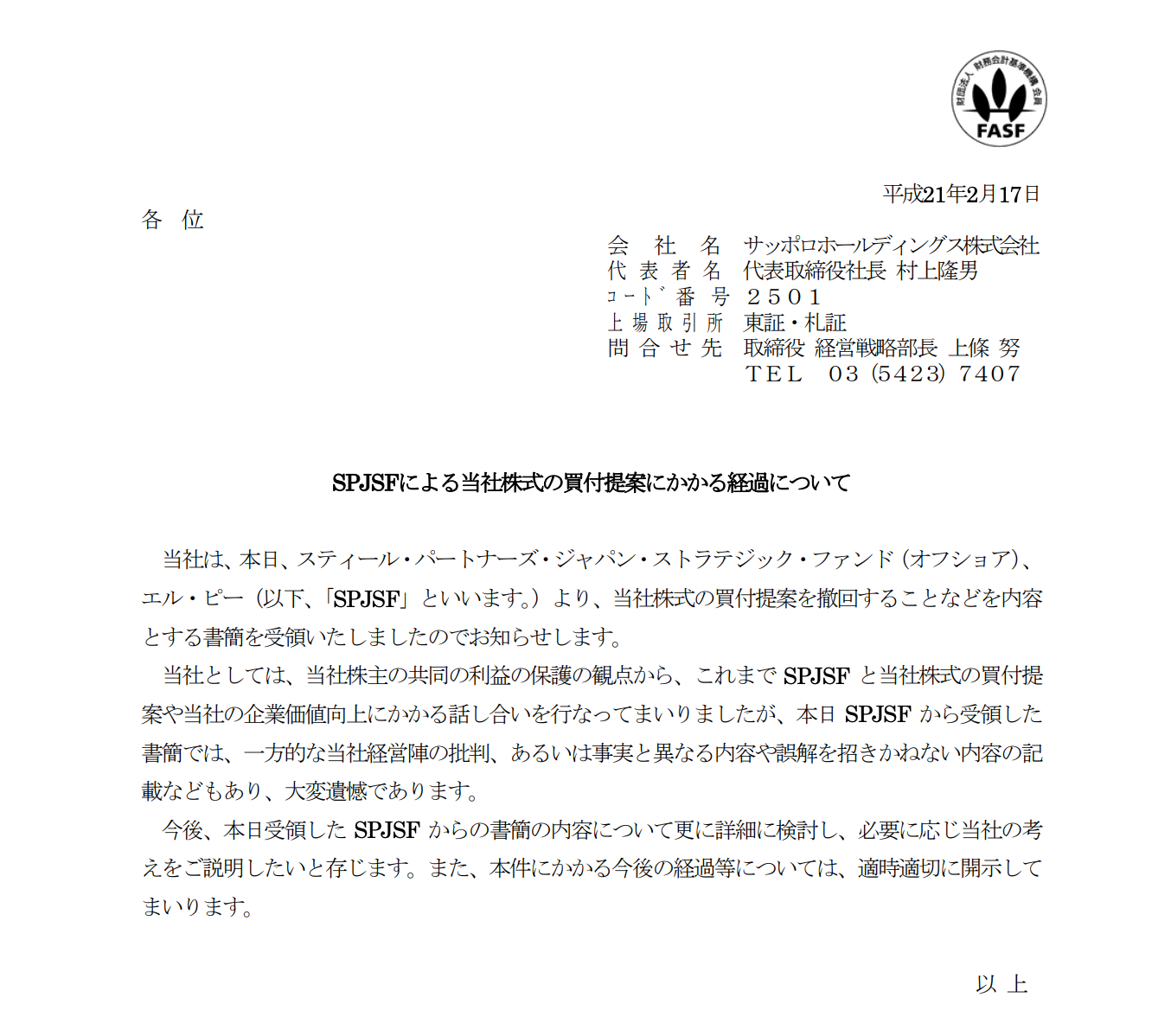
Concluded strategic business and capital alliance with Morgan Stanley
The Morgan Stanley alliance was a defensive measure designed to undermine Steel's acquisition motivation. While it was structured to secure stable shareholders by selling 15% of Yebisu GP shares for ¥50 billion, Steel's withdrawal dissolved the alliance's premise. In 2012, shares were repurchased for ¥40.5 billion and the alliance was dissolved. Defense was achieved but the business structure remained unchanged, and the series of transactions was consumed merely as defense costs.
BackgroundThe need for effective countermeasures against Steel
In 2007, Steel Partners had accumulated over 18% of Sapporo HD shares and made an acquisition proposal, forcing management to develop concrete defensive measures. Maintaining the takeover defense and buying time through questionnaires alone was insufficient, and a response that would undermine Steel's acquisition motivation itself was required.
The primary reason Steel had focused on Sapporo HD was the asset value of held real estate, exemplified by Yebisu Garden Place. If this real estate value could be dispersed externally, the economic rationale of the acquisition could be reduced—this judgment became the design philosophy of the alliance.
DecisionSale of Yebisu GP shares and conclusion of capital alliance
In October 2007, Sapporo HD concluded a 'strategic business and capital alliance' with Morgan Stanley. The centerpiece of the business alliance was the sale of 15% of shares (trust beneficiary rights) in its wholly-owned subsidiary Yebisu Garden Place to an investment fund managed by Morgan Stanley for ¥50 billion. As a capital alliance, a plan was presented for Morgan Stanley to gradually acquire up to 5% of Sapporo HD shares.
The stated reason was enhancing real estate value, but the substance was a defensive measure to simultaneously disperse the real estate assets targeted by Steel to an external party and secure stable shareholders. The public announcement of future share acquisition was also presumed to aim at pushing up the Sapporo HD share price and increasing Steel's acquisition costs.
ResultAlliance failure and ¥40.5 billion repurchase
However, the capital alliance did not proceed as planned. Morgan Stanley's share acquisition stood at only 1.8% as of July 2009, far short of the 5% target. When Steel announced its withdrawal from the acquisition in February 2009, the premise of the alliance dissolved, and Morgan Stanley announced the cessation of share acquisitions.
In March 2012, Sapporo HD repurchased the 15% Yebisu Garden Place shares for ¥40.5 billion, restoring its wholly-owned subsidiary status. The alliance was simultaneously formally dissolved. The series of transactions—selling for ¥50 billion and repurchasing for ¥40.5 billion—embodied the cost of the defense measure, while the business structure itself remained entirely unchanged.
The Morgan Stanley alliance was a defensive measure designed to undermine Steel's acquisition motivation. While it was structured to secure stable shareholders by selling 15% of Yebisu GP shares for ¥50 billion, Steel's withdrawal dissolved the alliance's premise. In 2012, shares were repurchased for ¥40.5 billion and the alliance was dissolved. Defense was achieved but the business structure remained unchanged, and the series of transactions was consumed merely as defense costs.
Naohisa Fukutani, partner at independent M&A advisory firm GCA Holdings, predicted: 'The purpose of Sapporo HD partnering with Morgan Stanley is to repel Steel, and it is almost certain that they will not accept Steel's acquisition proposal.'
Acquired Pokka Corporation
The food and beverage business, into which ¥93.4 billion was invested over 10 years starting with the Pokka acquisition, achieved neither revenue growth nor profitability. Unable to produce hit products amid vending machine market saturation and intensifying price competition, the company recorded ¥11 billion in equipment impairment. The structure where business results do not match the scale of acquisition and investment reflects both the severity of the competitive environment in the beverage industry and the limits of the company's product development capabilities.
BackgroundBeverage business vulnerability and external business acquisition
Throughout the 2000s, Sapporo HD had high dependence on the alcoholic beverages business, and its beverage business was undersized compared to competitors. As the beer market contracted, business diversification was recognized as a management issue, but self-directed expansion of the beverage business had its limits.
What emerged was Pokka Corporation. The company was in the midst of restructuring under private equity firm Advantage Partners and was seeking a buyer. Its most recent performance was revenue of ¥22.3 billion with a net loss of ¥810 million, but it held a product lineup including canned coffee and soups and a nationwide vending machine network.
For Sapporo HD, acquiring Pokka was a means of obtaining a beverage business foundation externally in one transaction. Acquiring existing products, distribution channels, and production facilities for integration was judged more rational in terms of time and certainty than building a business from scratch.
Decision¥34.8 billion acquisition and 10 years of aggressive investment
In March 2011, Sapporo HD acquired 98.59% of Pokka Corporation shares for ¥34.8 billion. Of the acquisition cost, ¥18.4 billion was recorded as goodwill. After the acquisition, it was integrated with the existing beverage business to establish subsidiary 'Pokka Sapporo Food & Beverage.'
Beyond the acquisition, Sapporo HD continued aggressive capital investment in the food and beverage business over the following 10 years. This included construction of a third factory at the Nagoya plant, expansion and second factory construction at the Gunma plant, construction of the Sendai plant, plus factory expansion in Malaysia and Indonesia. Cumulative capital expenditure from FY2012 to FY2019 reached ¥58.6 billion.
Combined with the ¥34.8 billion acquisition price, total invested capital in the food and beverage business reached ¥93.4 billion. At approximately ¥7 billion per year in capital expenditure, this was a resource allocation clearly intended to nurture the business as a 'second pillar.'
ResultStagnant revenue and ¥11 billion equipment impairment
Despite aggressive investment, food and beverage business revenue stagnated throughout the 2010s. The saturation of the vending machine market, intensifying price competition in the beverage industry, and absence of hit products combined to produce three consecutive years of revenue decline from FY2020 to FY2022.
On the earnings side, the depreciation burden from expanded production facilities and difficulty in raising prices became bottlenecks. Investment expanded, but commensurate revenue growth and profit generation were not achieved.
In FY2020 (December period), Sapporo HD recorded ¥11 billion in impairment losses in the food and beverage business. The targets were land, buildings, and equipment at the Gunma and Nagoya factories, signaling the abandonment of recovery on the aggressive investments of the 2010s. Meanwhile, goodwill of ¥18.4 billion was not impaired, meaning the failure of the acquisition has not been formally recognized on the books. However, as the beverage business continues to underperform, the impairment risk for goodwill is considered to be increasing.
The food and beverage business, into which ¥93.4 billion was invested over 10 years starting with the Pokka acquisition, achieved neither revenue growth nor profitability. Unable to produce hit products amid vending machine market saturation and intensifying price competition, the company recorded ¥11 billion in equipment impairment. The structure where business results do not match the scale of acquisition and investment reflects both the severity of the competitive environment in the beverage industry and the limits of the company's product development capabilities.